The hallmark of Chester Gould’s Dick Tracy is its surreal villains. Flattop, Pruneface, Mole, Mumbles, et. al. But Gould wasn’t satisfied expressing inner evil with outward disfigurement. He also loved to torture and kill them in equally grotesque ways during the prolonged hunt and chase sequences that were central to every Dick Tracy storyline. Gould wanted more than justice against evil. He wanted revenge and sometime literal pounds of flesh.
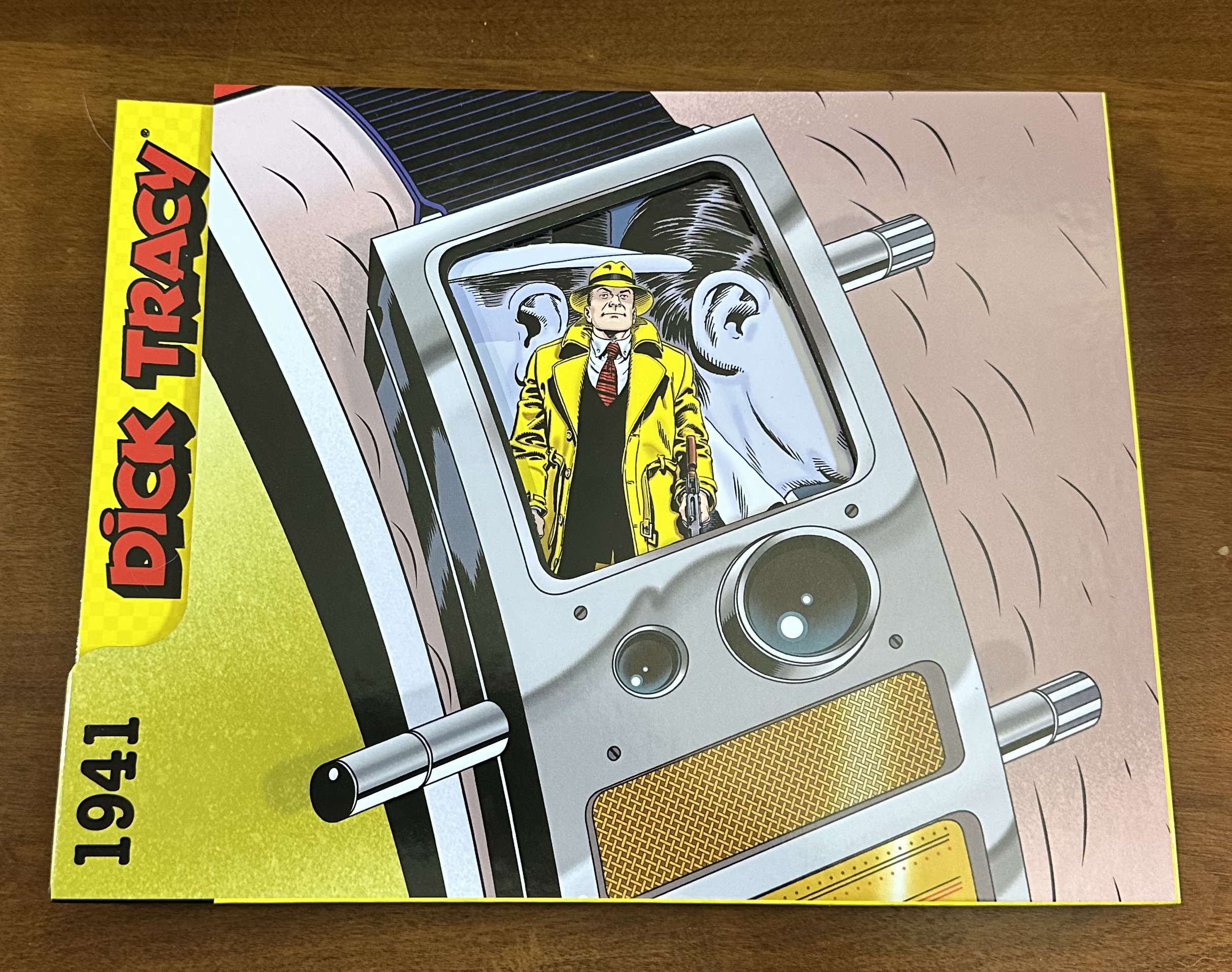
A lot of comic strip fans have been looking forward to these updated early volumes of The Complete Dick Tracy. Here are Vols. 1 and 2, just in today. This project reprints the first six volumes in the larger format that matches the rest of the series.
By the end of his career in 1977, Dick Tracy creator Chester Gould was notoriously reactionary. His disdain for the counter-cultural forces at play in the 1960s and 70s, for liberal explanations of criminal behavior, were clear in the strip itself. In fact, his resistance to leniency in America’s legal system, and progressivism in general, had been baked into his epic since its roots n the gangster era of 1931. From the start, Dick Tray was an exploration of individual valor and evil rather than institutional or social forces. Gould’s take on the 50s moral panic around “juvenile delinquency” via Flattop Jr. is an excellent example. And the moral universe of Dick Tracy hinged on the personal evil of villains(usually embodied in physical abnormalities) and the poetic symmetry of their deaths via some kind of retributive justice.
Chester Gould’s Dick Tracy was created in the 1930s as a response to the romanticization of gangsters and declining respect for law enforcement. And throughout its run under the notoriously conservative artist made no secret of his disdain for many modern trends. In the 1950s when mania around “juvenile delinquency” dominated popular culture, Gould added to his famous rogues gallery a few of these teen terrorists. Most notable for its outright weirdness (even for Gould) are the 1956 episodes spanning Joe Period and Flattop, Jr., the son of one of Tracy’s most famous nemeses of the prior decade.
Even 30 years into one of the most successful runs in comic strip history, Chester Gould’s Dick Tracy continued to promote itself to new newspapers that still hadn’t syndicated the iconic hero. This ad ran in Editor & Publisher, the longtime trade bible for print periodical publications. Of course, this “man of stature” led the most grisly, violent and truly weird of all American comic strips. It was also one of the most compelling. For a gallery of gruesome villain deaths, see this earlier post. On the impaling of The Brow. On the general strangeness of Gould’s imagination. On Gould and Tracy’s conservatism.
Retribution was Chester Gould and Dick Tracy’s model for justice from the beginning. The strip started in 1931 literally as a revenge narrative. Standing over the murdered body of his fiancé Tess Trueheart’s father, civilian Tracy swears vengeance on the killers. He quickly joins the police force, but the themes of retribution and conviction by poetic justice remained a hallmark of the strip across four and a half decade run. From the beginning Chester Gould unapologetically crossed the lines of good taste. By the late 1930s in criminals like The Mole, B.B. Eyes, Flattop, Pruneface and the like, Gould started using outward disfigurement as expressive of inner villainy. And the level of explicit violence and even torture in Dick Tracy was unlike anything else on the comics page, or elsewhere in pop culture for that matter.
The revenge motif was baked into the strip’s moral universe. Tracy villains didn’t just need to be sought, caught and jailed. They needed to be hounded and often tortured along the way. Many of Tracy’s prey ended up behind bars, but just as often they met poetically just ends. Gould turned the grisly, fitting deaths of villains into his own special kind of art. Here are some examples from the first two decades of the strip that highlight Gould’s dark talent for retributive justice and capital punishment Dick Tracy style. At these climactic moments we see most clearly the visual, moral and often bizarre world,
Final Curtain for Whip Chute – 1939
Subtlety was not in Chester Gould’s quiver. Here he triple underlines his irony.
B-B Eyes Gets Dumped – 1942
More than anything, Gould loved to kill and humiliate Tracy villains in slo-mo. Here, B-B Eyes hides in a garbage barge in the final leg of a desperate flight from justice, only to get dumped, trapped and drowned. Gould had a special talent for using the panel. framing and zoom techniques to communicate feeling through his use of space. His signature tight shots on dead villains often conveyed the loneliness and claustrophobia of death itself.
Flattop Gets Spiked – 1944
In 1944, Gould concocted two of his most venal villains. Flattop was simply psychopathic as a hit man, and he would be followed by The Brow, who was sadistic and a spy. Hiding beneath a ship being constructed, Flattop gets hung up on protruding spikes, leading to another close-up of deserving death.
The Brow Is Killed By Patriotism – 1944
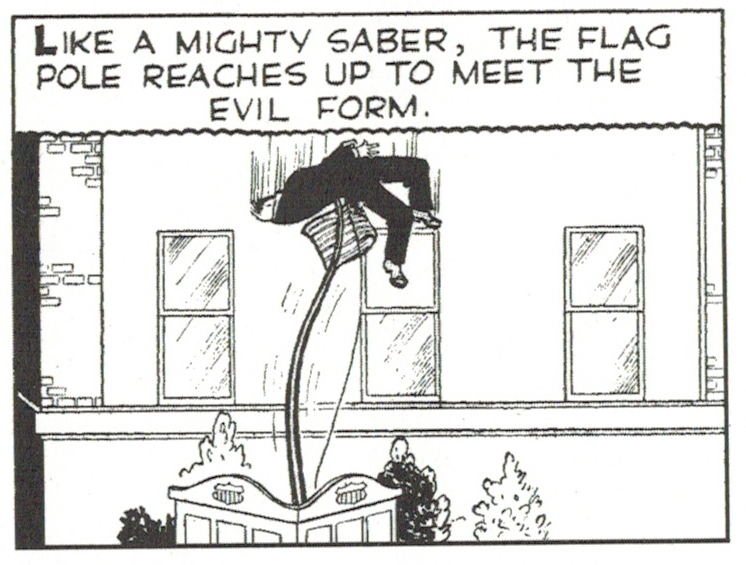
Far and away the most inventive and stomach-turning death in the first decades of Dick Tracy was the impaling of The Brow. I covered this in greater detail and with more context elsewhere. But here again is the wartime spy getting impaled on the flagpole commemorating the city’s war dead. The bending flagpole is a gruesomely brilliant touch to amplify that moment of maximal tension that will ultimately pierce the villain.
Gargles Eats Glass – 1946
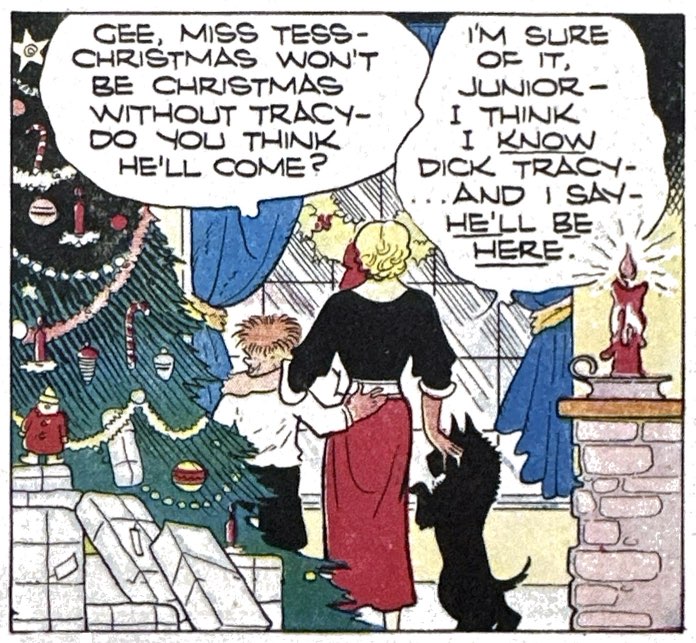
Falling through a skylight, again in comic strip slo-mo, Gargles gets sliced across three panels. And Gould can’t resist giving us his final shudders. In fact Gargles hangs on until the next strip so his final words exonerate an innocent suspect just in time for Christmas. One of the hallmarks of Dick Tracy was the strip’s extremism, Gould’s penchant for balancing unmatched graphic violence and angry vindictiveness with maudlin sentimentality. This sequence leads up to a Christmas strip that celebrates the villain’s death and the joy of the season.
Mumbles’ Cry for ‘Elp’ – 1947
Making a speech impediment somehow expressive of a villain’s evil was a questionable move to begin with. But Gould doubles down on this conceit by having Mumbles frantically, futiley hail for “ELP”.
T.V. Wiggles Can’t Move – 1950
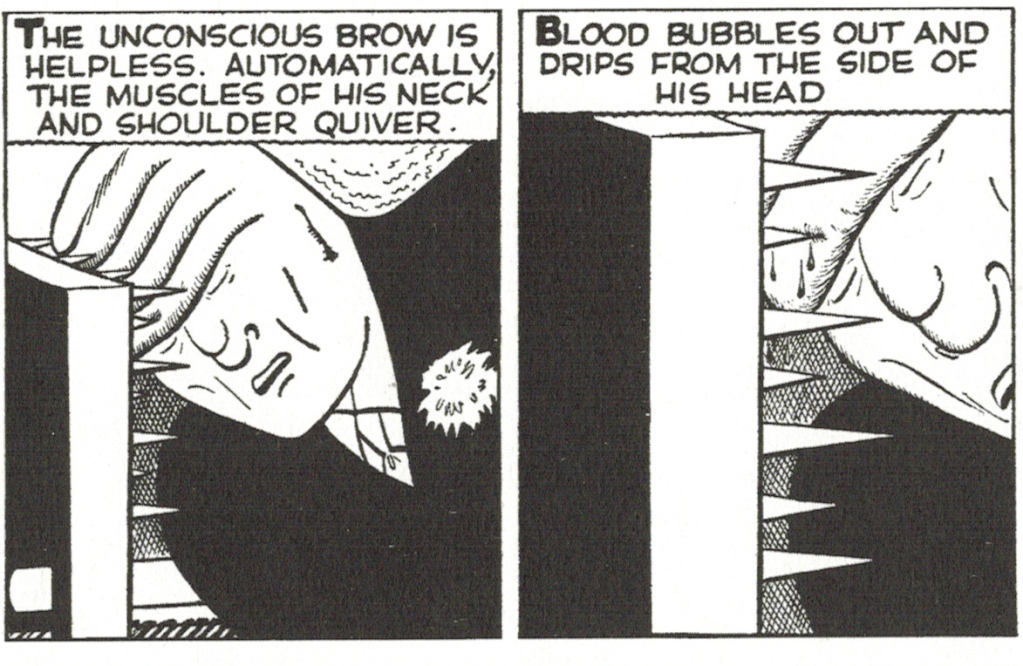
Gould loved to draw in that little bit of grisly business to convey violence. While he used a heavy, cartoonish line and unreal, expressionist style that set the strip far apart from the illustrative style of most adventure strips, Gould used other ways of communicating hard-boiled reality. He had a penchant for objects penetrating bodies. Bullets often passed through their targets in shootout sequences. And as the deaths of The Brow and Gargles showed, the impaled body has a special place in Gould’s sense of horror. The death of T.V. Wiggles comes from fallen metal sheets that form an ersatz coffin. But it is that little corner of metal piercing a flap of neck flesh that telegraphs the experience of death itself.
Mr. Crime and Judge Mix Blood and Money – 1953
Mr. Crime was among Tracy’s most ruthless, pitiless villains of the 50s, and in the context of the Gould moral universe I am surprised (and a bit disappointed) that he suffers a simple shootout with Tracy. In fact Gould reserves the grisliest image for Mr. Crime’s extorted dupe, Judge Ruling. When cornered, the corrupt Judge chooses suicide. But of course Gould can’t give us a gunshot sound effect heard through a closed door. We have to get an image of Judge Ruling eating the gun, complete with cheek lines to suggest how deep he has planted the barrel. But we’re not done with this duo. As is his wont, Gould closes in for a final tableaux of both villains swimming in their own blood and money.
Flattop Jr.’s Near Miss – 1956
Flattop Jr. was indeed the son of the original Flattop, but he was framed by Gould as a neglected youth who embodied the overhyped scourge of the 1950s – the juvenile delinquent. He appears to meet his end in a theater fire he himself set to cover his escape. Despite the massive explosion Gould depicts dramatically, and the presumption of having died in the inferno, Jr. turns up later where his genuine death takes place in the middle of another villain’s cycle. And so that final contemplative panel here turns out to be ironic.