
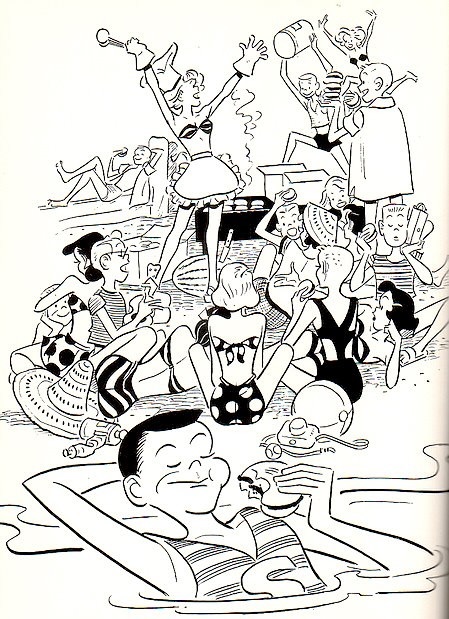
Like all American mass media of the last century, demographics and market forces provide the frame within which trends in comic strip content lived. Harry Haenigsen’s Penny launched in 1943 directly out of the intersection of two new social realities – gal power and the “invention of the teenager.” It is not surprising, then, that Haenigsen took an almost sociological approach to portraying two things he certainly was not – young nor a girl. Like any good cartoon anthropologist, he decided to go native. The Oct. 6 1946 Philadelphia Inquirer reports how the New Hope artist researched Penny by eavesdropping on soda shop conversations and even hosting cookouts for the local high schoolers.
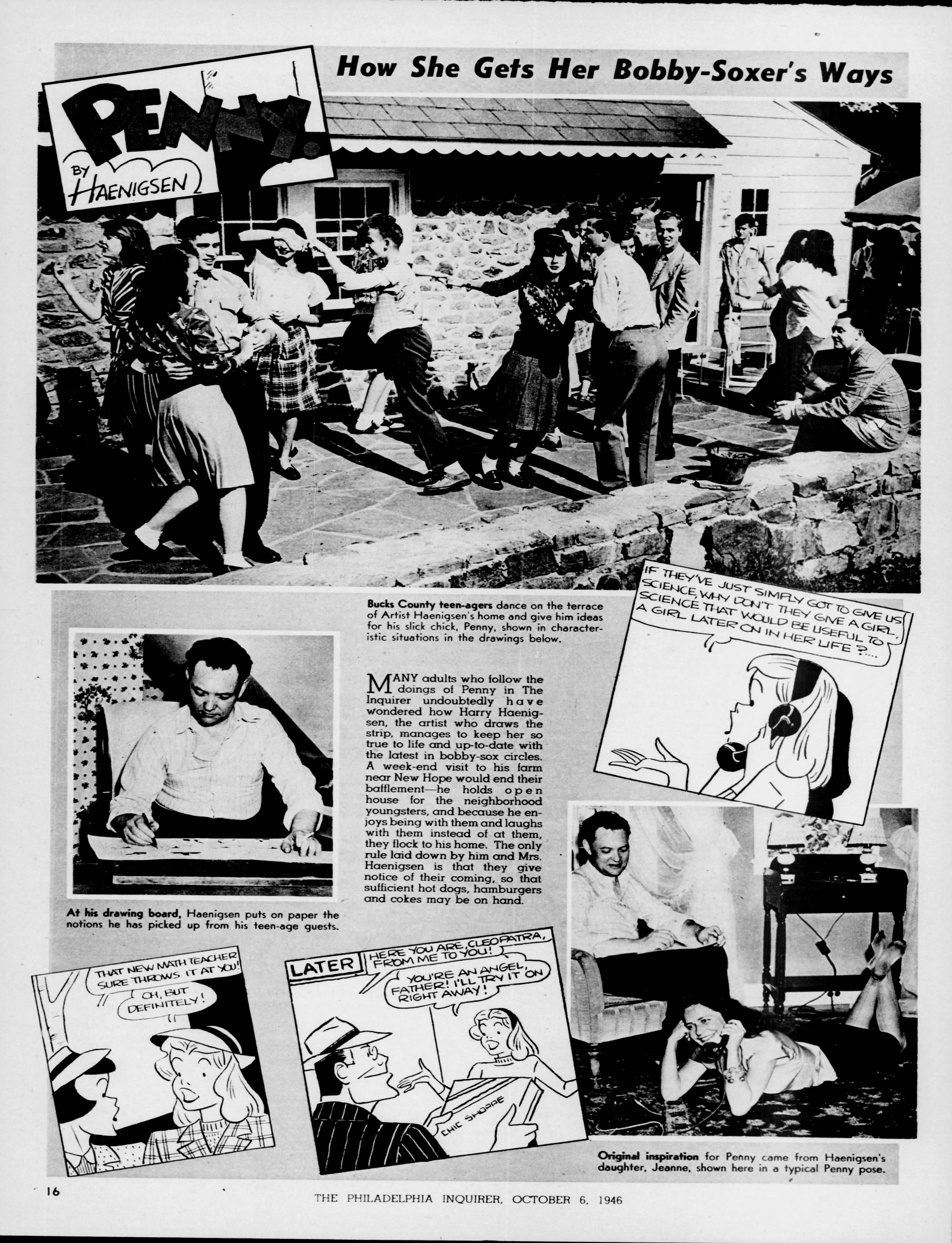
“Many adults who follow the doings of Penny in The Inquirer undoubtedly have wondered how Harry Haenigsen, the artist who draws the strip, manages to keep her so true to life and up-to-date with the latest in bobby-sox circles. A week-end visit to his farm near New Hope would end their bafflement-house he holds open for the neighborhood youngsters, and because he enjoys being with them and laughs with them instead of at them, they flock to his home. The only rule laid down by him and Mrs. Haenigsen is that they give notice of their coming, so that sufficient hot dogs, hamburgers and cokes may be on hand.” The Philadelphia Inquirer, Oct. 6, 1946
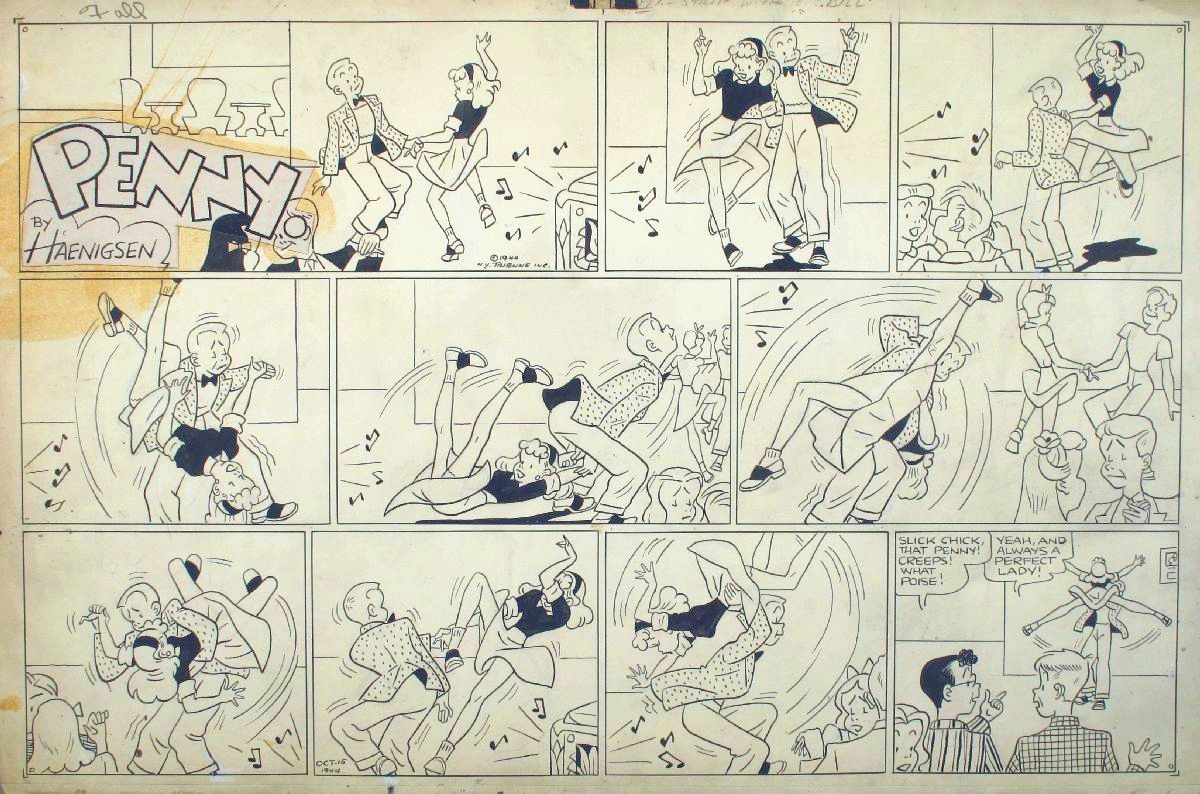
The fruits of Haenigsen’s anthropological dig into teen tribalism is evident especially in his focus on language, small rituals, eccentric postures. His study of the jitterbug is visually stunning, both in the way he freezes key expressive moments of the dance but contrasts it with the teens blithe disregard for the sexual subtext of what they are doing.
Penny is an instructive example of how personal artistry and vision assert themselves even within the severe constraints of market-driven mass media. In many ways more insightful and visually interesting than that more famous comic phenom, Archie (1941), Haenigsen’s take on teens was a singular blend of art, sociology and marketing.
When the President of the Herald Tribune Syndicate was looking to replace some cancelled strips in 1943, his wife Helen Reed put her foot down. Comics pages needed more leading women. Reed was not only standing up for her sex but channeling the zeitgeist. The 30s and early 40s were a remarkable moment in women’s history. In pop culture, leading ladies had been breaking out of typically demure sidekick roles for years. The Great Depression dealt a serious blow to male egos and traditional gender roles, a cultural pressure that drove some fascinating cartoon femtopias of 30s pop culture. And when WWII siphoned millions of able-bodied men overseas after 1941, wives, mothers and daughters filled the void. Many women enjoyed new feelings of competence and their marketplace power, a flex that migrated to the comics page. In 1940, Dale Messick’s Brenda Starr updated the traditional working girl comic strip with a more aggressive careerism, a jaded voice and even a good throwing arm. At the same time, the once-comely crime fighting heroine (i.e. Jane Arden, Myra North, Connie) became, well, more heroic. Crimefighters and spy-busters like Invisible Scarlet O’Neil, Miss Fury, Deathless Deer, Miss Cairo Jones and Claire Voyant were taking no prisoners during and after wartime. The late Trina Robbins and Peter Maresca resurfaced many of these in their recent, indispensable Dauntless Dames.
But the slang-swinging, bobby-soxer Penny Pringle took the girl strip in a different direction, straight into another 1940s demographic phenomenon, the “invention of the teenager.” While psychologists had discussed an “adolescent” stage of life since the beginning of the century, the “teenager” emerged mainly in the 1940s as a cultural and market force. Suburbanization, increased disposable income, child labor laws and increases in high school attendance intersected to create a seemingly alien being of discrete tastes, styles and even lingo. In 1944, a landmark pictorial in LIFE magazine followed a dozen ladies, 15-to-17, and declared., “Teen-Age Girls: They Live in a Wonderful World of Their Own.”
To be sure, teen stylings, slang and the generation gap had been comic strip commonplaces for decades. Carl Ed’s Harold Teen (1919) is familiar to cartoon historians as a proto-Archie. And in Polly and Her Pals, Bringing Up Father, The Bungles, et. al., adolescents were necessary generational foils to hapless sitcom dads. But Haenigsen’s Penny represented a much more assertive teen figure, more assured of her power both in the family and in the market. Haenigsen recycles a number of familiar generational tropes – about teen slang, musical heroes, irrational outbursts – but there is an unusual parity among the Pringle family. Decades before helicopter parenting, Penny is clearly the centrifugal force in this household.
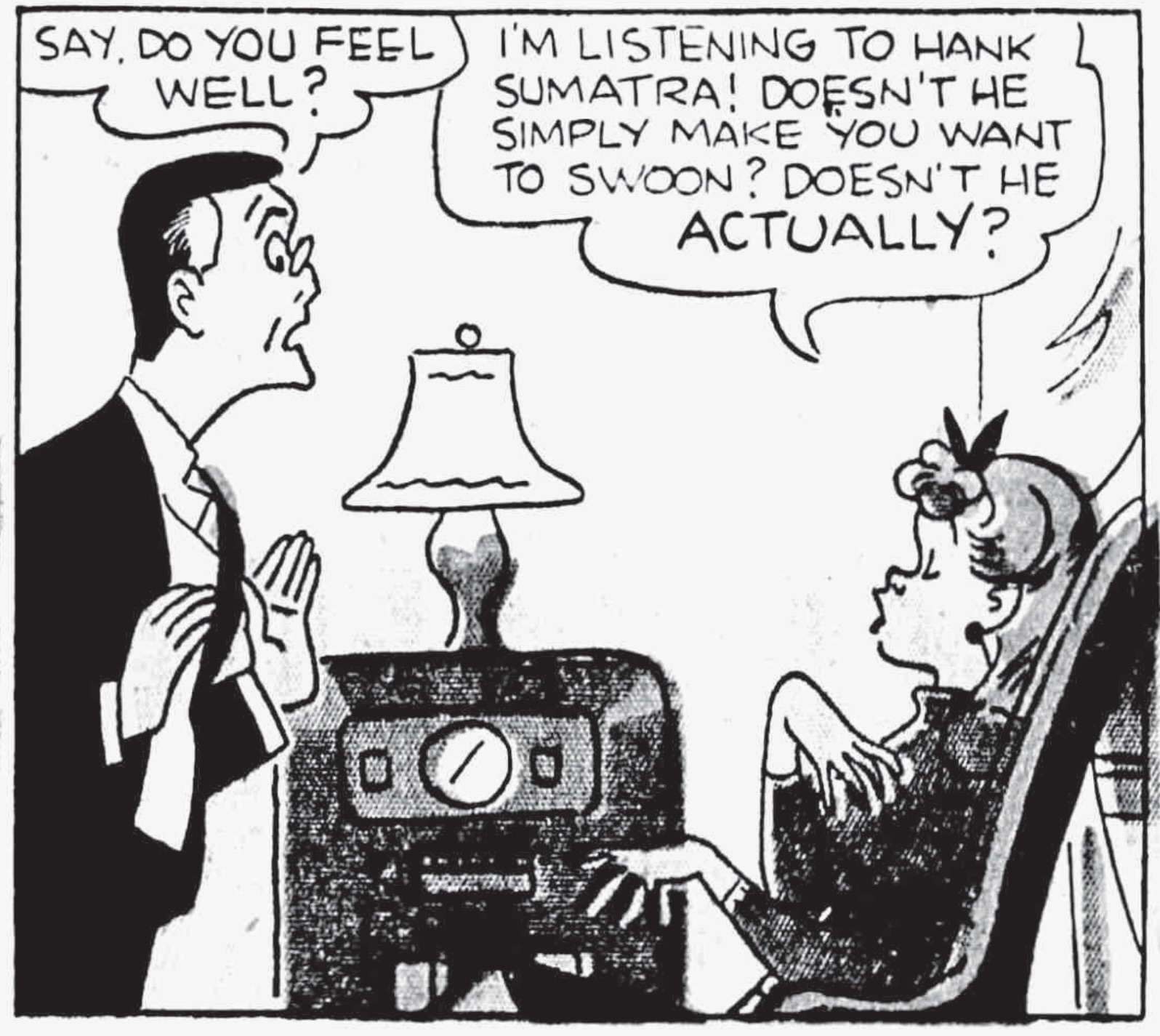
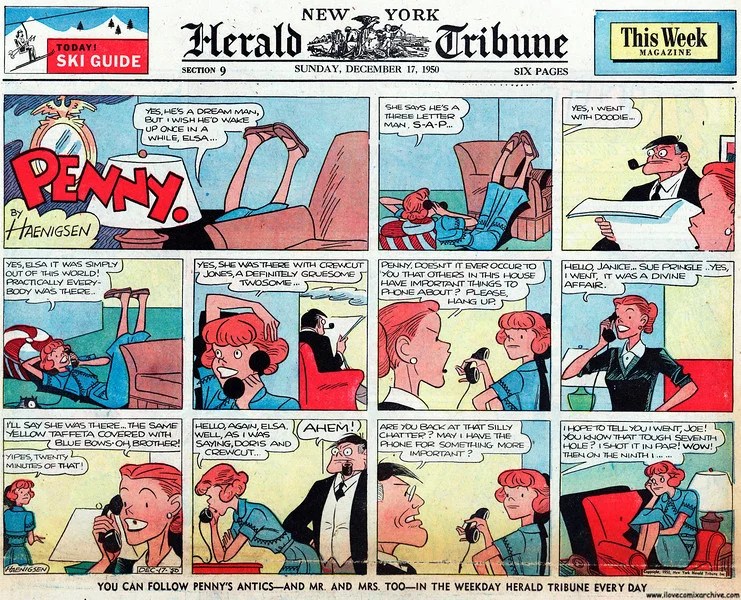
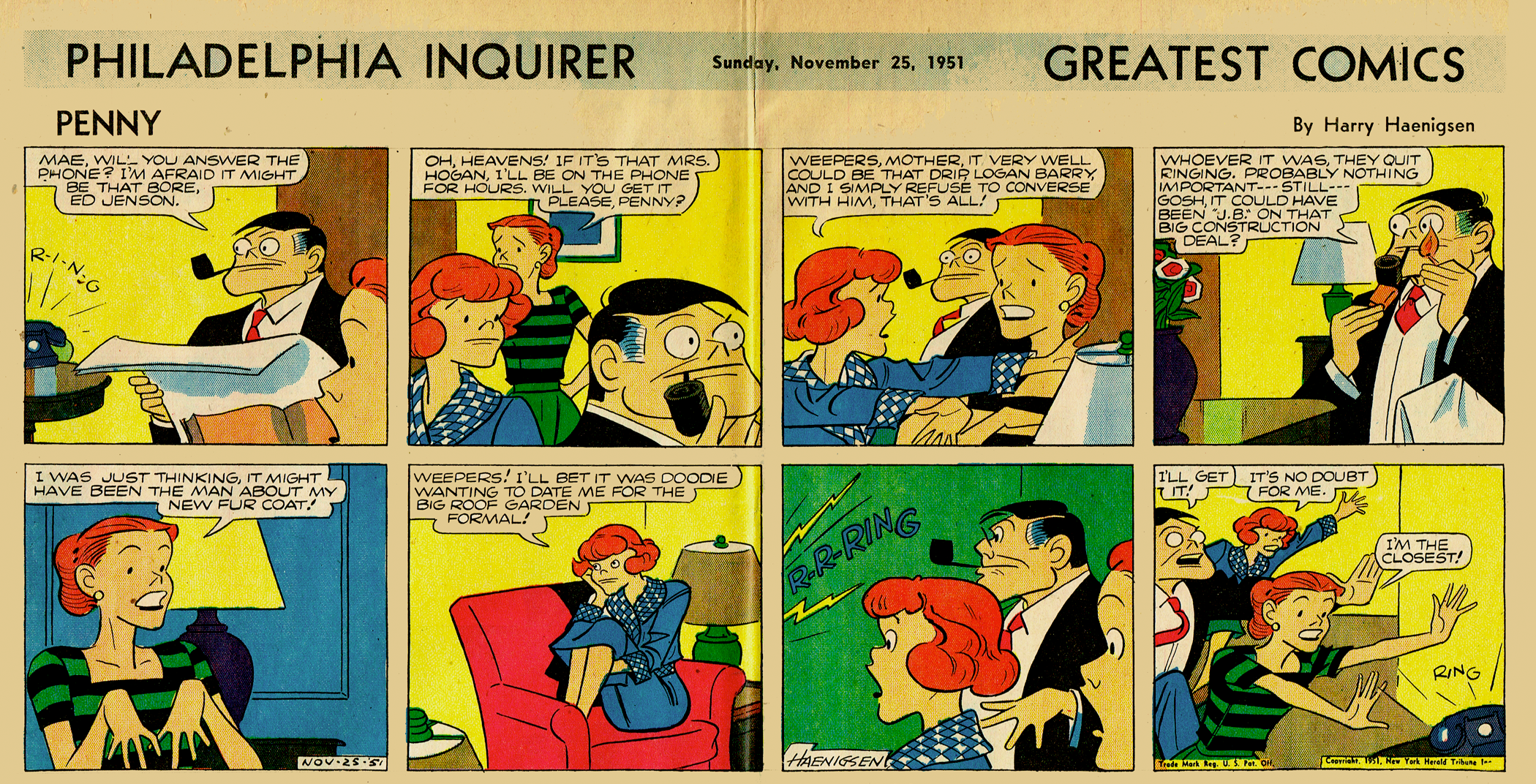
Speaking of centrifugal forces, Haenigsen had a talent for making even static moments seem active just through his unique angular minimalism. While 30s artists like Otto Soglow (The Little King) and Carl Andersen (Henry), had foreshadowed the clean-lined abstraction of 50s cartooning, Haenigsen added a mid-century modernism that captured an atomic age vibrancy. And with his own teen daughter serving as a model, he applied that style to capturing the antic energy of adolescence. He was a student of teen postures, analyzing his Penny from countless angles and bearings.
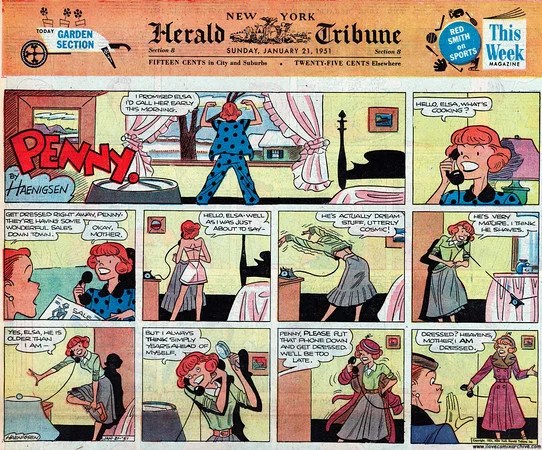
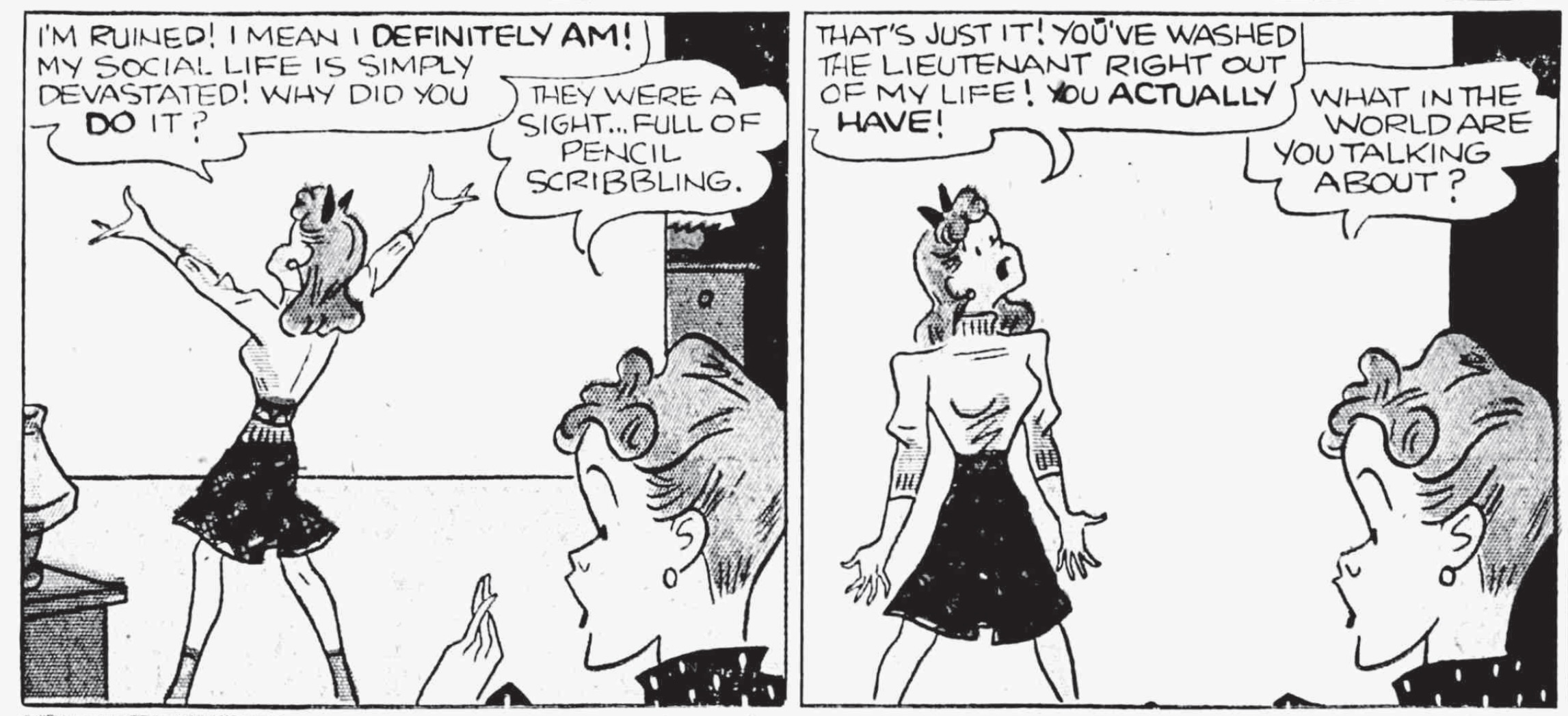
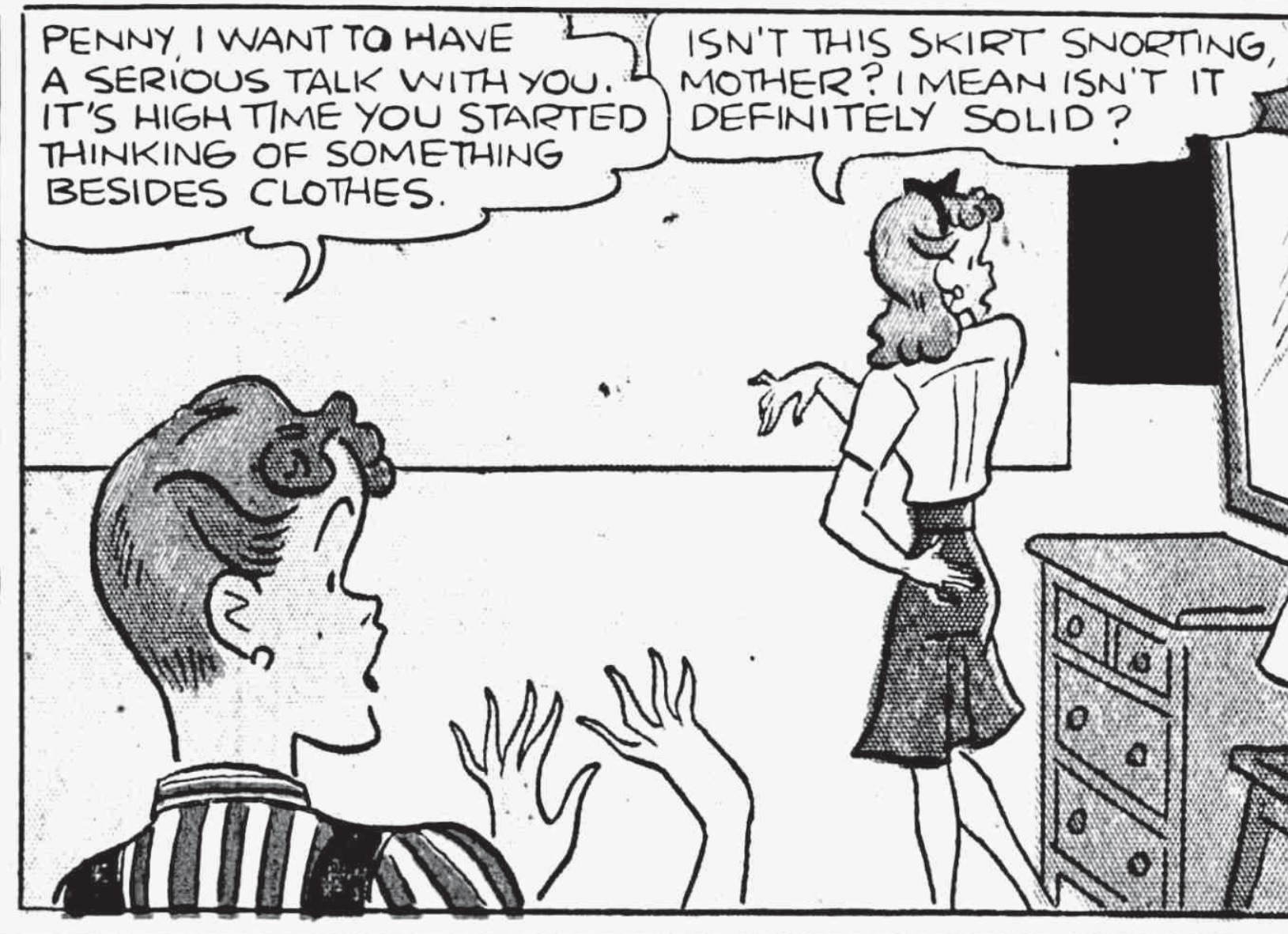
The way he has Penny splay across couches, contort un-self-consciously and burst into exasperation with an explosion of limbs are all pitch-perfect renderings of an adolescent’s misdirected hormonal energy. Even his ear for language (“Weepers!” “Snorting”, “Solid”, “Actually” “Definitely”) manifest that youthful need for extreme declaration, assertion, being heard. In all of those little moves, Haenigsen’s Penny registers the teen as a self-assured force in the culture.
Consciously or not, Haenigsen is also capturing the sexual dynamism of this generation in a way that is safe, prurient, playful rather than threatening. As the jitterbug sequence suggests, Penny’s sexuality is always suggested by her contorted poses but never realized. Her character is too assertive to be fully innocent. And Henigsen was doing something different here from the competition. Dan DeCarlo and Bob Montana well understood the Betty and Veronica’s sheer cheesecake value. But the horniness of Archie’s gang, while inexplicit, was unsubtle. The teen sexuality of the Penny comic strip was more naturalistically vague and part of a larger lack of executive functioning.
All of which is to say that the Penny strip’s persistent, if modest popularity may lie in in its subtle, recognizable expression of the new teen figure that is also defused of threat. Consider how the later 1950s moral panic over “juvenile delinquency” conceived new teen energy in radically different ways. Penny was part of a larger cultural conversation about the meaning of “teen” in postwar America – including Archie, Andy Hardy movies, James Dean’s “Rebel Without a Cause” persona, let alone countless anodyne sitcoms and the like. Haenigsen’s pop culture hat trick was to offer a vision of the teenager that was at once palliative yet still insightful. Penny accurately registered the confidence and power of emerging post-war youth but found artful ways of redirecting its sexual adventurousness, even rebelliousness, into safer channels. This is where the most compelling and creative mass media operate, at the nexus of art, demography, market need, which is where myth lives.
Discover more from Panels & Prose
Subscribe to get the latest posts sent to your email.

