
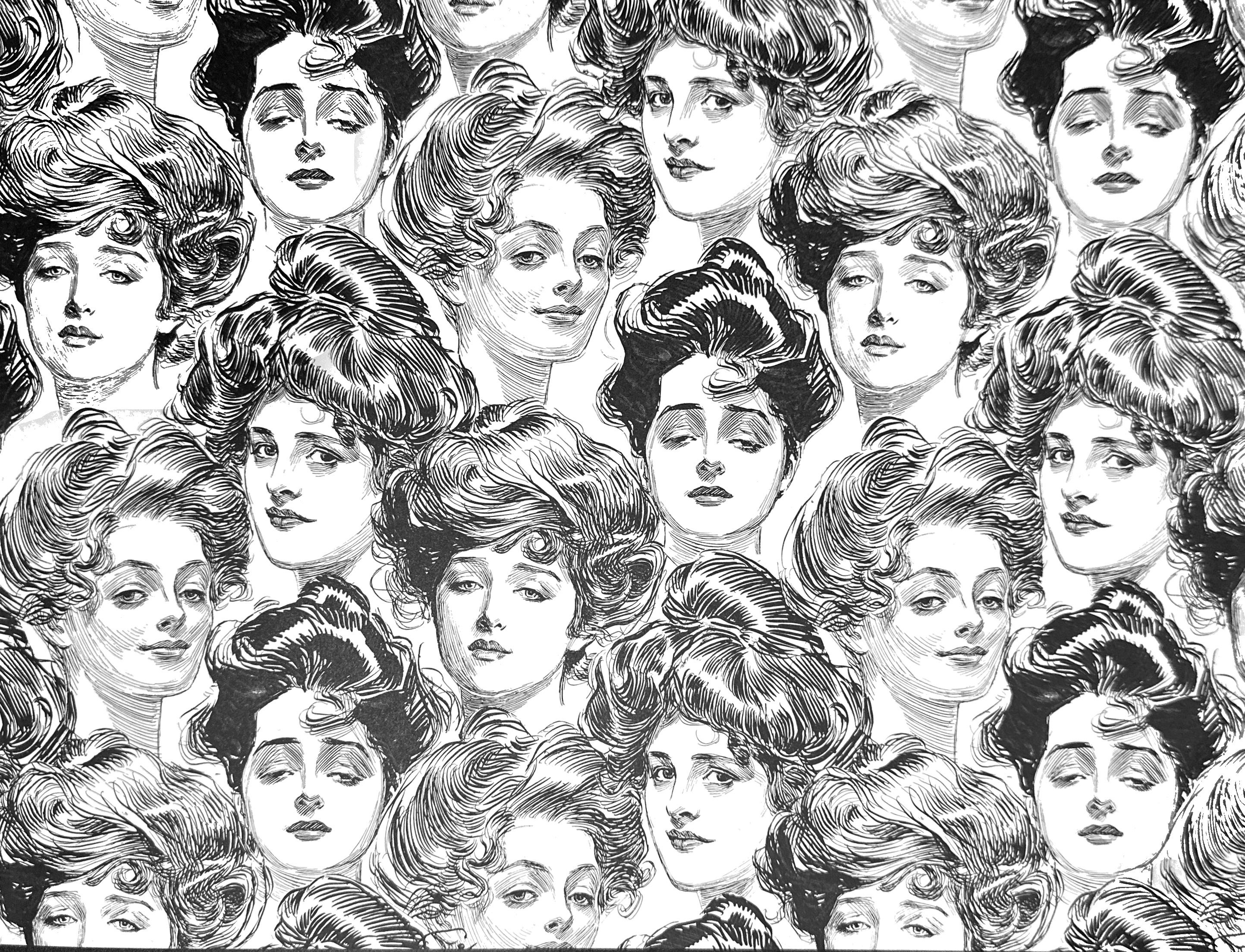
This is a good time for modern comic strip fans to recall Charles Dana Gibson’s role in late Victorian American culture. The most famous illustrator of his day had a calming, languid line and upscale focus that contrasted sharply with everything the early newspaper comic strip represented. Just as a tsunami of recent comic strip reprints celebrate the raucousness of 20th Century cartooning, Gibson’s epoch-defining artistry reminds us of what the “vulgar” new medium was disrupting. It also suggests why the scions of civility found the Sunday supplements so offensive and magazine illustrators like Gibson so engaging.
And yet, Gibson’s legacy is more than a staid Victorian counterpoint to the rise of riotous cartooning. A new reprint series revisits the signature illustrator of his age in a larger frame that captures his innovations to pen and ink graphics and the ways he anticipated 20th Century imagery. In his own sublimated, polite fashion, the great chronicler of the fin-de-siecle middle class was really loosening the corsets for modern femininity.
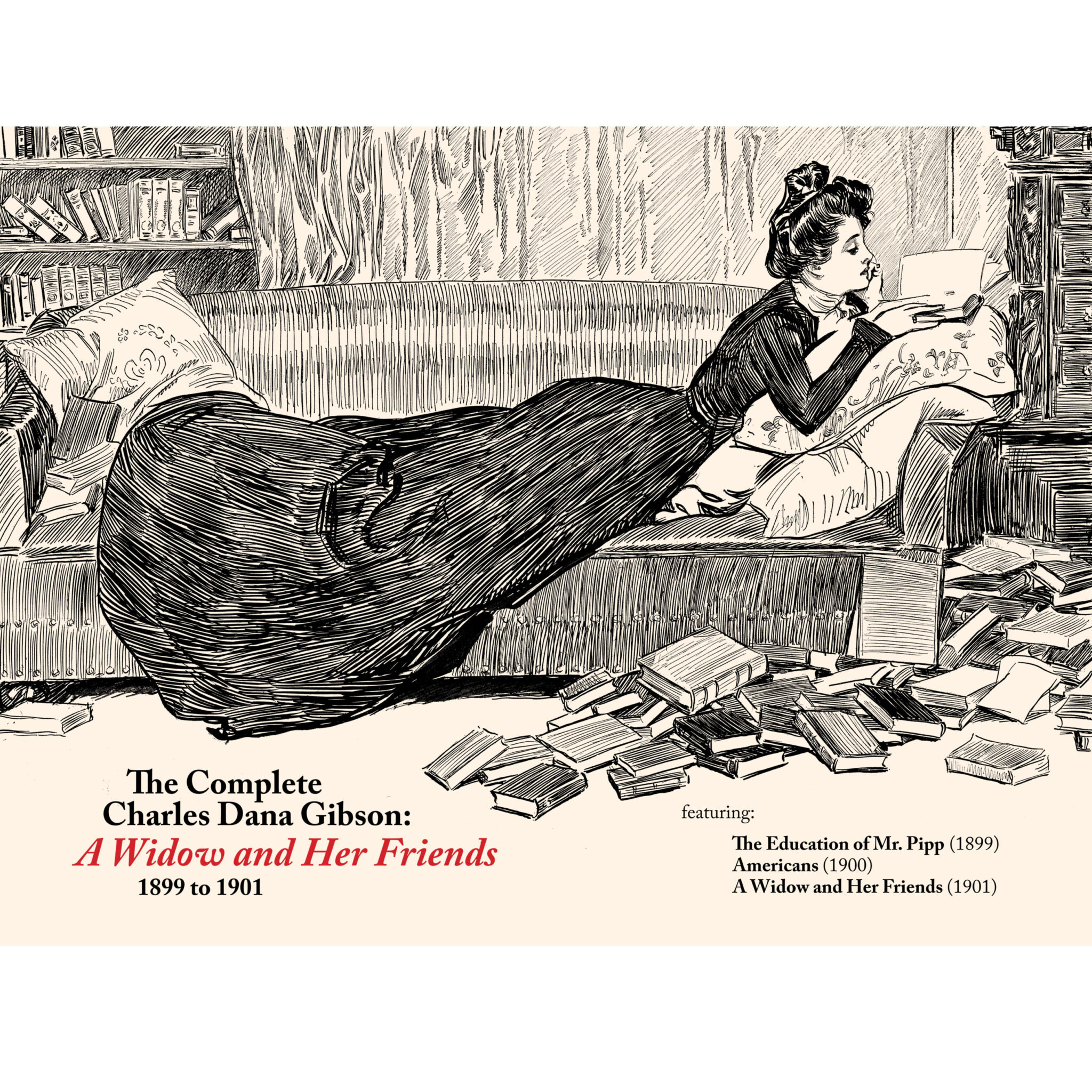
The first of a multi-volume series, The Complete Charles Dana Gibson, 1899-1901 gathers three collections of Gibson’s work from those few years: “The Education of Mr. Pipp” (1899), “Americans Drawn By” (1900) and “A Widow and Her Friends” (1901). Generally these are reprints of magazine narrative series and standalone illustrations Gibson had been publishing in recent years. The Mr. Pipp story, for instance, initially appeared as serial centerfold spreads across several months in Life.
Physically, publisher Living the Line reproduces these collections quite well. As editor Sean Michael Robinson points out in his excellent intro, Gibson liked to work on very large boards, but with fluid, broad lines that communicated effectively even at extreme reductions. The original reprint of the Mr. Pipp story I wrote about a while back was enormous, at 17 ½ x 11 ¾ inches. The current iteration keeps the art immersive but at a more manageable 12 ¼ x 9 1/4. The crisp printing on solid matte white stock serve well Gibson’s use of differently weighted pen and ink lines.
In his thumbnail bio, Robinson emphasizes Gibson’s prodigal childhood talent for cut-out silhouettes and a folksy, cartoonish style that distinguished even his early work from academic realism. He was a born storyteller who used composition, posture and facial expression to suggest a narrative. Robinson is a sensitive analyst of Gibson’s use of the relatively new technology of steel-nibbed ink pens and the expressive range it allowed. He calls attention to the ways Gibson used different line weights across a large scene to achieve a visual balance and depth. He likens the illustrator to contemporary watercolorist John Singer Sargeant, both of whom “strip-mined” the potential from media that were often devalued by elites. Both artists absorbed into their work aspects of European Impressionism and selectively deployed swathes of abstraction and detail to focus attention, especially on their characters’ expressive faces.
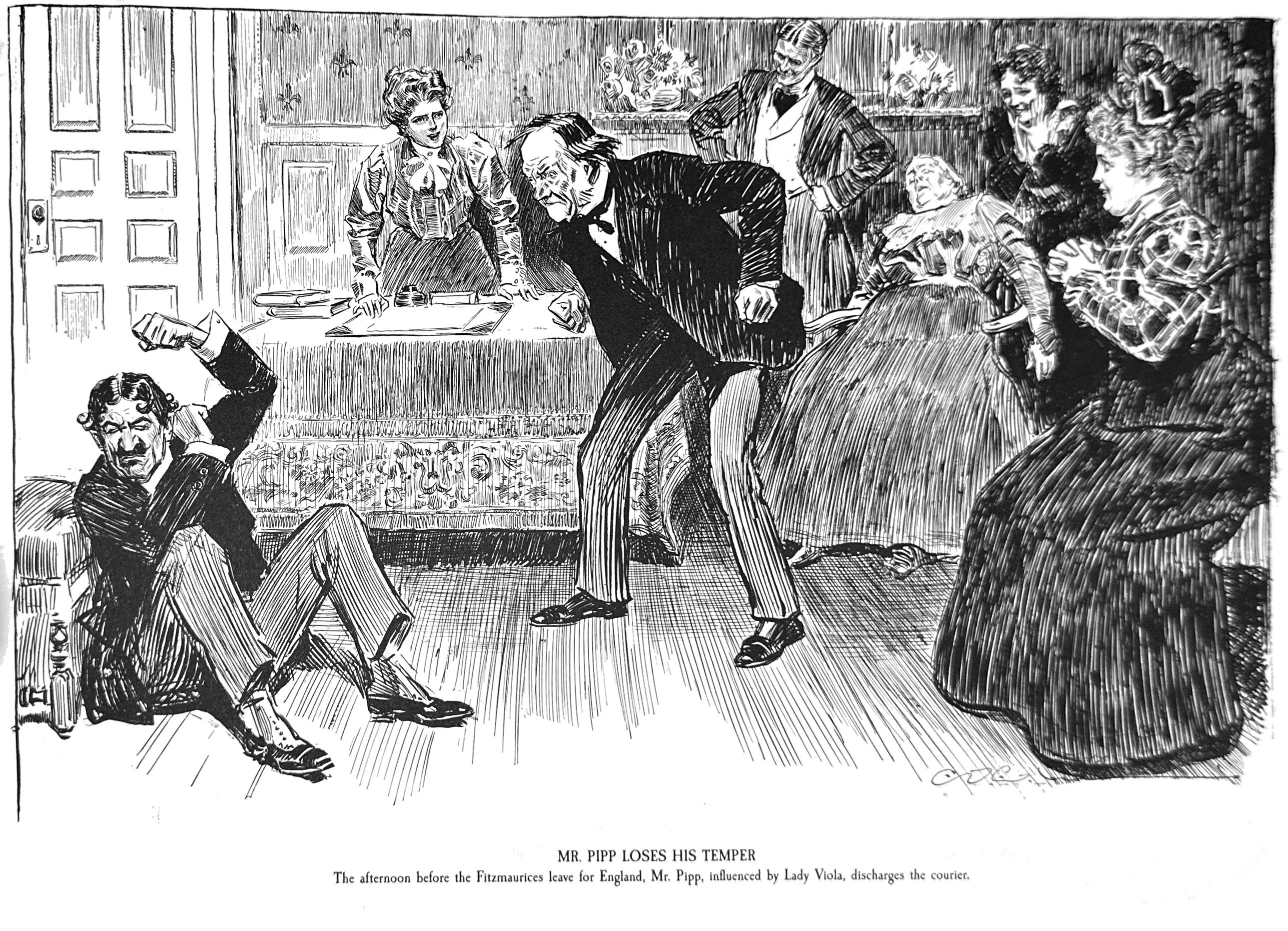
By the time Gibson crafted the three turn of the century book reprinted here, he had already moved from reflecting social trends to setting them. His fame is hard to overstate. That famous “Gibson Girl” and guy helped define the look of an ambitious new generation of bourgeoisie. American youth especially looked to these images for ideas and ideals of fashion, hairstyle, affectation. Gibson was a self-conscious American chronicler. He was preoccupied with questions of social class, generational change and national identity for an America that was becoming the driving force of world progress. We have already explored the first book, “The Education of Mr. Pipp”, but it is very much in this vein. The diminutive Pipp is an American iron magnate who brings daughters and wife on the customary “European Tour.” Charlatans, snobs, seducers and many fish-out-of-water hijinks ensue. It is the closest Gibson gets to sitcom mayhem.
“Americans Drawn By” collects many of his best one-panel captures of contemporary middle class life. Young men courting Gibson Girl types is a commanding trope here. One restaurant image titled “Supper: Shall it be what she is accustomed to or the best he can afford” describes a scene with a young diffident girl, her judgmental chaperone/mother, and the anxious young man trying to prove his worthiness to both. It is all about the faces here and the story Gibson is trying to tell about class anxiety, feminine power and social pressures. The background of fellow diners evaluating the trio is delicious. People eyeing and judging other people is a persistent theme in Gibson’s work: middle class life as theatrical performance. He captured the intense class and social anxiety for a particular American tribe at that moment.
And Gibson could be brutally candid about the inanities of social privilege. In “The Race Is Not Always to the Beautiful” he depicts, delightfully it seems, a cluster of resentful beauties amazed by a homelier lady attracting all of the available men. He was not averse to mocking the very Gibson Girls he invented. If Gibson’s cartoonishly expressive faces remind me of any artist it is of a later Norman Rockwell, that other folksy American idealist. Like Rockwell, Gibson was popular in his time precisely because his illustrative style was so reassuring to an anxious new managerial class. He converted radical social change into light comedy and parlor room faux pas.
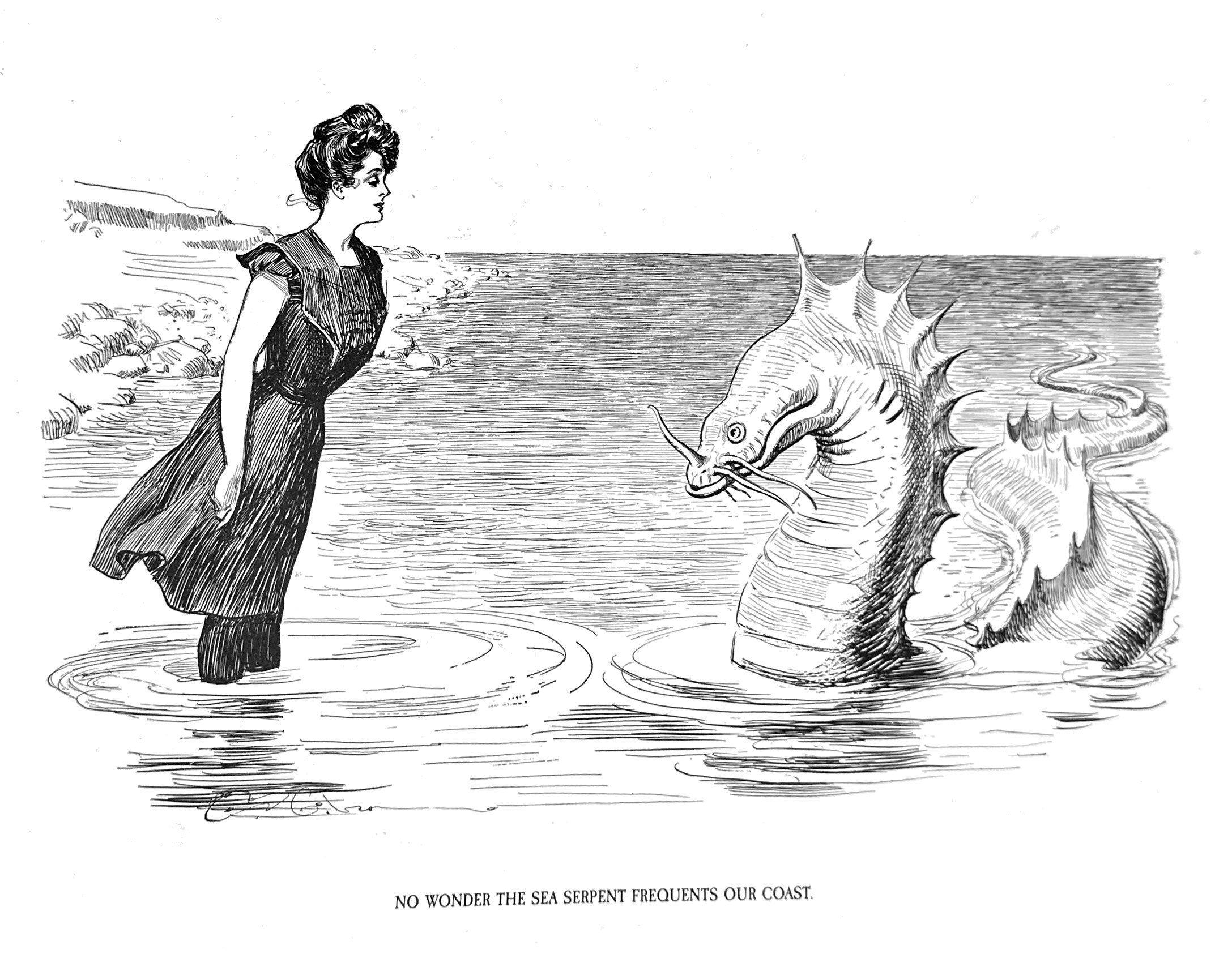
Gibson is so identified with the buttoned-down bourgeoisie of late Victorian America it is easy to miss the sheer eroticism of his work. Some of it is neatly repressed, as in the pillowy tufts and languorous loose locks of Gibson Girl hairdos. Doubters need only look at the near-pornographic Gibson wallpaper that was merchandised at the time. Imagine such a mob of Gibson Girl headshots clustered across a young man’s apartment, a harem of half-closed eyes, long bare necks and those pounds of hair. In one “Picturesque America” image he literally foregrounds bathing beauty calves in a beach scene. In another bathing fantasy (“No Wonder the Sea Serpent Frequents Our Coasts”) a laughably phallic sea creature faces off with an unmoved lass leaning her bust towards the sea. Freud had not yet hit American shores at this point, but you really don’t need him to decipher this one.
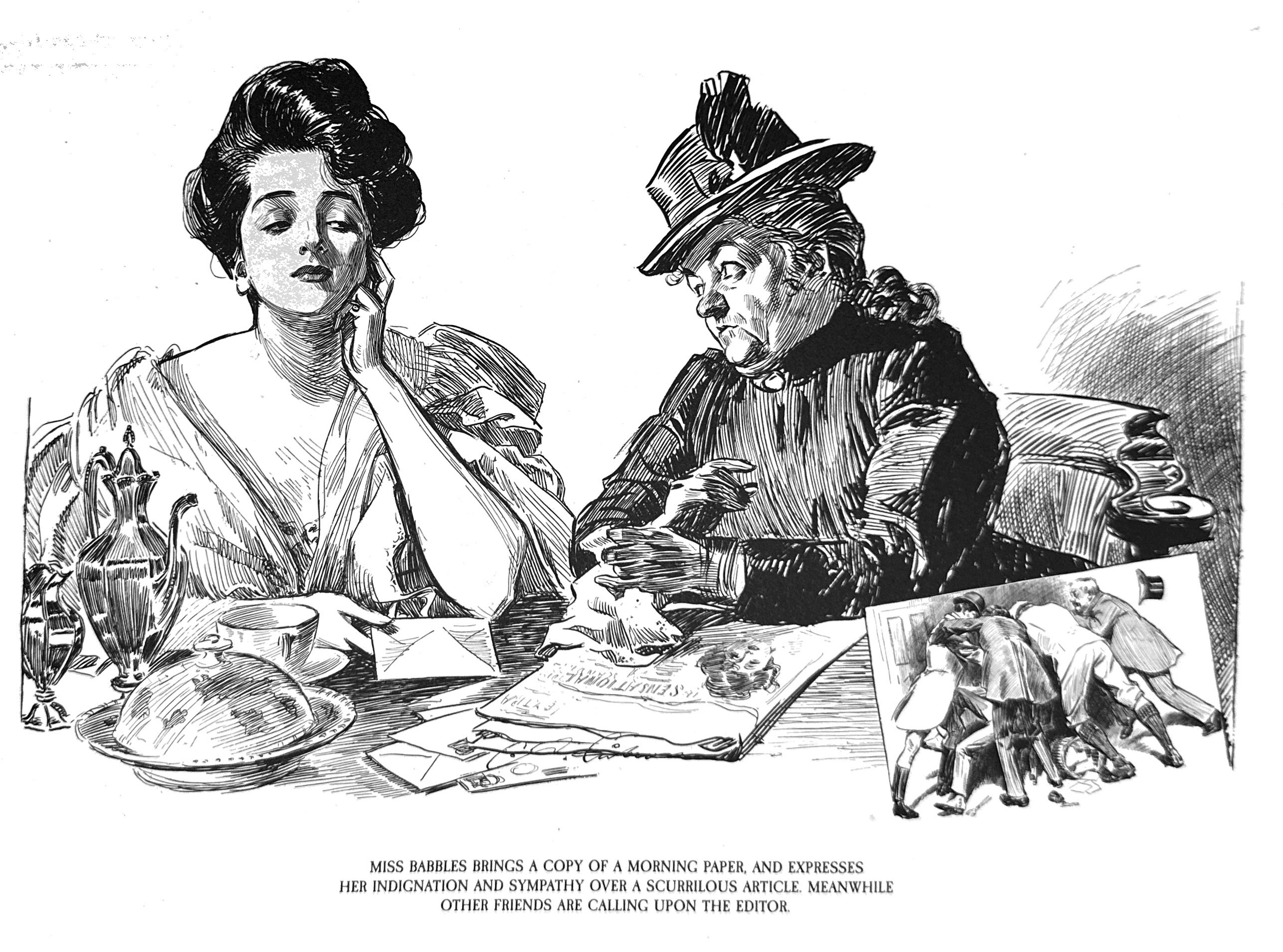
The final book in this collection, the ironically titled “A Widow and Her Friends,” is the tale of a gorgeous but grieving woman coming back into society. Unsuitable suitors, scandal-mongering socialites and the persistently diffident look of our heroine drive the comedy here. The actual storyline often feels obscure as Gibson is telling his long tale with a limited number of illustrations that leave a lot to infer. Still, we are seeing here the halting steps towards more ambitious, predominantly visual narrative. Comics fans may not appreciate how the roots of today’s “graphic novel” already ran deep in American illustration and caricature of the 19th Century. While most of the humor magazines that dominated cartooning in the late 1800s like Puck, Judge and Life relied on one-shot panels and short sequential drawings, the comic graphic narrative had been imported earlier in the century with Rodolphe Töpffer’s The Adventures of Mr. Obadiah Oldbuck, which was widely imitated here. A.B. Frost’s 1884 Stuff and Nonsense reprinted multiple graphic short stories aided only by minimal captioning. In two of the three books reprinted in this Gibson volume we can see a bridge into a the more epic visual novels of Lynd Ward and Milt Gross.
For contemporary cartoonists there is much more than mere artifact to Gibson’s work. As this collection tells us, his talent for composition, facial expression, line weight, and endowing a single image with dense backstory should be object lessons for any artist at any time. Publisher Living the Line promises at least two more volumes, which, at this scale and quality of reproduction, is a steal at $25.
Discover more from Panels & Prose
Subscribe to get the latest posts sent to your email.

