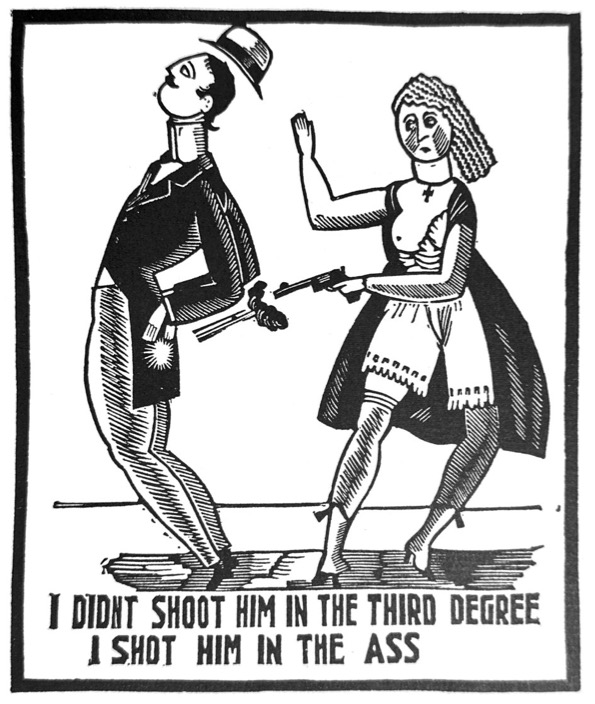
“I Shot Him In the Ass!” John Held Jr.’s Lewd Linocuts

John Held Jr.’s highly stylized, fine line cartoons are identified with “The Jazz Age” of Fitzgerald’s 1920s for good reason. His imagery on the covers of Fitzgerald books, in his Oh, Margy and Merely Margy comic strips and especially in his work for the early New Yorker and other humor magazines pretty much defined that decade visually. He found a way toi make privileged youth look even more air-headed and frivolous than they prbably were. It made him enormously wealthy, for a time, and in constant demand. Yet, for all of his identification with modernity, Held was deeply nostalgic. Many of his other illustrated works departed radically from his signature flapper stylings and used instead a pre-modern linocut technique that gouged an image into a linoleum surface to effect a primitive woodcut-like effect. Rob Stolzer recently posted the full run of Held’s Civilization’s Progress series from Liberty magazine (1931-32), where Held contrasted the Gay Nineties with contemporary life by juxtaposin his flapper and linocut styles.

Continue reading

Baby Mandrake’s Evil Twin?

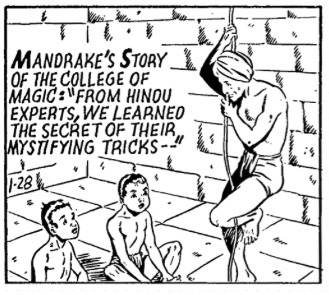
Lee Falk’s tux-clad adventure hero Mandrake the Magician was among the strangest characters on the comic page since his mid-30s launch. As we have covered here before, some of his strips were downright surreal. And so you just know that his origin story must be wild. According to a 1949 flashback sequence, orphaned twins Mandrake and Derek are raised by an island school of monk-like magicians. The boys learn ancient mystic secrets like “Instant Hypnosis, the art of making things appear to be what really aren’t — the art of the seemingly impossible.” But Derek shows his evil nature early and resurfaces in a 1949 story that threatens Mandrake’s reputation. Dig the signature slicked back hair on those toddler tops.

Calling Dick Tracy…Again: Shaking Up the Reprint Game

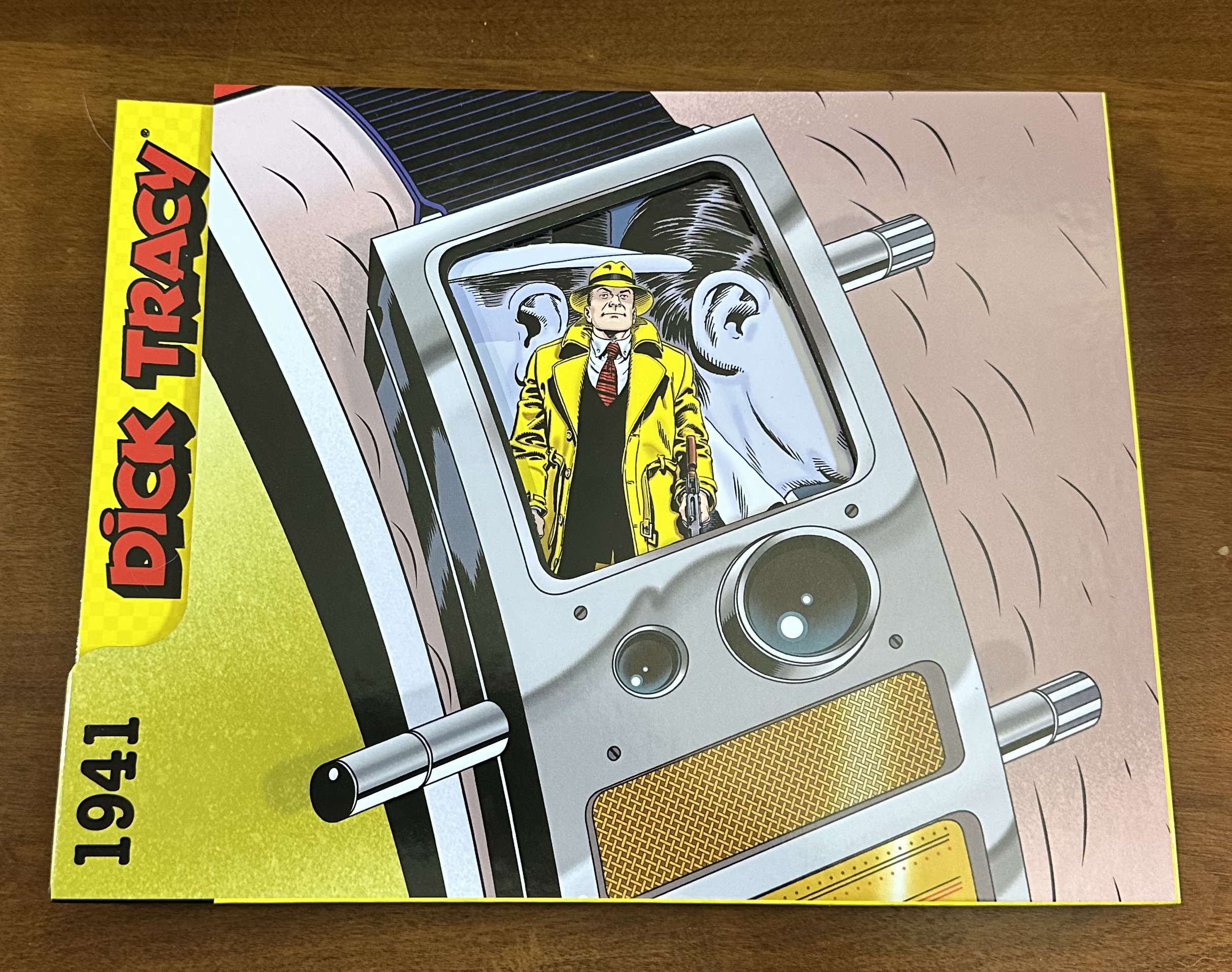
Chester Gould’s Dick Tracy has been among the most reprinted strips of all time. The reasons are obvious, and I don’t need to rehash this site’s exegesis on my personal favorite. Tracy was the strip that turned me on to classic newspaper comics. Gould’s singular visual signature, his grisly violence, grotesque villains and deadpan hero made Dick Tracy compelling on so many levels. And now we get yet another packaging style from the same Library of American Comics group that finished its magisterial 29-volume complete Gould run, 1931-77. With new publishing partner Clover Press, LOAC has reworked some of its earliest projects, like the magnificent upgrade of Terry and the Pirates and the first six volumes of The Complete Dick Tracy. And now we get slipcased, paperback editions of prime-time Gould, 1941 through 1944. Much more affordable, manageable, and available than the original LOAC volumes, each of which covered about two years of comics, the four $29.99 books are also available as a discounted set from Clover. This new series started as a crowd-funded BackerKit project last year.

Continue reading

Peg-Leg Bates Gets a Cameo in Hank

The Weekly Weird. Coulton Waugh’s experimental adventure hero Hank was the first disabled character to lead a comic strip. Shortly after losing his leg, the veteran Hank finds inspiration from real-life Broadway sensation, Peg-Leg Bates. Bates was a sensation on the stage show circuit around the country during the 30s and 40s on Broadway. The sharecropper’s son lost his leg in a cotton gun accident at the age of 12. He was determined to overcomethe disability and eventually turned it into a dance routine. More on Hank and Bates here.

“Fake News” Hot Off the 1894 Presses

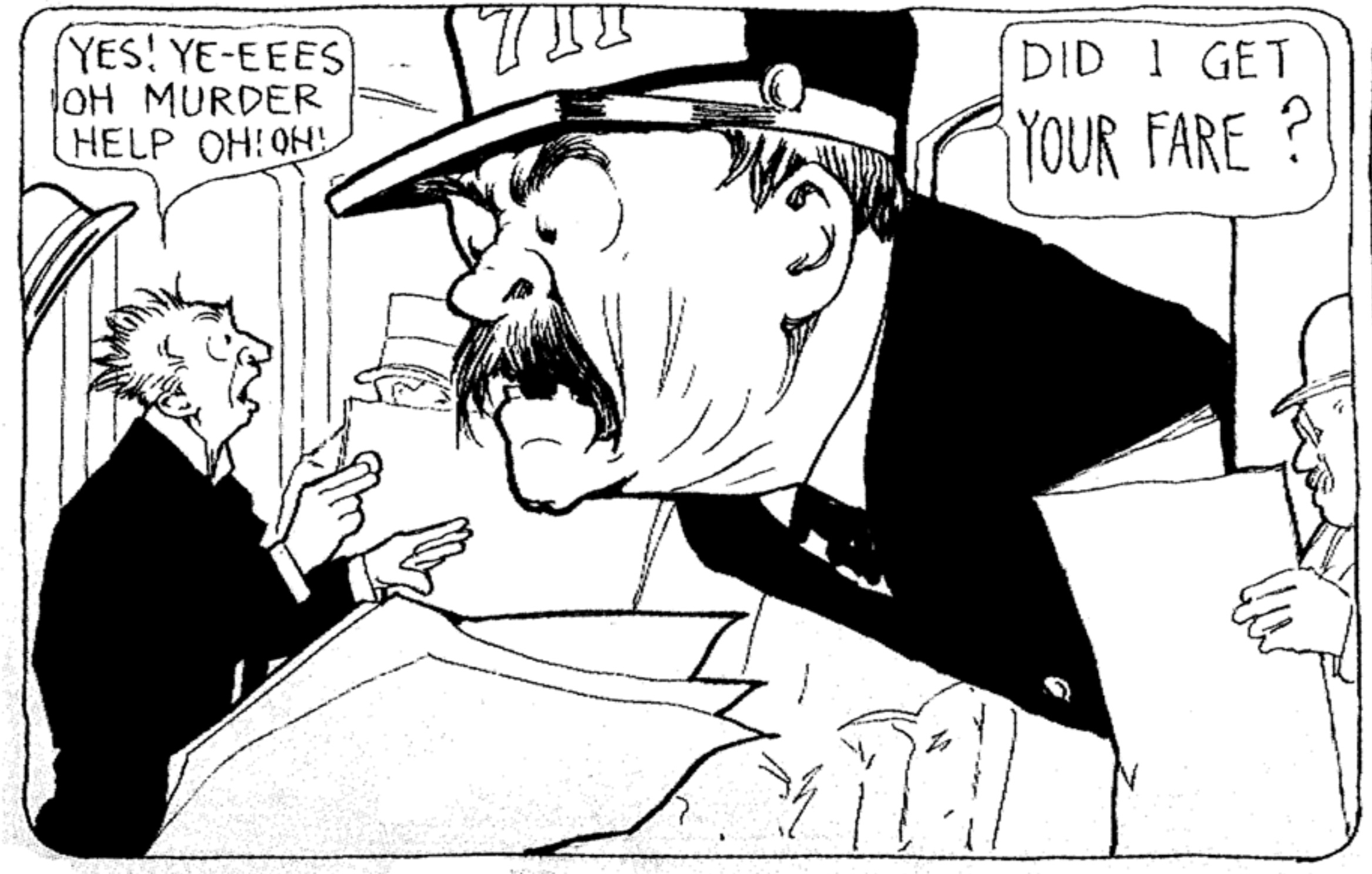
The Weekly Weird. In 1894, Puck magazine took aim at the rising influence of increasingly sensational and less costly city newspapers. Here, Frederick Burr Opper, who would go on to be one of newspaper comics’ founding fathers, called out Joseph Pulitzer in particular as a purveyor of “fake news.” More on the full cartoon here.

A Bigger Barks: Taschen Supersizes the Duck Man

Is a bigger Barks a better Barks? Taschen’s long-awaited Disney Comics Library: Carl Barks’s Donald Duck. Vol. 1. 1942–1950 supersizes the Duck Man, and we are all the richer for it. This is one of their “XXL” volumes, so let’s go to the tape. It weighs in, literally, at 11+ pounds: over 626 11 x 15.5-inch pages that include the longer Donald Duck stories from 15 issues of Western Publishing’s Four-Color series.  up to 1950. These include some of the greatest expressions of Barks’s quick mastery of the comic book format. In “The Old Castle’s Secret” (1948) he uses page structure, atmospherics and pace to create real suspense. His masterpiece of hallucinogenic imagination married to landscape precision surely is “Lost in the Andes” (1949). And his well-tuned sense of character is clear in creating a purely American icon of endearing greed in Uncle Scrooge in “Christmas on Bear Mountain” (1947). Of course we have seen these and many of the other stories in this collection reprinted before. So, to answer my own question, does scaling up Barks give us a better Barks?

Continue reading

Elmo Gets Hairy

Force-fed a new brand of cereal by his kidnappers that grows hair uncontrollably, Cecil Jensen’s country rube Elmo is awash in a pool of his own tresses. More on this strange late 1940s satire here.