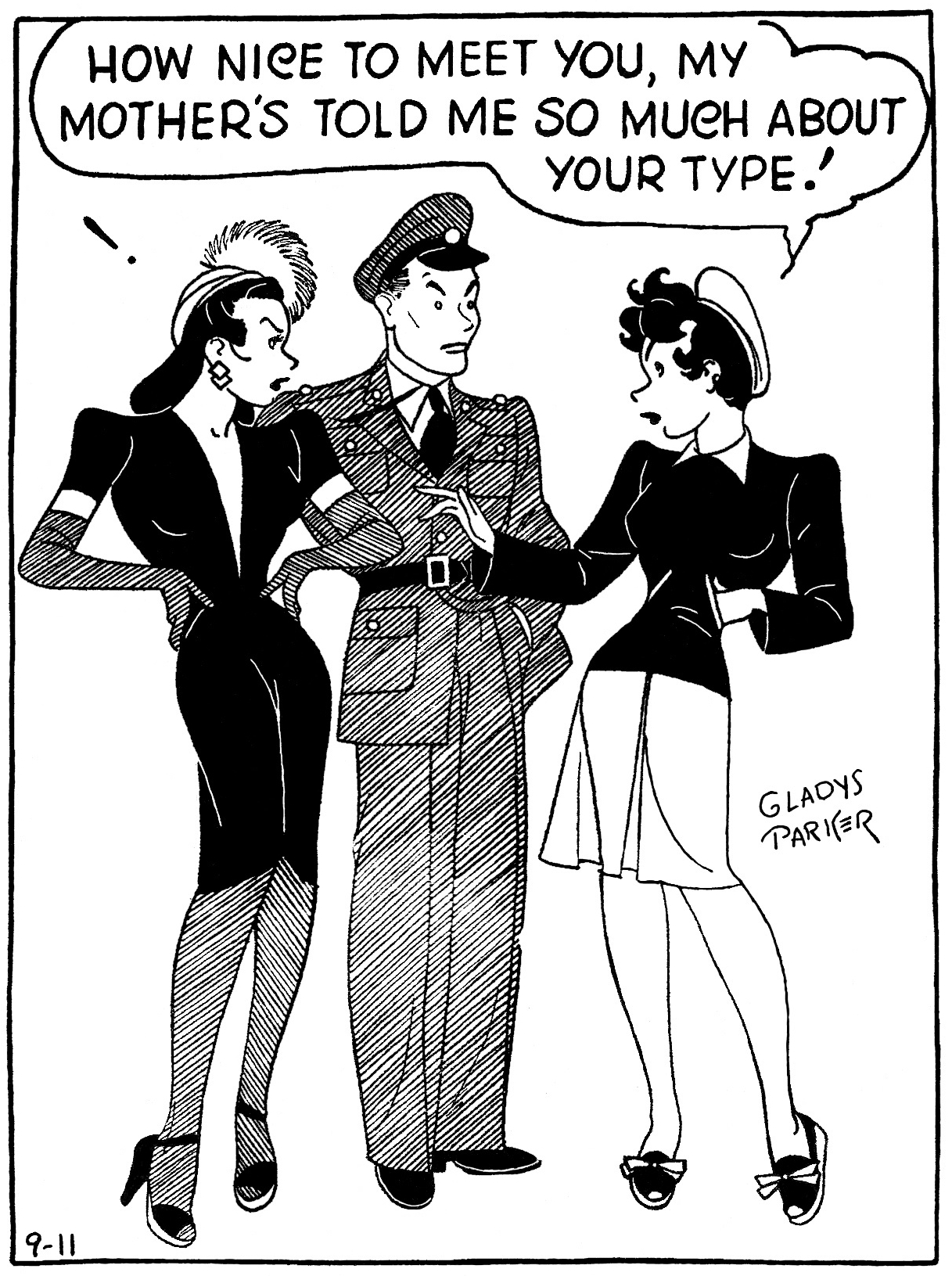
Gladys Parker was among the most recognizable and well-reported cartoonists of the 1930s and 40s. It was hard to miss her. She was the spit-curl image of her avatar Mopsy, the sharp-tongued and stylish star of her own single-panel comic (1937-1966). It is hard to say which came first, Parker’s cartoonish look or Mopsy’s, but they shared the same shock of black curlicues, sharply lined brows and eyes, and a precisely “sticked” set of lips. And since Parker was also a noted, audacious clothes designer, Mopsy was a working girl with a seemingly endless closet of ultra-modern fashions.
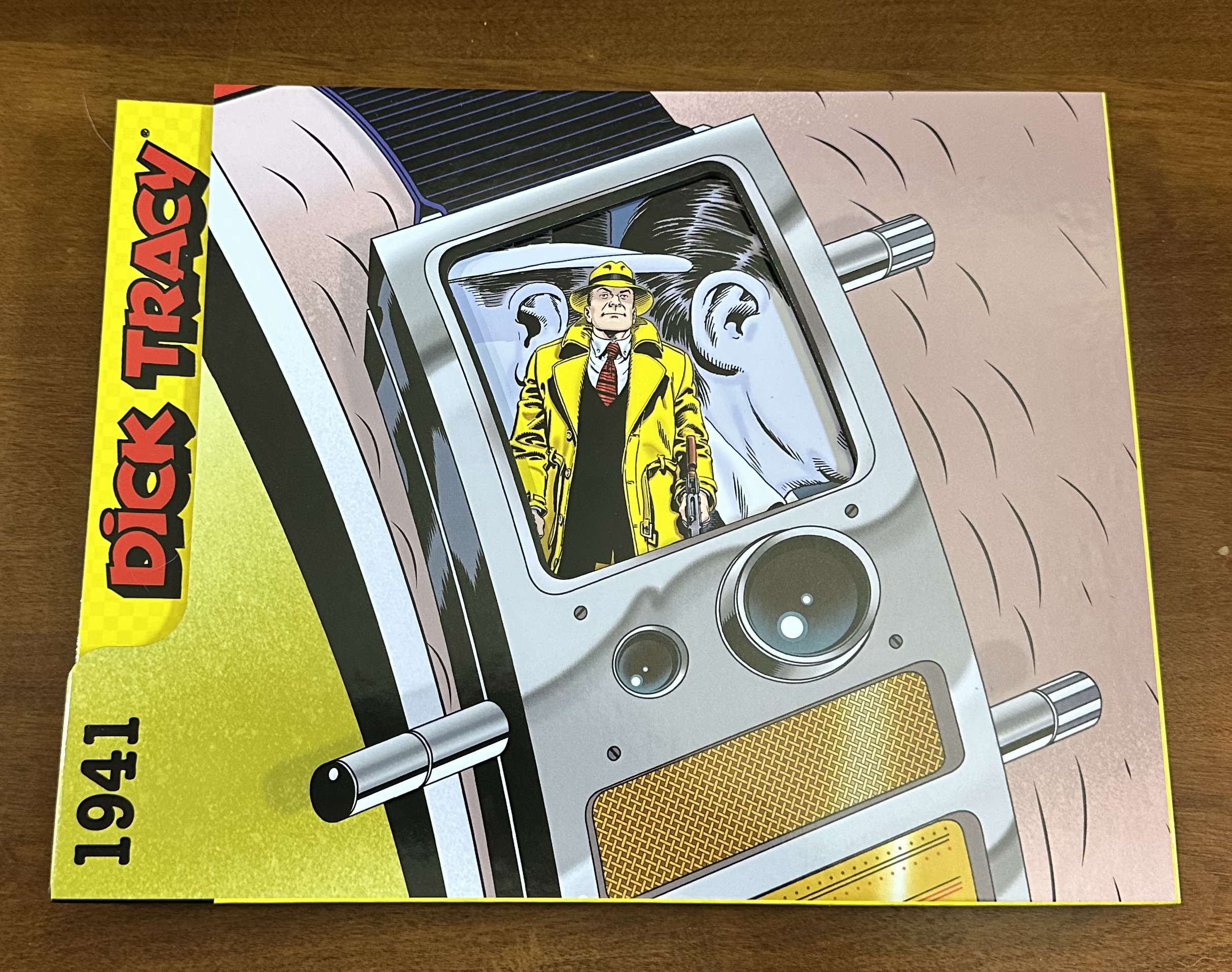
Chester Gould’s Dick Tracy has been among the most reprinted strips of all time. The reasons are obvious, and I don’t need to rehash this site’s exegesis on my personal favorite. Tracy was the strip that turned me on to classic newspaper comics. Gould’s singular visual signature, his grisly violence, grotesque villains and deadpan hero made Dick Tracy compelling on so many levels. And now we get yet another packaging style from the same Library of American Comics group that finished its magisterial 29-volume complete Gould run, 1931-77. With new publishing partner Clover Press, LOAC has reworked some of its earliest projects, like the magnificent upgrade of Terry and the Pirates and the first six volumes of The Complete Dick Tracy. And now we get slipcased, paperback editions of prime-time Gould, 1941 through 1944. Much more affordable, manageable, and available than the original LOAC volumes, each of which covered about two years of comics, the four $29.99 books are also available as a discounted set from Clover. This new series started as a crowd-funded BackerKit project last year.
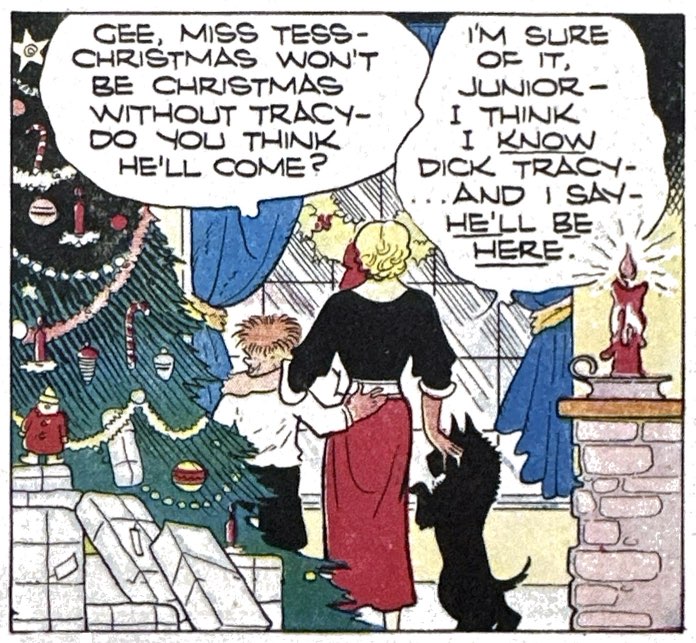
Christmas always had a special place on the comic strip page. Many artists creatively wove Yuletide celebrations into their storyline or just broke the fourth wall for a day to send holiday messages directly to readers. Over the next few days we will recall some of the most creative examples. But let’s start with one of the heartiest celebrants of the holidays, Dick Tracy, and trace how he and Chester Gould treated the holiday.
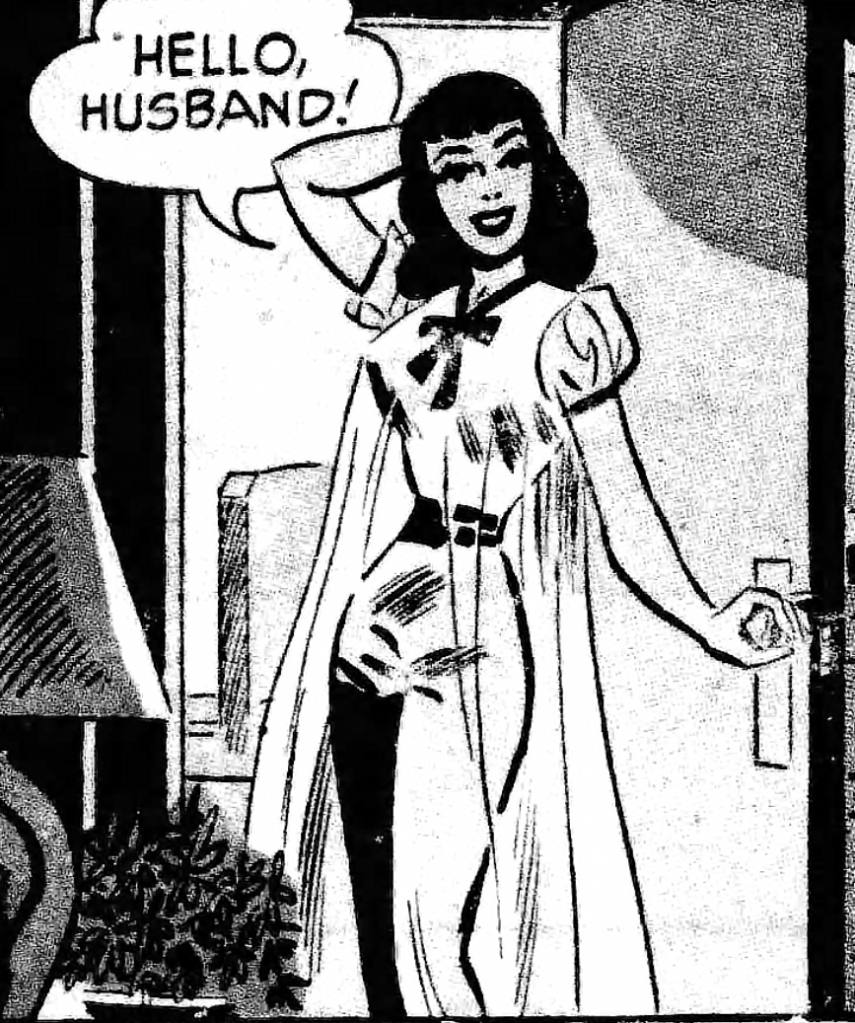
“It is a old comical strip trick – pretendin’ th’ hero gotta git married.” It keeps “stupid readers excited,” Li’l Abner claims in 1952. Days later he unwittingly weds Daisy Mae, ending a nearly 20 year tease. But this time it was no “comical strip” trick. In fact, several perennial bachelors of the comics pages fell in a post-WWII rush to the altar. Along with Abner, Prince Valiant, Buz Sawyer, Dick Tracy and Kerry Drake all enjoyed funny page weddings between 1946 and 1957. Comic strip heroes were just following the lead of the real-world heroes returning from WWII. Desperate to make up for lost time and return to normality, over 16 million Americans got hitched in 1946, the year after war ended in Europe and the Pacific. But each of these strips framed the new normal in American life differently. As the best of popular art often does, Vale, Dick, Abner, Buz, Kerry and their mates offered Americans a range of stories, myths really, about what this new normal meant.
Across five decades of adulthood, every woman I have ever known was familiar, often intimately, with Cathy Guisewite’s Cathy (1976-2010). Our heroine’s struggles with new and old gender roles, the pressures of fashion and body messaging, diet trends, new tech, workplace culture…and MOM, always MOM, found their way into more diaries, onto more refrigerators and clipped into mother/daughter exchanges than any comic of its day. Tis a pity that so many of us male comics readers passed it over as “not for us” or simply unfunny. Spending a couple of days immersed in the new and most welcome 4-volume Cathy 50th Anniversary Collection ($225, Andrews McMeel) makes clear that Cathy was among the most insightful, witty and intelligent strips we had about the experience of post-counter-culture America. And I could have avoided a lot of stupid missteps with the women in my life if I had paid even glancing attention to Guisewite’s wisdom.
If you let the original art designer of The New Yorker loose on the Sunday comics page, then Rea Irvin’s The Smythes is pretty much what you would expect to get. For six years in the early 1930s, Irvin rendered the foibles and class anxiety of upper-middle class ex-urbanites Margie and John Smythe with impeccable Art Deco taste and reserve. Could we get anything less from the creator of Eustace Tilley, the monocled, effete and outdated New Yorker magazine mascot who appeared as the inaugural cover in 1925? Irvin was also responsible for the design motifs and even the typeface (“NY Irvin”) still in use at the fabled weekly. And The Smythes newspaper strip carried much of that magazine’s class ambivalence and self-consciousness, its droll observational humor, as well as its lack of real satirical edge. The Sunday feature ran in The New York Herald Tribune from June 15, 1930 to Oct. 25, 1936. It was among the most strikingly designed and colored pages in any Sunday supplement, even if its humor may have been too dry for most readers. Beyond the Trib, The Smythes only ran in about half a dozen major metros.
“Bah, for Mr. Charles Dana Gibson,” declared the Spokane Press in early 1908. Who needs the signature Gibson Girl anymore. “Miss Fluffy Ruffles is the newest type to which all the girls aspire.”1 The job-hunting, resourceful, and decidedly independent heroine became a national sensation shortly after her Feb. 3 premiere in the New York Herald. Fluffy was a pioneering woman in the workplace battling a reversal in fortune by making weekly tries as a journalist, florist, schoolteacher, dairy maid, waitress and more. The full page Sunday story was conceived and told in comic verse by a professional woman of note herself, the children’s and mystery writer Carolyn Wells. Herald illustrator Wallace Morgan dramatized the tale in vignettes that seemed to channel Charles Dana Gibson’s genteel magazine style. The series ran until early 1909 and quickly a multimedia juggernaut. The early episodes of her job-seeking stage were reprinted in book form before 1907 ended. Within six months of the launch The Herald started contests to find real-life Fluffy Ruffles that migrated to partner newspapers around the country. Paper dolls, chocolates, sheet music, branded hats and suits, even cigars, soon carried the Fluffy Ruffles brand. A 1908 Broadway musical production would travel the country until at least 1910, a year after the strip itself had ended.



 Panels & Prose