Kurtzman Turns The Funnies Into The Sillies

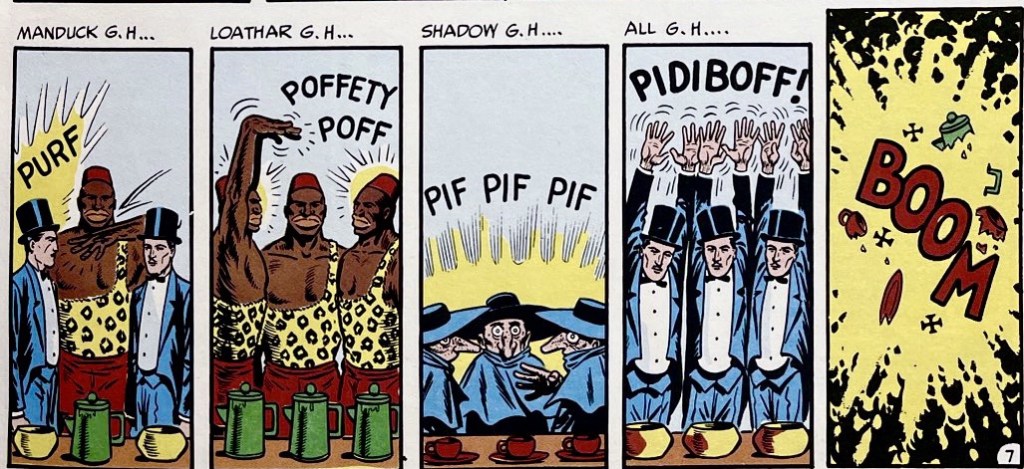
As part of his general send-up of modern popular culture in the original MAD magazine, Harvey Kurtzman took special care with his satirical takes on famous American comic strips. Most often aided by the uncanny mimicry skills of Will Elder, who seemed able to channel any cartoonist’s style, it was clear that their hearts were really in these stories. Whether it was Manduck the Magician, Little Orphan Melvin or Prince Violent, these parodies were coming out of deep familiarity of having been raised on these strips. And Kurtzman always zeroed in on the inane in pop culture as his target.

Putting Manduck into a mind-bending duel with fellow mystic The Shadow was an inspired but typical Kurtzman assault on the shallow and phoney in pop culture conventions.

Continue reading

Lance: Warren Tufts’ Beautiful…Strange America

Lance (1955-60) was Warren Tufts’ masterful exploration of mid-19th Century American expansion, and it remains among the most breathtaking uses of the newspaper comics medium in its history. Tufts, who had previously fictionalized the Gold Rush in his wonderful Casey Ruggles (1949-55), was a self-taught savant of realistic illustration and frontier history. Lance embodies some of the signature qualities of the American newspaper strip. Visually, and much like Winsor McCay, Cliff Sterrett, Frank King, Hal Foster and Alex Raymond before him, and scouted new ways of using the full-page Sunday format and especially color to evoke emotions and a sense of place. And like Chester Gould’s Dick Tracy, Percy Crosby’s Skippy and Harold Gray’s Little Orphan Annie, Tufts’ rendered a highly personal, idiosyncratic and often weird vision of America and humanity. Lance demonstrates how such individual and offbeat perspectives were still possible in the comic strip format, and could make this medium much different from other modern mass media that had become corporatized and collaborative.

Continue reading

Rip Kirby Introduces the 1950s

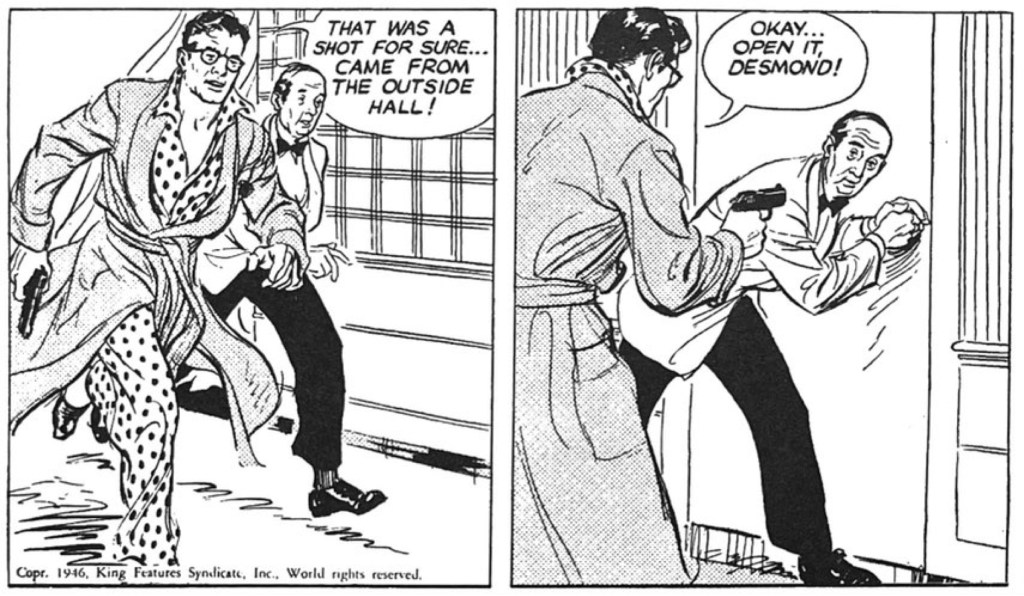
In the first days of Alex “Flash Gordon” Raymond’s post-WWII detective adventure Rip Kirby, it was clear the master was going to redefine the look of comic strip adventure. Day two of the March 1946 launch story speaks volumes about the influence Raymond was going to have on a decade of 50’s adventure style. The panel progression here is so engaging. The first two panels are energized so that you can almost feel the weight of the murder victim slump into Kirby’s arms and instantly change valence of the scene. And that final close up communicates the deadly reality of the situation by bringing us right into the complex reaction to beauty and death. The photo-realism is here, as is the increasing influence of cinematic points of view, timing, and close-ups. And arguably, the next decade would also see in comic strip adventure a turn inwards, toward psychological realism, the emotional lives of characters, that accompanied the more photographic style of the art. All of these elements would be deployed in different ways by Stan Drake in the Heart of Juliet Jones, Leonard Starr in On Stage, Warren Tufts in Casey Ruggles and Lance and John Cullen Murphy in Big Ben Bolt.

Continue reading

Casey Ruggles: Beauty and Brutality, Fact and Fantasy

Warren Tufts (1925-1982) was a self-taught artist and historian of the mid-19th Century Westward migration, and he combined both avocations into two of the most compelling and distinct adventure strips of the 1950s. In Casey Ruggles (1949-1954) and Lance (1955-1960) he brought visual and historical realism to an otherwise romanticized vision of the West that flourished in post-WWII  pop culture. In Tuft’s West of the 1840s, settlers were as often selfish, greedy, cowardly, incompetent, sadistic and capriciously violent as they were an heroic forward guard of civilization and commerce. Tufts had a mixed view of human nature that allowed all of these qualities, good and bad, to coexist in many of his characters. 

Continue reading

More than Mopsy: Gladys Parker Is Back In Fashion

Why don’t we hear more of the marvelously talented, witty, prolific American cartoonist Gladys Parker (1908-1966)? She was the mother of the long running strip and comic book character Mopsy. More than that, Parker was among the better-known cartoonists of the day, in part because she was also a fashion designer to both the general public as well as Hollywood stars. Meanwhile, Parker was a frequent item in the celebrity gossip columns of the 1940s as she dated a noted boxer and character actor. 

Why don’t we know more about Gladys Parker? Well, obviously for the same reasons we don’t know more about Nell Brinkley or Ethel Hays or Jackie Ormes, despite the high quality of their work and substantial public profile in their own day? Not only has the comics field itself been overwhelmingly male dominated, but its history has been written almost entirely by men. And yet, as I myself encounter these overlooked artists as I make my way through comics history, I am struck by their singular visions, how different their aesthetic and social perspective were from their male brethren. To miss these women in our history of the medium is to narrow our understanding of the rich creative range the comic strip reached in the last century. Brinkley used color, facial and emotional expression, line, the contours of the Sunday comics page in ways no other artist did in the 1910s and 1920s. Ormes’ racial satire was sharp and blunt at a time when American needed it desperately. And Parker brought the feminine wit of Hollywood romantic comedy into the comics page and merged the aesthetics of fashion with those of the comic strip into a drawing style that was unlike any other on the comics page.

Continue reading

Twin Earths: Matriarchy Meets Patriarchy…In 1952

Most media, cultural and certainly women’s studies historians have long understood that the post-WWII era represented a twisted nadir for the representations of women in American popular culture. During wartime, women famously took on more prominent, responsible and even strenuous roles in the workforce than ever before. And once the war ended and the male troops returned, these same women upon whom the home front depended were explicitly urged by ever quarter of American society to surrender these gains for the sake of passing these jobs back to the traditional male breadwinners. There was nothing subtle to this process either. Many women were badgered back into domesticity, often accused of “stealing” livelihoods from returning veterans. Other aspects of popular culture like the the rise of the femme fatale trope in noir and crime fiction, the ditzy blonde bombshell, the irrational, imbalanced feminine figure in thriller genre – all helped undermine the legitimacy of women taking more powerful roles in the post-war “man’s world.”

This context makes the premise of the Twin Earths sci-fi strip all the more curious and fascinating. Running from the middle of 1952 to 1963 in dailies and 1953-1958 in a separate storyline in Sundays. When the overlooked strip is remembered at all, it is for some prescient gadgetry that anticipated later everyday tech. To be sure, the writing by comic book illustrator and editor Oskar Lebeck and drawn by comics veteran Al McWilliams was often leaden and unexciting. But Twin Earths was home to some genuinely intriguing and thoughtful futurism that echoed literary science fiction. And as I make my way through the strip’s early years, it is the basic premise of Twin Earths’ divergent social organizations that is most striking. The twin Earth (Terra) is a female-dominated society where a diminishing population of males is retained mainly as idle breeders. The Terran spy Vala infiltrates our earth to ensure this male-dominated planet is not developing its technology towards destructive ends. She pairs up with FBI agent Gary Verth to avoid Communist spies and assassins from her own host planet. The banter between the two, especially Vala’s accusations of masculine aggression (an early take on male “toxicity”?) is a remarkable standout at a cultural moment when most popular culture sought to diffuse, defeat and mock women aspiring to power.

Premiere Panel: Who’s That Stowaway?

October 2, 1955 saw the first Sunday entry for a strip that had been running all week from the Chicago Tribune syndicate. Written by Gus Edson, who also had taken over legendary strip The Gumps, and drawn by former comic book cover artist Irwin Haden, Dondi follows the adventures of of a refugee orphaned by WWII.