Stereotyping The New American City

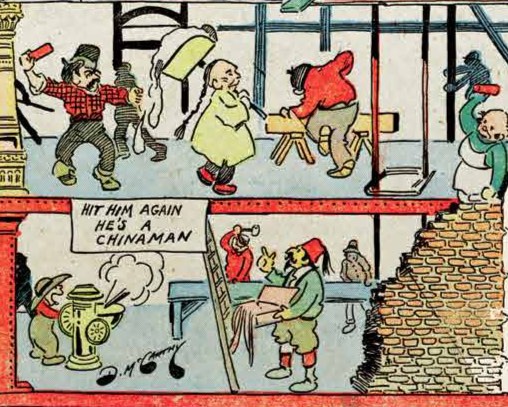
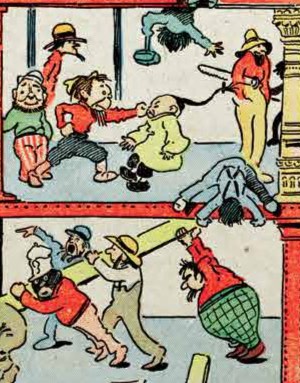
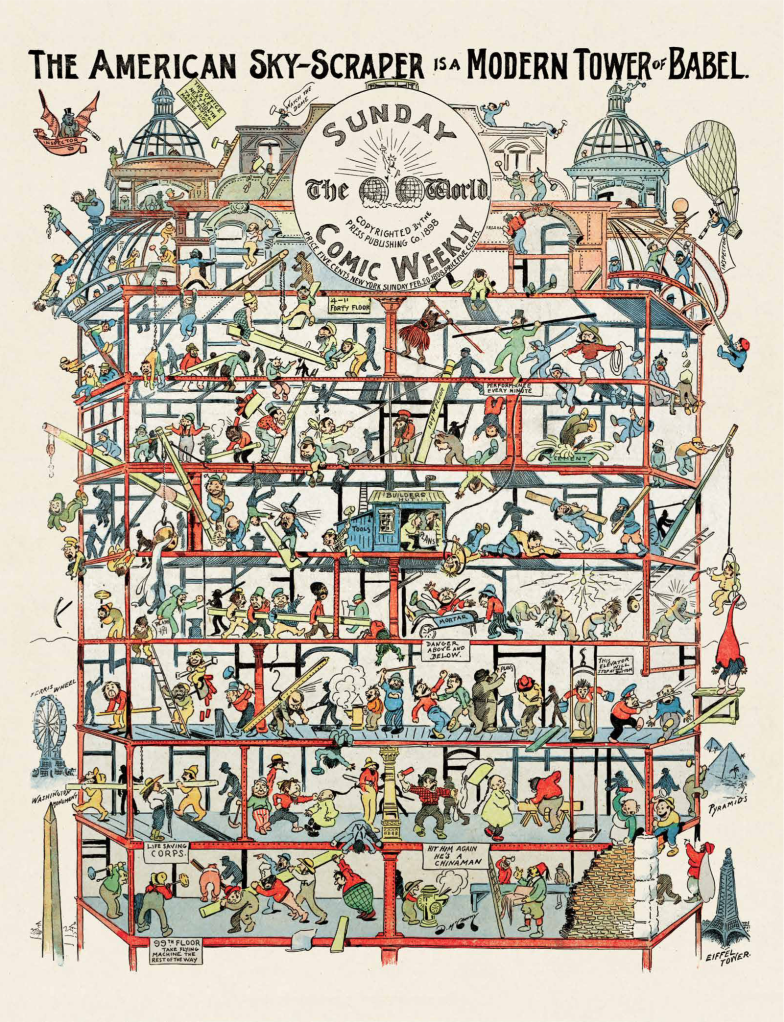
New York World staff cartoonist Dan McCarthy’s 1898 “The American Sky-Scraper Is a Modern Tower of Babel” is a trove of tropes that characterizes so much of the first decade of American newspaper comics. Like R.F. Outcault and Walt McDougall, McCarthy uses that massive Sunday newspaper page to draw a tableaux caricature of the cityscape, the new and rapidly changing environment the World readers experience each day.  

Some of the most talented and ambitious early newspaper cartoonists used the full page tableau format to capture the energy of the city. Outcault’s Hogan’s Alley was the first to use the format to depict the city scape, which is to say it was an interpretation of that new experience. Walt McDougall was another fan of the tableau to depict social landscapes, including his magnificent “Life in the City as the Countryman Sees It.”  Comic artists seemed to absorb the physical energy of turn-of-the century America and direct and shape it into popular art. Just as the slapstick, chases and fight scenes of early film were aesthetic conventions that channeled the antic energies of modern urban progress, mechanization and rapid change, so too did modern preoccupations with motion, energy, cause and effect, the urban experience shape the aesthetics of early comic art. 

Dan McCarthy 1898. McCarthy was a well-regarded caricaturist for the humor weeklies and eventually for the World. He founded a caricature school but died in the first decade of the 20th Century in his 50s. His “The American Sky-Scraper is a Modern Tower of Babel” is a caricature of urban progress seen through the lend of ethnic diversity. The panoply of so called “hyphenated American” – Italian-, Irish-, Chinese-, Eastern European-, and African-Americans – are all stereotyped here at the same time they are acknowledged as the builders of the new city. 

You can spend hours dissecting McCarthy’s depictions of individual ethnic groups here, and there are some predictable bigotries. They are mainly distinguished by their common visual stereotypes of the day. Italians with triangular hats and handlebar mustaches. Irish with chin beards and simian face. Chinese figures with yellow long shirts and thin braided pony tails. Eastern Europeans/Jews with full beards, hats and high boots. The Irish characters often seem to be ready for a fight. One African-American sports primitive dress. And for some reason the Chinese-American figures are on the receiving end of deliberate violence. But generally, this “Tower of Babel” is a tableaux of chaos, slapstick mishaps all in service of a mechanically sophisticated scientific wonder. The tension between the chaotic energy and play of McCarthy’s workers and the rigid symmetry of the structure they are building is of course the “joke” here.
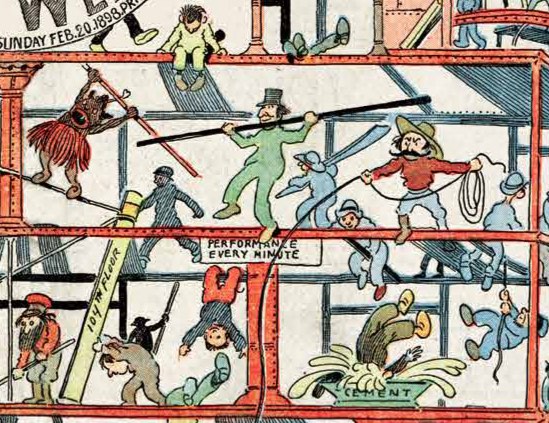
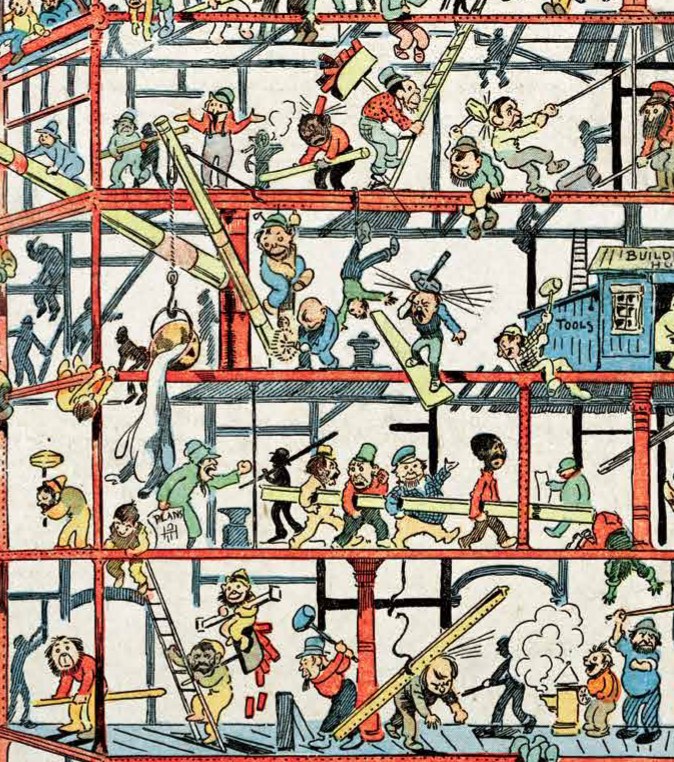
But McCarthy’s cross section of both the building itself and the New York population generally embodies the ambivalence of WASP America towards the massive waves of emigration during this era.

In other depictions of emigration, Americans seemed to greet emigrates as newcomers and fledgling Americans. It was generally acknowledged that a fast-growing and internationally ambitious America needed this infusion of cheap labor to fuel its growth. And so the stereotyping was not of the most vicious and dehumanizing sort we find elsewhere in American culture. Here it is more patronizing and imperialistic. The American middle class seemed to recognize that immigration was key to American ambitions, but patronizing stereotyping kept these emigres at a distance and always inferior.  
Great Moments: A. Mutt Meets Jeff (1908)


One of the longest lasting marriages in comic strip history began on March 27, 1908 when Bud Fisher’s wildly popular A. Mutt comic strip anti-hero meets a character who soon became his companion until the strip finally sputtered to an end in 1983.

As told by Jeffrey Lindenblatt in the NBM reprint of early strips, A.Mutt had a whirlwind start in the five months from its brilliant inception to the introduction of Jeff. Bud Fisher was a self-taught artist who talked his way onto the the San Francisco Chronicle in 1906. He worked his way up from layouts in the art department to spot illustrations around news stories to regular caricatures in the sports section. Here is where Fisher sold editors on an idea for a daily strip that would top the sports section with betting neophyte A. (Augustus) Mutt’s uninformed picks to win one of that day’s horse races. The next day’s strip would include Mutt’s winnings, losings and mood after the real world results.


A.Mutt was an instant hit, but its Chronicle run lasted only 26 days. The strip attracted the attention of no less than notorious newspaper staff raider William Randolph Hearst, whose rival San Francisco Examiner battled the Chronicle for circulation. As he had done so many times in his “Yellow” newspaper war with Joseph Pulitzer in New York a decade before, Hearst drowned Fisher in cash and the promise of national syndication to lure him to the Examiner less than a month after A.Mutt launched. Eventually Fisher would leave Hearst too for a much more lucrative syndication deal that became a model for decades of lavishly paid cartoonists.


Fisher’s final A.Mutt for the Chronicle appeared on Dec. 10, 1907, but that last iteration had one very important (and lucrative) addition – “Copyright 1907 by H.C. Fisher.” In Lindenblatt’s telling, Fisher accompanied the artwork to the printing department that day and before the printing plate was struck added that copyright note that led to his being one of the wealthiest cartoonists of his and subsequent decades. Until his death in 1953, Fisher benefited from gushers of revenue from licensing, theatrical and syndication deals that saw Mutt and Jeff on just about anything willing to pay Fisher royalties. There were a number comic strip millionaires during the golden era of newspaper circ wars, but few were as showy and press savvy about that’s wealth than Fisher.


It is under Hearst’s banner that A.Mutt moved quickly away from racing track picks, added Jeff and because a buddy strip that also introduced extended continuities. Alas, the sad anachronistic later decades of Mutt and Jeff strips obscured its earlier, genuinely witty, edgy slapstick years.

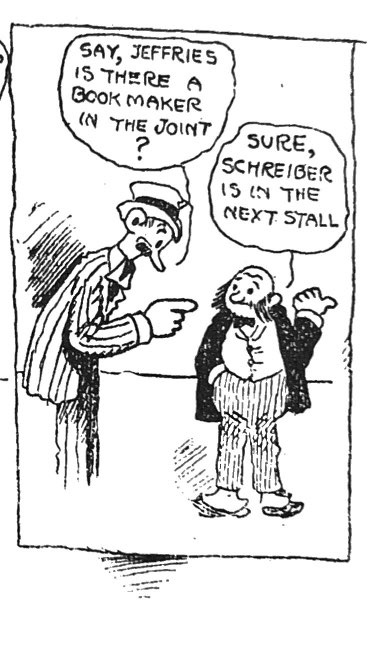
But in its early years the strip was indeed gritty. In fact, Mutt meets Jeff in an asylum, one of many incarcerations for him. This time he meets up with multiple cases of delusional inmates, including a diminutive fellow who fancies himself boxer Jeff Jeffries.

While the strip soon evolved beyond its origin as a sports cartoon, it carried with it to mainstream comics pages the sharp-tongued banter, slang, and snide irreverence that typified much of sport page cartooning. Mutt and Jeff took on politics, lampooned public figures, poked at social pomposity, and even ventured down to Mexico in the 1910s to engage with Pancho Villa.

Mutt was also among the first of a staple for the comics pages – the hapless schemer. Always looking for a buck, failing at the serial jobs he tries, the early Mutt conspires with Jeff (who is usually more flush) just to score a much-needed meal. Well evolved from the early simpletons of comics like F.O. Opper’s Happy Hooligan’ and Ed Carey’s Simon Simple, Mutt was like Harriman’s Baron Bean and Goldberg’s Boob, the American always on the make but falling short, working the angles unsuccessfully at the margins of America’s booming modern economy. The rising middle classes at whom 20th Century newspapers generally were aimed seemed to delight in the misfired ambitions of characters like Baron and Mutt, later Moon Mullins, Bobo Baxter and to some degree Andy Gump. It is a figure that extends into Laurel and Hardy, Abbott and Costello, Chester Riley and Ralph Kramden. Failed ambition is often leavened ironically with empty bravado and inflated self-confidence. It is light satire of America’s core tropes: social and economic ambition, masculinity, mobility, looking for the main chance.

The candor of Mutt and Jeff is in full display in 1918 when the duo scheme to dodge the draft.

The Original ‘Fake News’: Opper Takes Aim At Newspapers

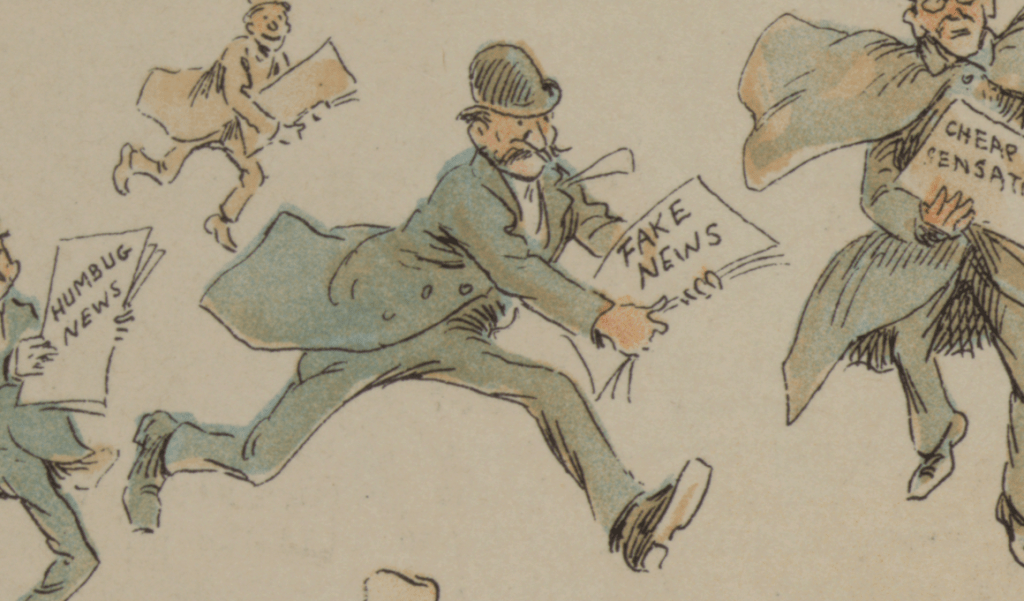
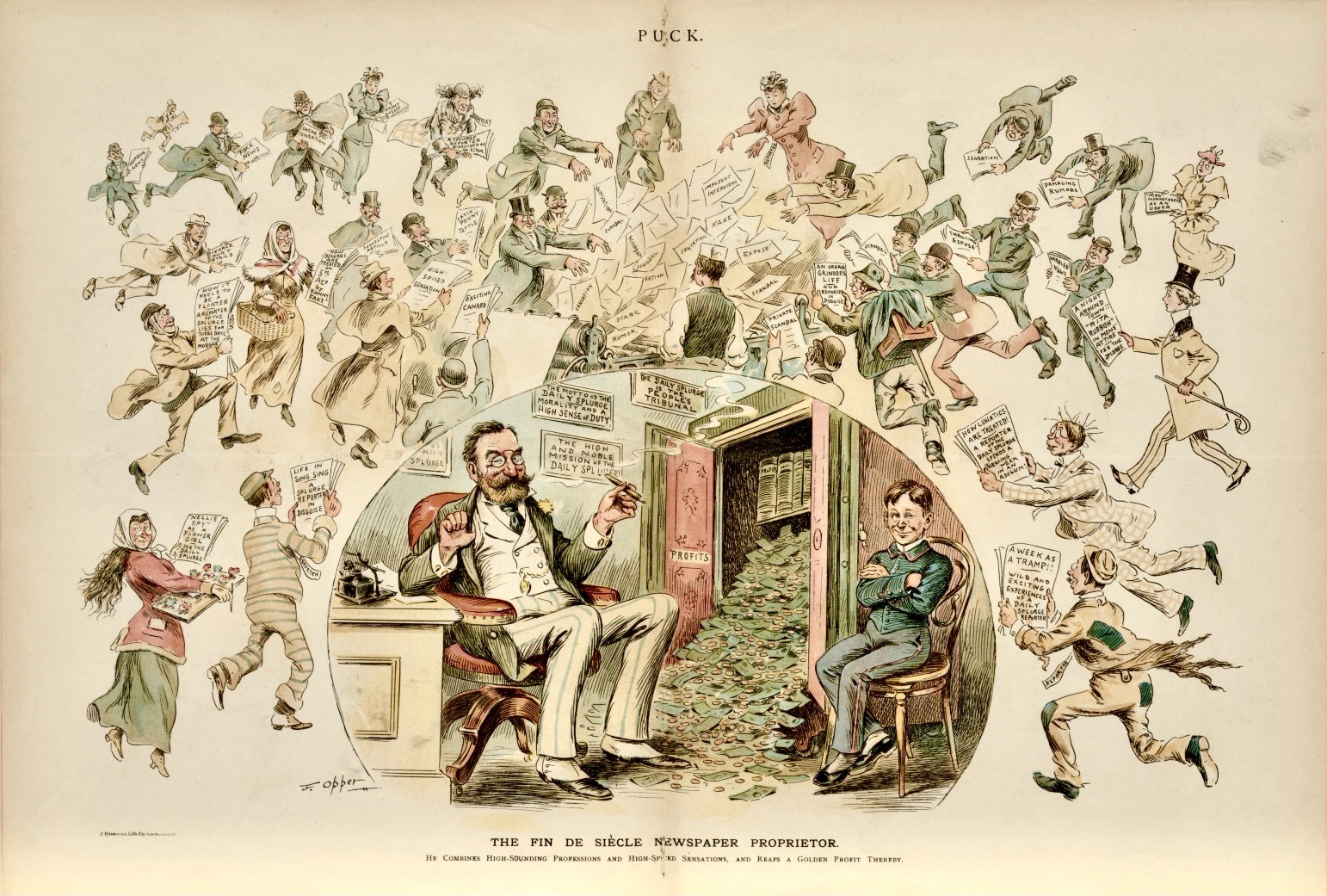
Before Frederick Burr Opper became a pioneer of early newspaper comics (Happy Hooligan) he was a critic of the medium. In this cartoon from the March 7 1894 issue of the top humor magazine of the day, Puck, Opper targets the increasingly sensational mass circulation city newspapers. While not called out by name, the caricature is clearly Joseph Pulitzer (1847-1911), publisher of the New York World. Ironically, Opper would sign on with Pultizer’s rival William Randolph Hearst and his New York Journal. In fact, Opper’s cartooning skills would be one of the main weapons in the Pulitzer/Hearst newspaper wars of the 90s.

Before the rise of newspaper comics over the next decade, cartooning was the domain of American humor magazines like Puck, Judge and others. And Opper was one of Puck‘s most popular illustrators. In many ways the rapid expansion of daily newspapers rang the death knell for the humor weeklies, so it wasn’t surprising to see them come after the dailies as “vulgar,” profiteering and sensationalist. Indeed, the newspapers were even accused of peddling “fake news,” as you can see depicted in the upper left quadrant.

Kat and Mouse: Herriman’s Creative Absurdism

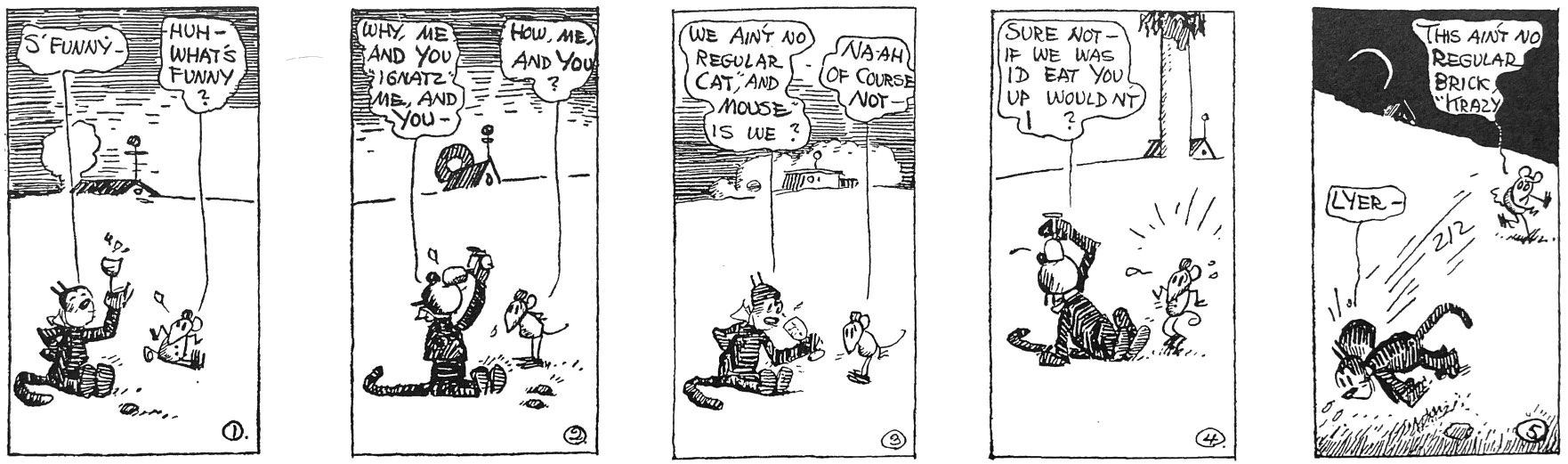
Herriman enjoyed calling attention to the absurdities of his own strip. In these dailies (1919) he also uses his signature device of changing the background landscape from panel to panel. All together Herriman is creating an absurdist space in which Krazy, Ignatz and the Coconino County cast focus on language and interpersonal dynamics.

The unique aesthetic of the comic strip is its ability to create an immersive environment through visual style, composition and character that we fall into for less than a minute a day across three or four sequential panels. Herriman used the full palette available to those panels to ground us in his characters by making the physical environment disorienting and fluid.

Krazy Kat Gender Reveal?

MAD Looks at Politicized Comics: 1969

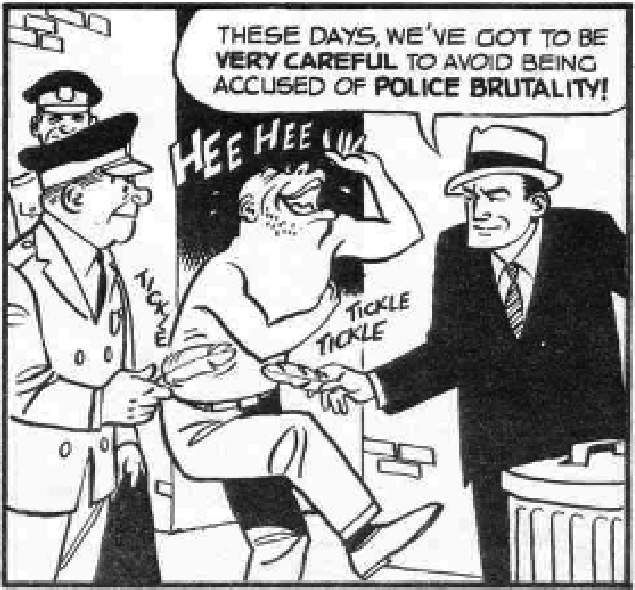
By the 1960s American newspaper comics had gained a deserved reputation as generally banal and innocuous pop culture, prime targets for satire. In April 1969 MAD Magazine took aim at the generally apolitical nature of most strips by imagining a world where comic strips actually reflected their culture. With art by Bob Clarke and script by Frank Ridgeway, “If Comic Strips Covered the Issues of the Day” has Superman coping with air pollution, Dick Tracy adapting to police brutality concerns and Mandrake the Magician’s already-racist depiction of his assistant Lothar turned into an even more troubling notion of Black American fantasies.

Bobo Baxter: Rube Goldberg’s Bleak Screwball

Rube Goldberg (1883-1970) is best remembered for his cartoon inventions, ridiculously intricate mechanical solutions for common activities. These send-ups of modern technology and the romance of engineering appeared under multiple titles and formats across his career, but took most regular form in Collier’s Weekly between 1929 and 1931 as The Inventions of Professor Lucifer Gorgonzola Butts, A.K. His Foolish Question panels ran from the teens in various forms for decades. And his best-known continuous character strip of hapless failure Boob McNutt ran for more than a decade in the 1920a.

But it is in his forgotten small masterpiece Bobo Baxter (1927-1928() that I think we see Goldberg’s array of talents for satirizing the modern world come together into a persistent and satisfying whole. And at the same time Bobo shows how a sad note of alienation often lurks beneath the surface of many slapstick characters.

As godfather of comics historians Bill Blackbeard points pout in the intro to a 1970s reprint of the complete (Hyperion Press, 1977) run of strips, Bobo Baxter represented Goldberg moving (or being forced by trends) away from the gag-a-day format to the continuous characters and situations of other 20s strips like Little Orphan Annie, Bringing Up Father, The Gumps, Polly and Her Pals, etc. He had already made his Boob McNutt Sunday strip into a major hit by introducing recurring characters and continuing storylines. In 1927 he sent the form into a daily new creation, Bobo Baxter. 

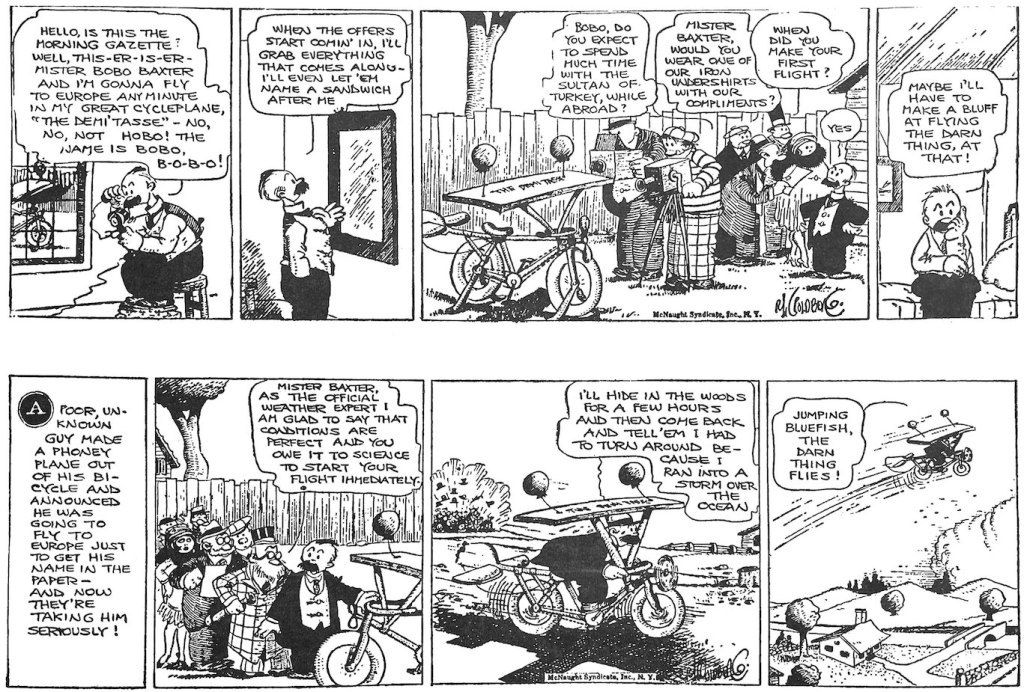
We meet Bobo as an unsuccessful dreamer, envious of the fame and fortune of well-publicized explorers like Admiral Byrd and aviator Charles Lindbergh. So he builds a flying machine out of a two-seater bicycle, prop,  wing and some balloons. He seems as surprised as anyone that it flies, and he dubs the contraption “The Demi’Tasse”, bound for glory by flying across the Canadian border.

Bobo’s fixation on fame, celebrity and the press course through the strip. He is forever courting journalists and dreaming for the headlines he thinks his oddball journey will merit.

The discipline of storyline and continuity seemed to inspire Goldberg’s satiric sensibilities. In many ways the story becomes a picaresque journey through modern American social types and institutions – all of from which Bobo himself seems woefully alienated. 

Bobo himself is pathetically friendless, and a bit of a comic nebbish. At one point early in the strip he mistakenly reserves a table for his entourage at  the pricey Cafe Du high Hat. When Bobo can’t recruit anyone to come with him, he ends up animating a group of mannequins. 

Likewise, Bobo spends the first months of the strip simply in search of a passenger to bring with him. But it is the haplessness of Bobo’s plan that brings him into contact with a pastiche of American types. There is the desperate henpecked husband who would do anything to escape his onerous wife. There is the jewelry thief who is looking to escape with a pilfered pearl necklace. And there is Bobo’s own assistant Nosedive Kelly who is both too obese and anxious to make the flight but proves to be a self-promoting braggart.

Bobo’s encounters with a cast of American characters produces some wonderful moments where Goldberg’s native visual silliness, satiric eye, and critique of mechanisms both technical and social merge beautifully. Among my favorite moments comes when a Nosedive goes for an insurance checkup. “Your blood pressure is 5 pounds over the legal limit,” “Your ears a very badly designed” and “the hinges of your backbone squeak” he is told.

This is prime Rube. “Goldberg is a satirist not of fads and fanciest of rationality,” wrote Gerald W. Johnson in his 1958 review of political cartooning between the World Wars. 

The hapless comic outsider is a feature of modern comedy that deserves further thought. We see this anti-hero (and it is almost always male) in vaudeville, certainly the silent film clowns and in comic duos like Laurel and Hardy, Abbott and Costello.

But the comic strip turns the figure into a genre. Consider Happy Hooligan, Simon Simple, Moon Mullins, Jiggs, Andy Gump, A. Mutt, Baron Bean, Boob McNutt, among others.

In fact for the first two years of Goldberg’s Boob McN tut, each Sunday strip finds Boob trying to off himself 

In his recent, indispensable history of screwball comics, Paul Tumey characterizes Boob McNutt’s early years as black humor that reflected the post-WWI disillusionment of 20s America.

Maybe. I am more inclined to put Boob’s suicidal comedy and Bobo’s desperation for modern celebrity part of a longer tradition of modern comedy and especially the comic strip – the alienated clown. So many of the comic strip’s comedy fops feel themselves somehow on the curb as the great parade of American life goes by.

Indeed it is arguable that the comic strip itself carves this curbside role for us. On a daily basis, we are invited to look over the shoulder of Jiggs, Happy, Boob, Barney, Jeff, Popeye, Abner, et.al at a main cast of characters of which we are bemused – part of but slightly apart from.

In future posts I hope to explore further this idea that the daily comic strip often created for us a light satire of modern American life and styles, types and trends that registered and leveraged a sense of middle class alienation from the very world they were creating.