
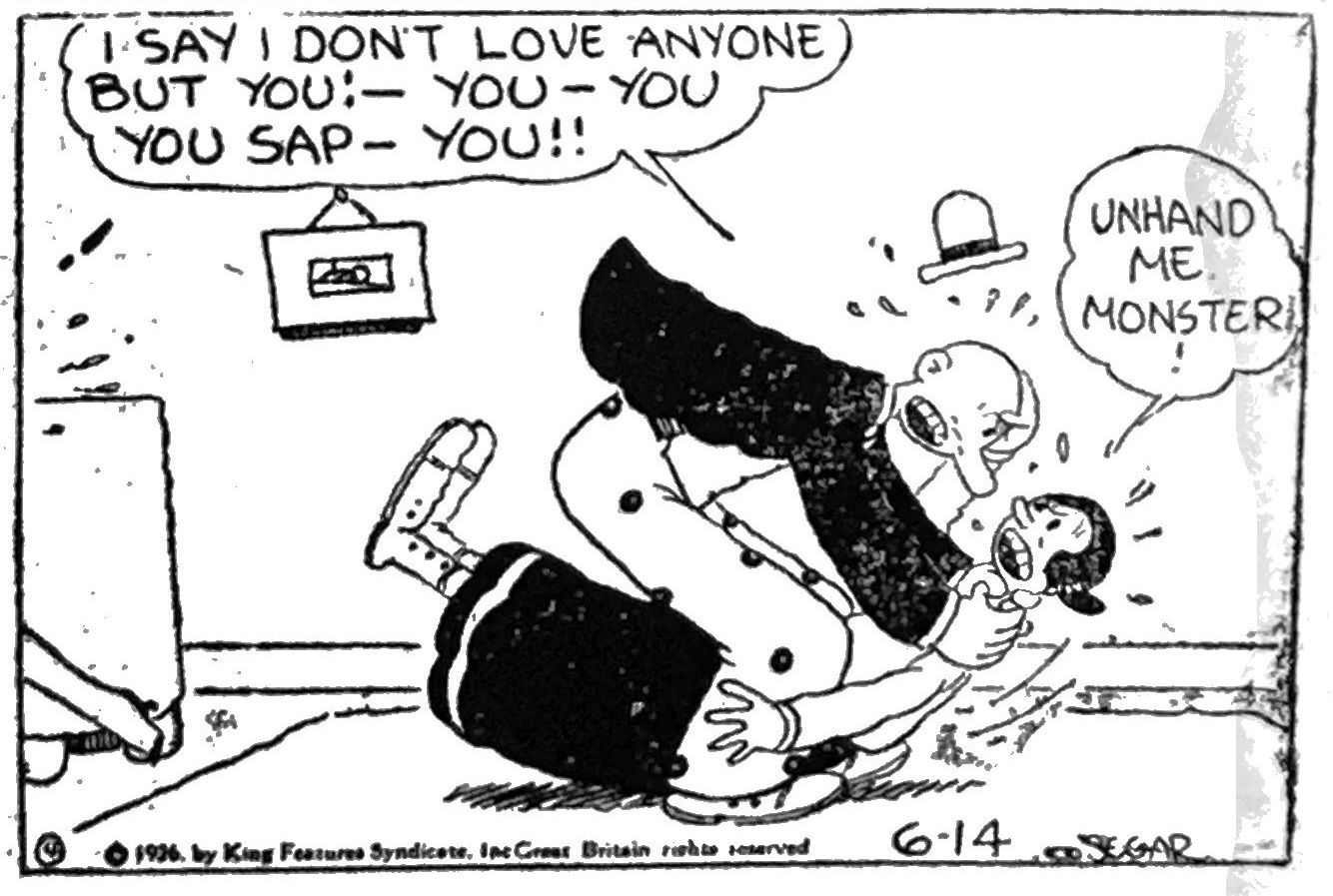
Popeye’s impact on E.C. Segar’s Thimble Theatre in 1929 was so enormous that the previous decade of the strip’s life soon became a footnote to comics history. But, of course, Segar’s legendary storytelling skills in sagas like Plunder Island and the Popeye’s Ark/Spinachova cycle did not spring spontaneously from any newfound talent. He spent the previous decade developing a unique comic voice. Until now, the only deep dive into Pre-Popeye Thimble Theatre came from the beautiful, oversized, pricey collection from Sunday Press that collected select color Sundays across the1920s. But two new reprints of extended daily runs now let us zoom into the maturation of this singular American humorist through extended runs of the dailies. Thimble Theatre, The Complete Dailies, 1919-1920 (Boring Comics) initiates a multi-volume reprint project of all pre-Popeye strips from Library of American Comics veteran Kurtis Findlay. And Thimble Theatre: “The Saga of Cylinda Oyl” Vol. 1, which covers April 22, 1926-Jan. 19, 1927) starts three-volume coverage of a major story, which comes to us from filmmaker Frank Tovar.
Part of the legend of E.C. Segar is that his strip extended both rich traditions of American humor, folk and working class culture as well as more modern vaudeville and silent film forms. Both reprint books reiterate this background, but Tovar’s intro to the Cylinda Oyl episode is the more substantial. As he tells it, the Chester, Illinois into which Elzie Crisler Segar was born in 1894 was a mix of trades, coal mining, saloons, traveling entertainments, some working-class resentments, and a lot of rough and tumble joking. His father Amzi, a painter and paper hanger, was known in Chester for entertaining customers and writing satiric letters to the local newspaper. Deadpan irony, tall tale exaggeration, and edgy banter were all key elements in an American style of humor that permeated all aspects of Midwest small town life. Elzie was not only immersed in these 19th Century traditions but he fully embraced the emerging forms. He worked multiple jobs for the local opera house that hosted film, lectures, vaudeville: as a drummer accompanist for its silent movies, a poster-hanger, and a street artist/promoter.
Upon becaming a cartoonist, then, it wasn’t surprising that his earliest work drafted off of those worlds, including a Charlie Chaplin strip and others that lampooned stage and screen. The first episodes of Thimble Theatre were straight send-ups of film melodrama. A recurring cast featuring Olive Oyl and Harold Hamgravy acted out a ten-panel version of a short film. While the “Now Showing” frame remained atop each daily, the strip quickly evolved into a gag-a-day format involving Ham, Olive, her brother Castor and parents.
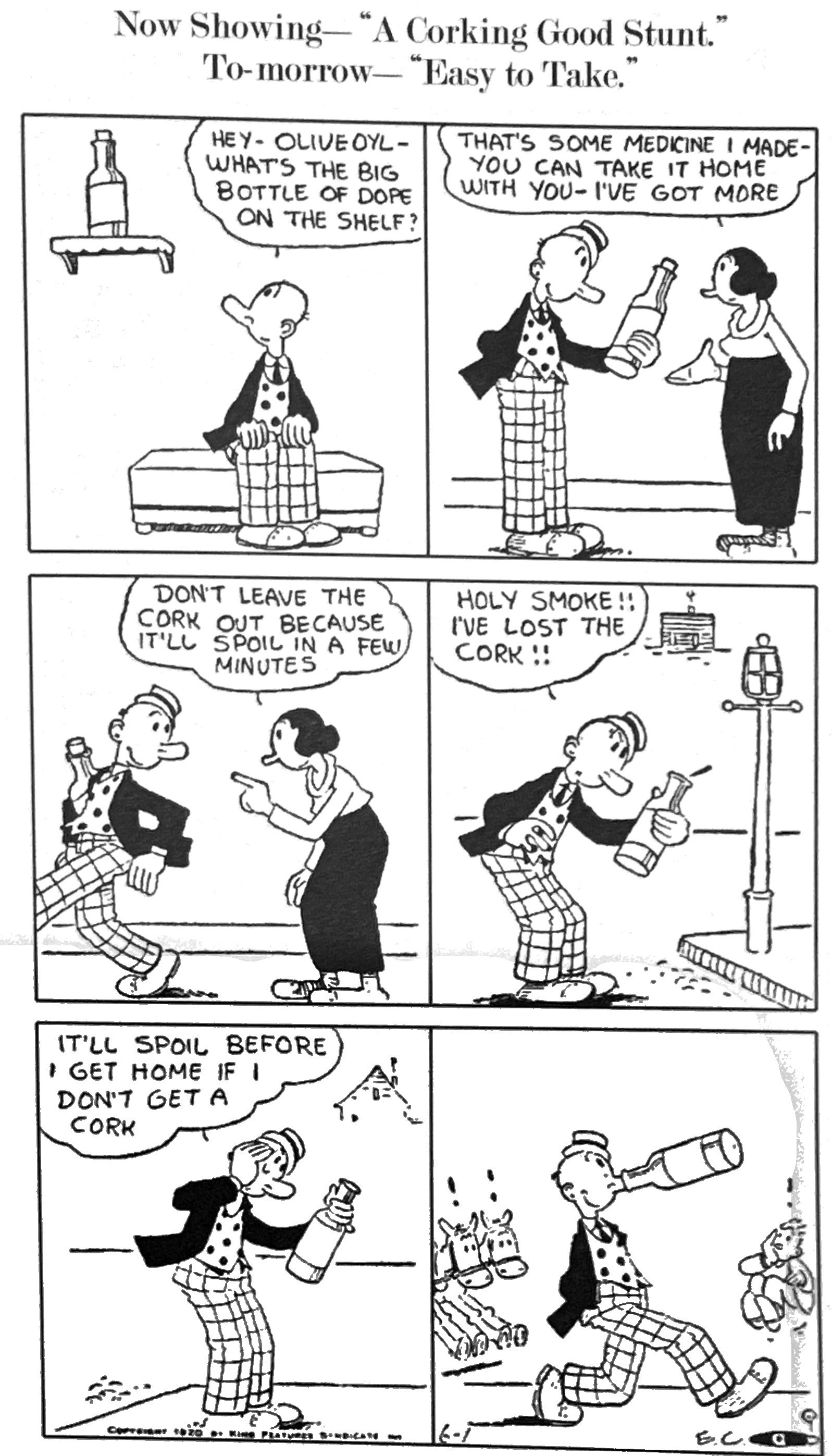
It should be noted that in his reprint of 1919-1920 strips editor and restorer Kurtis Findlay did an excellent job bringing out the fineness and detail in Segar’s line. A lot of Thimble Theatre reproductions rely on gloopy source material that make his art seem less careful and polished than it actually was. I don’t think that anyone will accuse Segar of being the most adept draughtsman. But smaller details and his slapstick sense of motion often mattered in his visual comedy. Keeping the image and the pen line thin and clean, as Findlay does very well, lets the strip’s antic energy come through unimpeded.
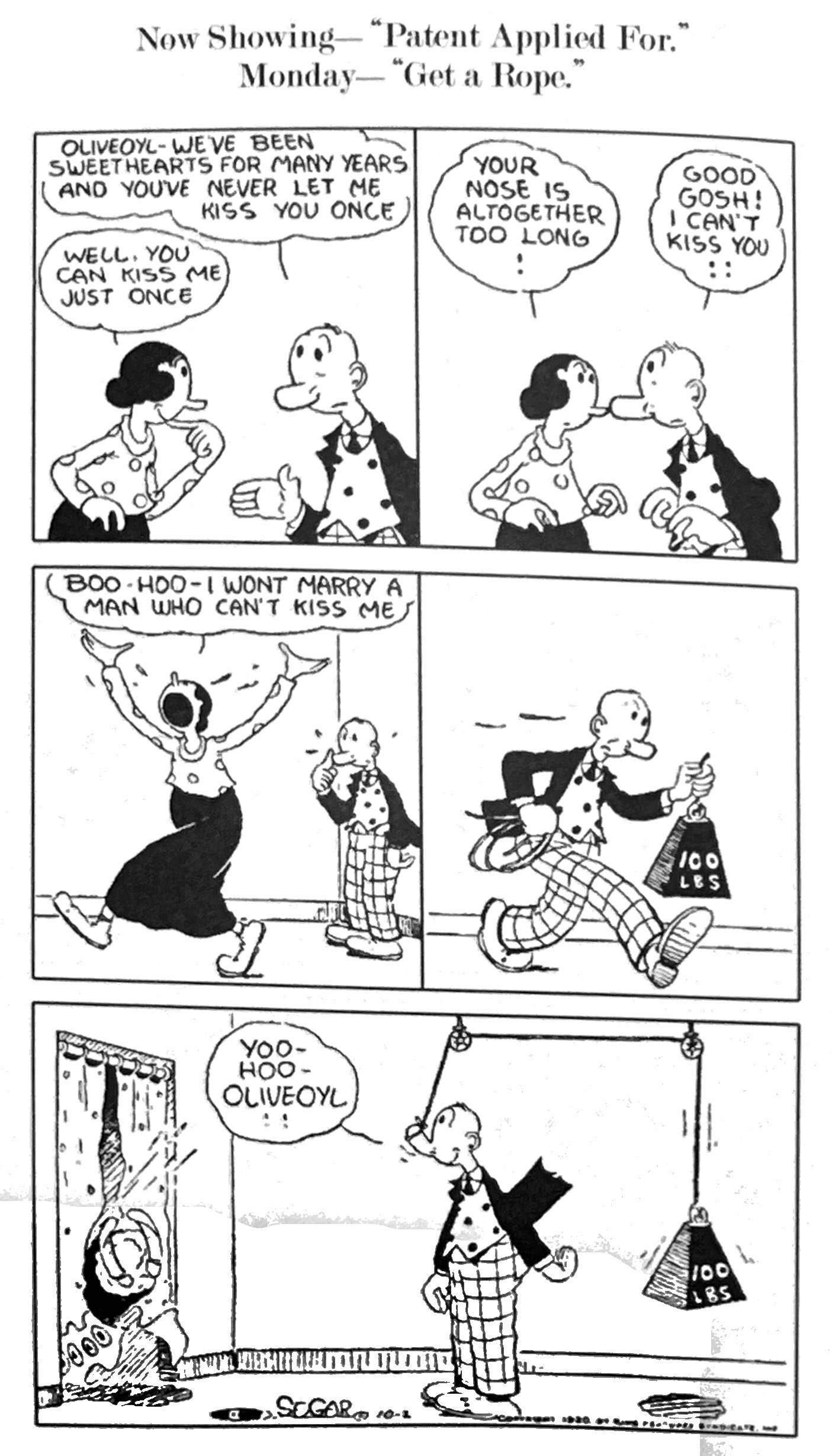
As much as one might like to pretend to see the seeds of future genius in this first year of strips, honestly, much of it is mildly interesting vaudeville banter or occasional absurdist sight gags. Segar’s offbeat sense of timing and novel use of panel framing were yet to come. But from the beginning, he had a firm grasp of silliness. His outlandish final panels, like Ham counterweighting his protruding nose so Olive can kiss him, or him using that same nose to double as a bottle cork, echo Bud Fisher and Mutt and Jeff. He was good at the inane visual solution to a problem, very much anticipating Ernie Bushmiller.
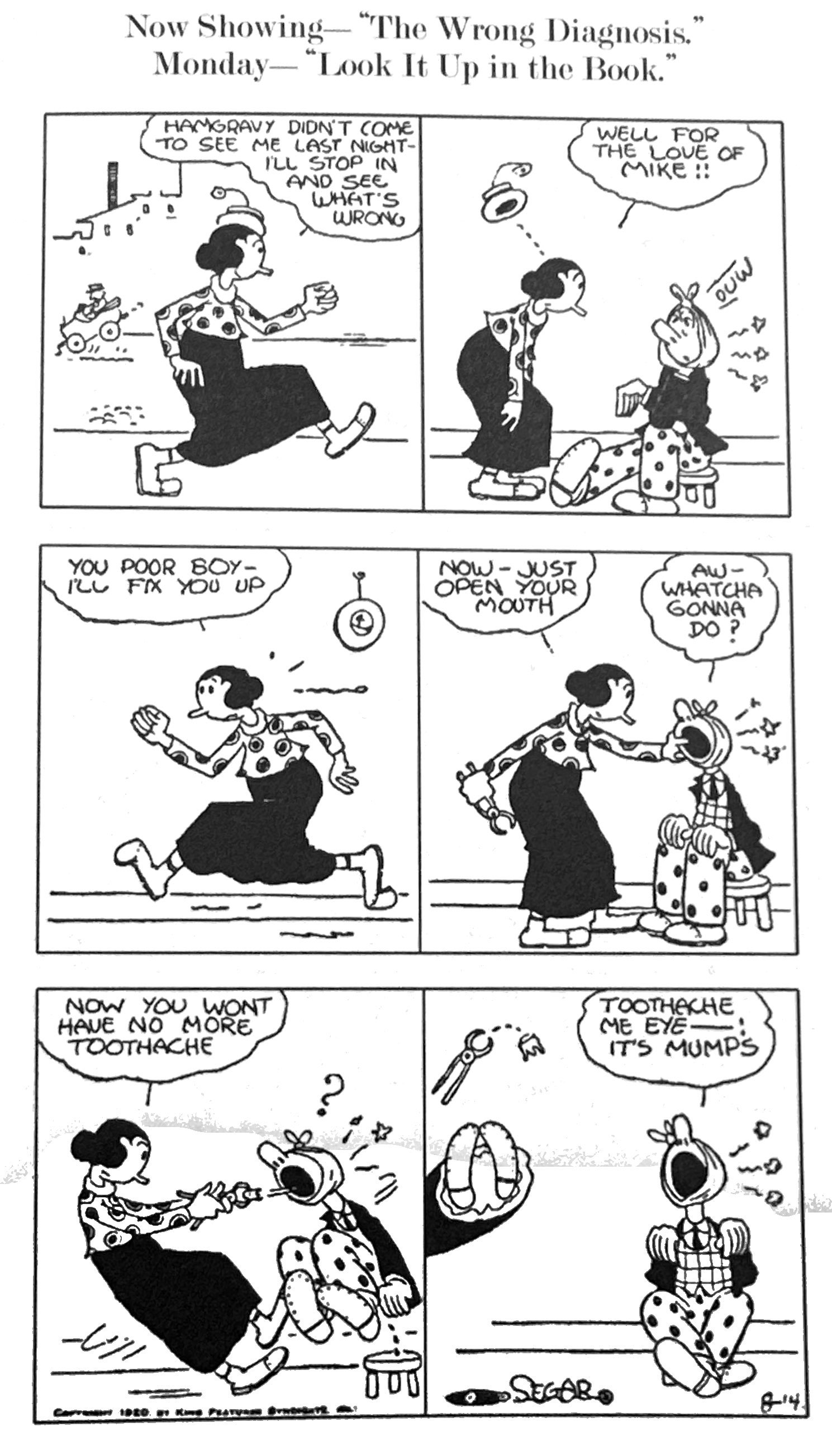
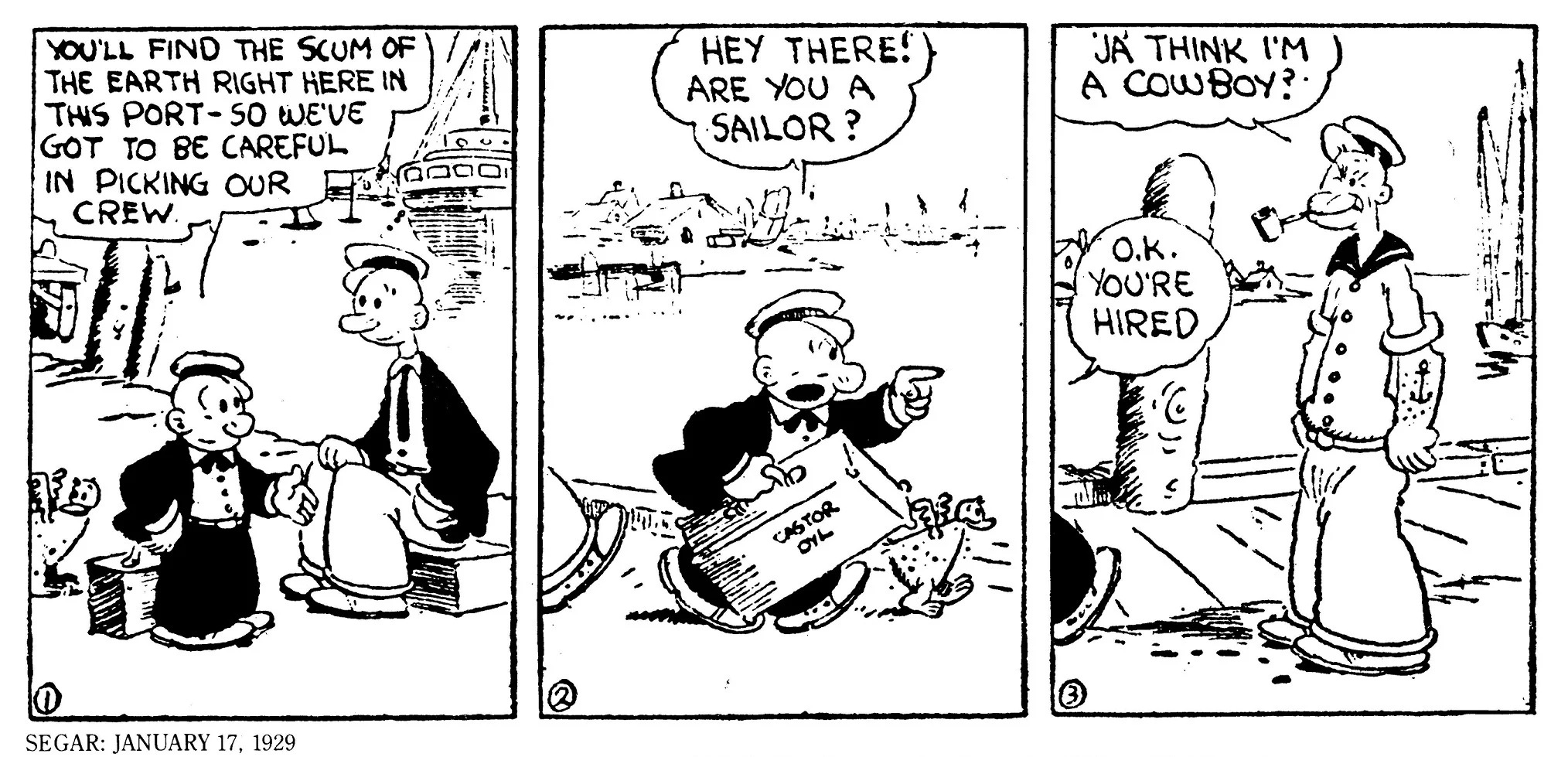
We do see Segar developing his cast into genuine characters. Castor is relentlessly on the make with new schemes for fast fortunes. Ham is hapless and forlorn. Olive is demanding, self-important, insulting and frequently violent. The caustic relationship among the characters is also developing here. By the time Popeye comes into the Oyl’s world in 1929, Castor, Ham and Olive can often seem selfish and unlikeable. In many respects, the Sailor Man helped catapult Segar’s strip to a higher creative plane, and popularity, by anchoring it with a two-fisted, imperfect moralist. The Thimble theatre cast seemed in dire need of a referee.
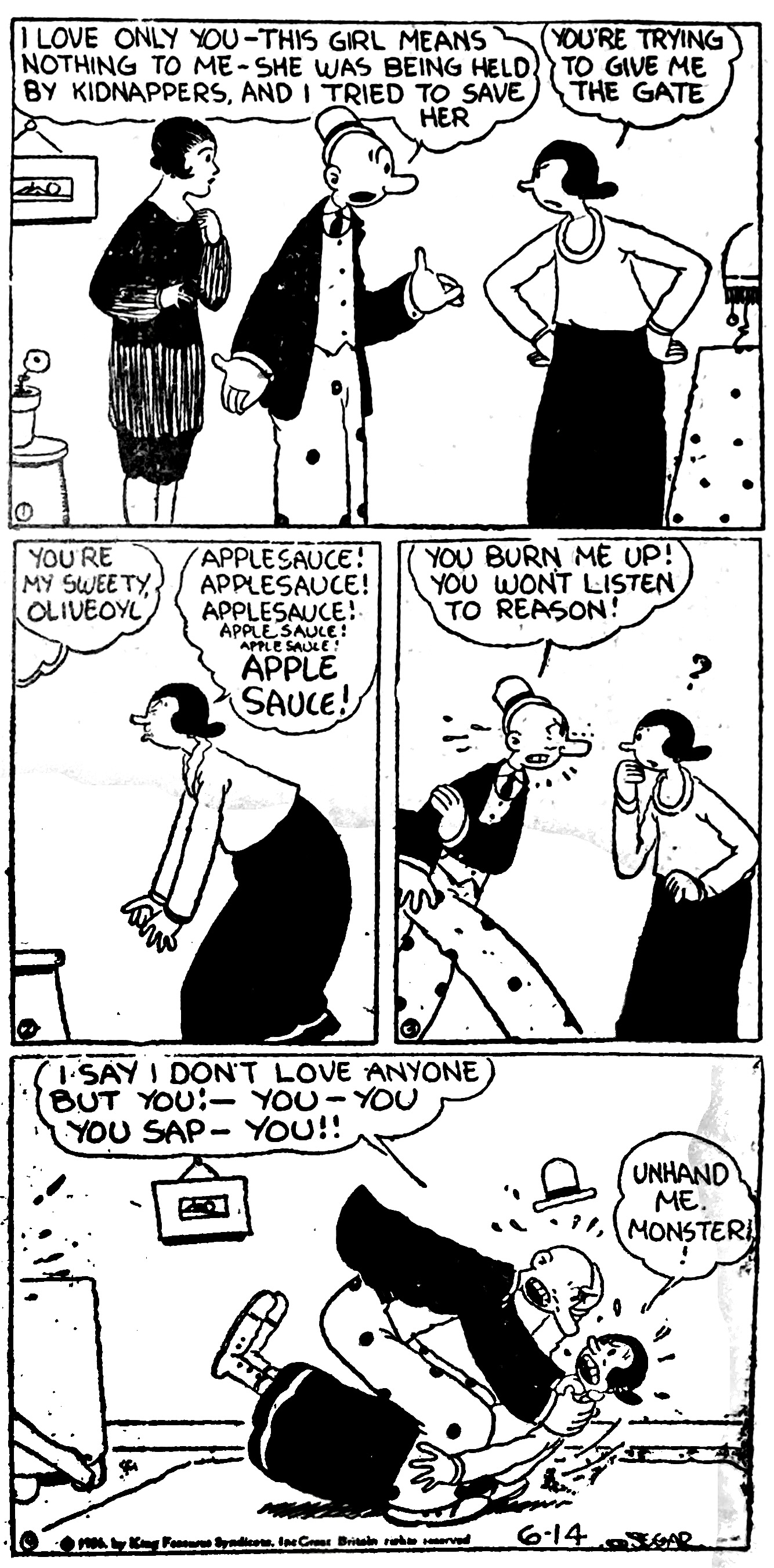
In the immediate run-up to Popeye’s arrival, some of that later blend of sentiment, moralism and venality starts evolving, especially in the Cylinda Oyl story Tovar rightly singles out. By 1926, Segar had already introduced the longer continuities that were in vogue among other comedy strips. And he wove into them convoluted twists, bizarre coincidences and richer characterization. In this sequence, Ham Gravy happens upon a kidnapped, amnesiac woman in the woods. But before her wealthy father, Mr. Lotts, can pay ransom, the loss drives him temporarily insane and to an asylum. After Castor Oyl rescues Ham and the woman, Mrs. Oyl takes the girl in, sparking Olive’s jealousy and a rivalry between Ham and Castor. Castor eventually wins Cylinda’s hand, and she becomes Mrs. Oyl. Meanwhile, in a parallel storyline, M. Lotts returns to sanity and hunts for his lost daughter. After several zany coincidences and twists, Lotts rediscovers his daughter, whose memory returns. Rather than resolution, this only begins Mr. Lotts’ hateful campaign to rid the commoner Castor from his and Cylinda’s lives.
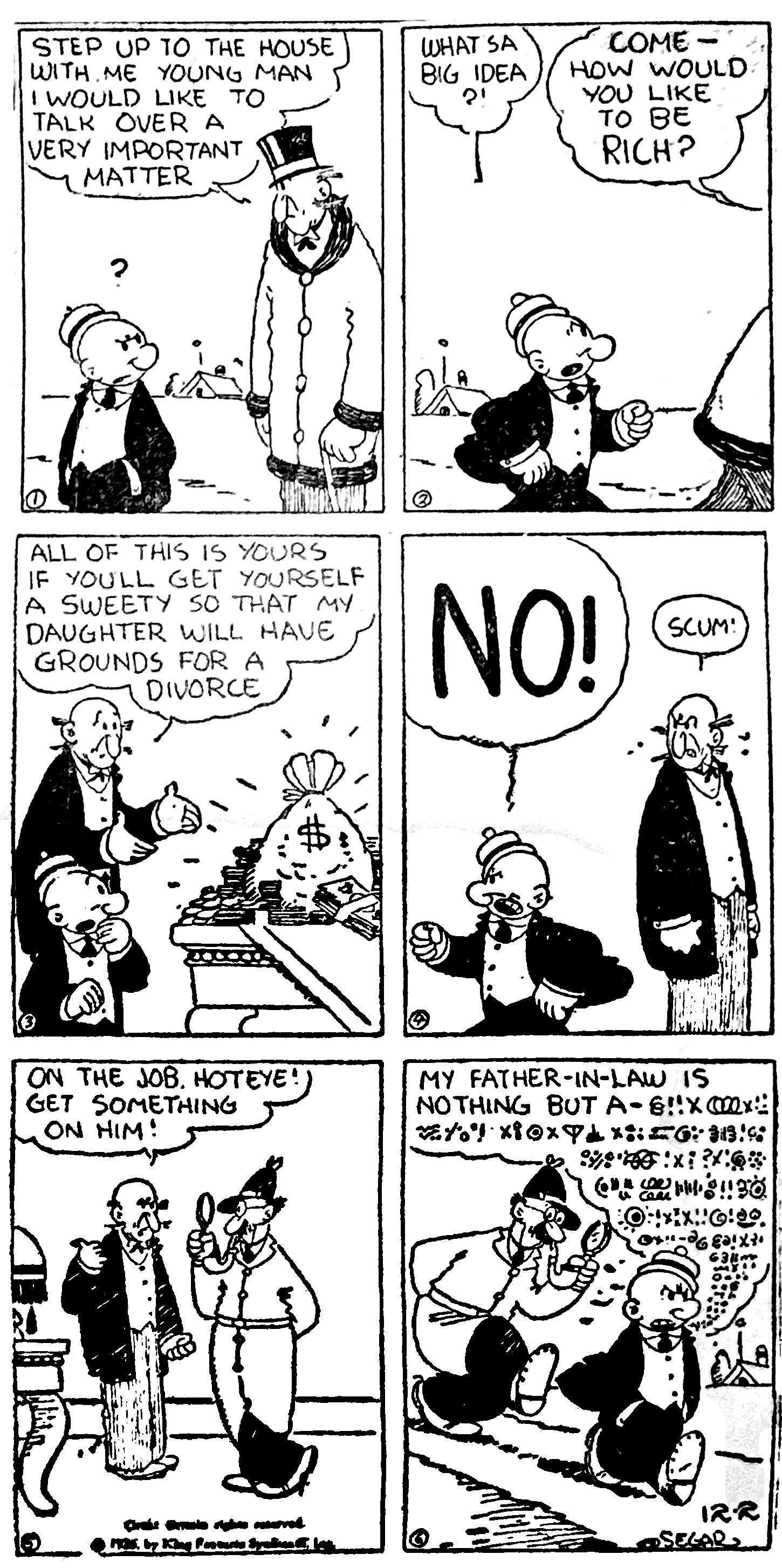
To be sure, the Cylinda Oyl episode shows Segar honing his skills for integrating farce, Dickensian coincidence, and burlesque characterizations into a wild but compelling continuity. For that alone, this arc has historic value. But we can also see the artist starting to work the panel frame and progressions with that signature, offbeat cadence that made the Popeye years unique. Segar created an odd space with his narrow panels where he often isolated a figure reacting to action outside of the frame. Absent, “off-stage” characters will speak into a panel that another character occupies alone. Small bits of arms and legs of exiting figures appear along the panel edge. And then in a final wider panel Segar brings these previously secluded figures back together to dramatize the gag or social tension. He creates a strange cartoon stage that is somewhere between the full proscenium of theatre and cross-cutting and tight framing of cinema.
And if there is such a thing as a “deadpan” cartoon posture, Segar was perfecting it. While slapstick informed the very early strips, and the Popeye years were famous for eccentric Sunday fight scenes, many of his dailies by the end of the 20s deploy a weird stillness. His figures often seem just to hang in space, inanimate and weighed down by their limbs. Across a strip these figures maintain the same inert pose as they talk or respond. To me, the evolved Thimble Theatre we begin to see in this reprint, was unique for its odd combination of staging, cadence, off-panel action…and inaction. Segar establishes visually a wry, deadpan tone all his own.
But as Tovar wisely argues in his thoughtful introduction, the “Saga of Cylinda Oyl” most importantly shows the storyteller developing an emotional nuance and complexity to his characters. “Segar’s characters might seemingly start off as comic exaggerations or types, but gradually they reveal recognizable fears, affections, insecurities, vanities, and stubborn dignities,” he observes. Castor is genuinely tender and protective towards Cylinda. Olive is petty and jealous but occasionally compassionate. Even the conniving, imperious moneybags Mr. Lotts ratchets through a range of feelings as he tries to control his daughter. Segar’s character-within-caricature approach to his cast helped make the Popeye years so rich. Remember, even the Sea Hag falls in love. Alice the Goon quickly turns from violent adversary to sympathetic mother figure. And the Sailor Man himself is remarkably self-deprecating and self-doubting, which stood in contrast to the pulp-inspired flawless proto-Supermen – Buck, Flash, Phantom, etc.
This return to the pre-Popeye Thimble Theatre helps surface an overlooked aspect of 20th Century American comics, their debt to earlier traditions of American humor. Segar’s ties to cinema and vaudeville are overt, of course. But his sense of rough and tumble humor, imperfect, conniving anti-heroes, class conflict and fabulism are more informed by Davy Crockett, Rip Van Winkle, Sut Lovingood, Paul Bunyan, Huck Finn. His love of supernatural animal characters (The Whiffle Bird, Eugene the Jeep) echo the mythical animals that trappers and lumberjacks wove into folk myth. Like many in his generation of cartoonists, especially the Mid-westerners, Segar would have been raised on these tales through the joke books, traveling theatres, and humor pamphlets that were the stuff even of late 19th Century childhood.
As well, the anti-heroes of American humor were generally folks on the social margins, who, like Castor and Ham, would rather scheme their way into fortune than get a job. In this, the cast of Thimble Theatre were not alone in the 1920s. Barney Google, Moon Mullins, even George Bungle were in this mold. This to me is an important point about comic strips as part of a larger cultural conversation. While the “Jazz Age” is often characterized by F. Scott Fitzgerald’s “sheiks and flappers” or even Sinclair Lewis’s booming middle-class Main Street and Babbit, the comics pages were among the few places in 20s culture that featured marginal men scrambling to get by or looking for that “big chance.” In Thimble Theatre’s Cylinda Oyl saga, the repulsion of wealthy Mr. Lotts towards son-in-law Castor makes explicit a class consciousness that often resides beneath the surface of many 20s strips. The comic worlds that Moon, Barney, Mutt and Jeff occupied were also edgier than even the domestic sitcom world of boasting, chiding and nagging (The Gumps, Gasoline Alley, Mr. and Mrs.). They had tough skin. They traded in rough talk. But often they exposed big hearts when you didn’t expect it. It makes perfect sense that Popeye would emerge out of this world Segar was crafting. He was a modern version of an American archetypical frontier hero: violent and naturally moral, barely literate but reflective, impatient with pretense and empathetic to the vulnerable. These were all qualities that resonated for Depression America: its unfocused rage, its class consciousness, its longing for an organic morality grounded in a national character that preceded this mess modernity had wrought. Segar may have tripped upon it, but somehow he crafted a hero for his time.
Discover more from Panels & Prose
Subscribe to get the latest posts sent to your email.

