
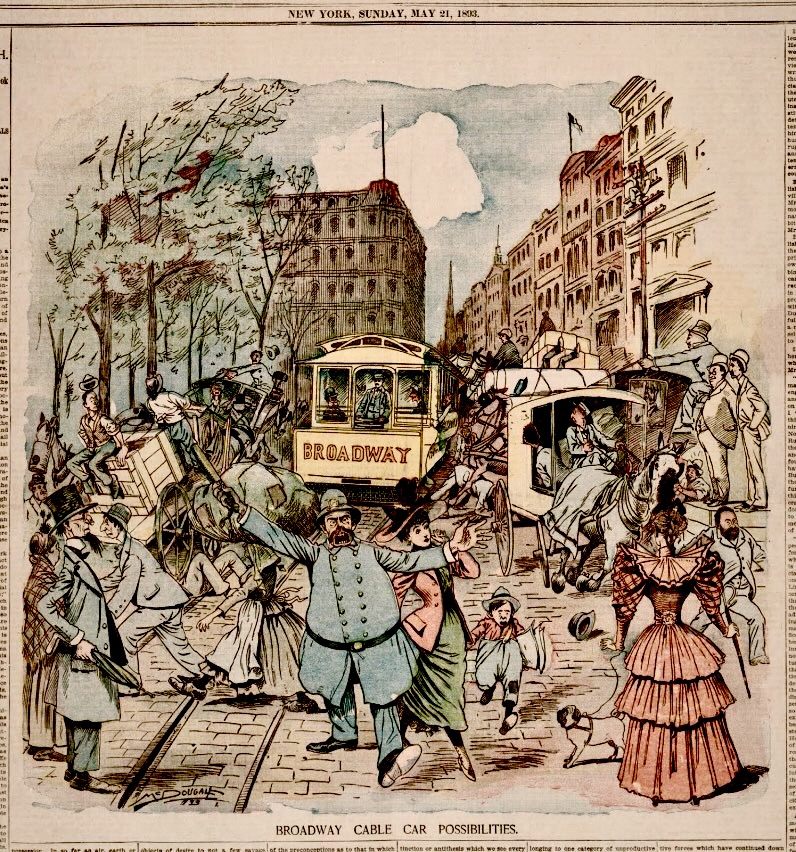
This Walt McDougall comic should be more famous than it seems to be. On May 21, 1893, Joseph Pulitzer’s New York World published the first true color comics supplement of the modern era.1 It was a landmark effort that soon placed cartooning at the center of newspaper circulation wars and sparked a new mass medium. It is beyond me why this inaugural comic supplement cover is not more widely studied. McDougall’s “Broadway Cable Car Possibilities” was more than an historical marker. It carries within it, much of what made newspaper comics so appealing so quickly.
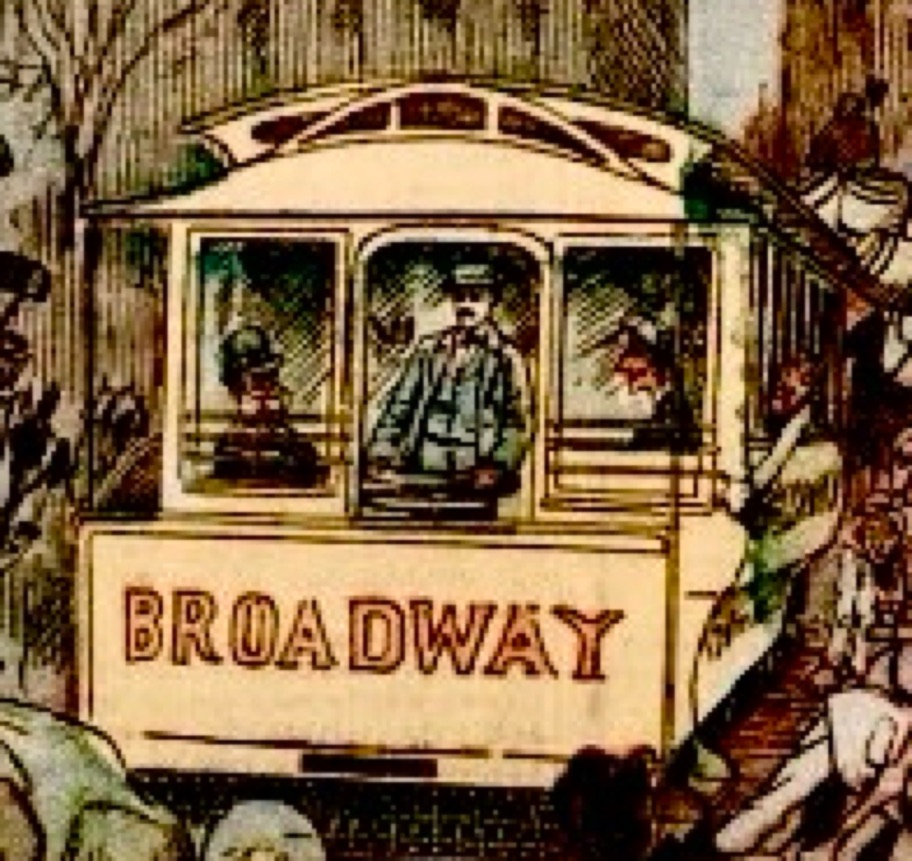
This color, full-page cartoon announced the immersive power of the new medium as well as its dominant themes. Street-level mayhem and slapstick, urban social types, foppish authority figures, machinery gone awry – soon became mainstays of the Sunday Supplement’s first decade. The comic strip version of modern American life had launched.
The new urban experience would be central to the medium’s early years, and I believe it helped drive its quick popularity. For 1890s New Yorkers, the press of the new city was as exciting and hopeful as it was disorienting and anxious. America was becoming an urban nation, as 15 million people moved into cities between 1880 and 1900, and the number of places with more than 100,000 people grew from 12 to 38. Chicago had 1.7 million people by the turn of the new century, while New York boomed to 3.4 million, many of whom came from the great emigration of Southern Europeans. In fact, most famously, the Irish ghetto in Manhattan, where R.F. Outcault’s fictional Hogan’s Alley appeared to live, was the most densely populated square mile on the planet.
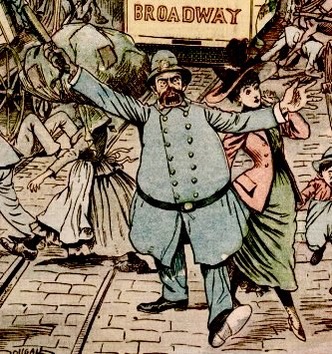
The massive, immediate popularity of newspaper comics can be explained in part by how its unique approach to cartooning made this pressing new reality of life graspable, decipherable, manageable. There are so many ways that McDougall does this intuitively in “Broadway Cable Car Possibilities.” Consider just the intimacy of the composition, that it is thrusting out of the page and to the reader. Unlike the comics in conventional humor magazine, the reader is not looking at the comic so much as the comic is looking at them, just as the action is moving towards them. Like Outcault’s later Yellow Kid, McDougall’s hapless cop meets your gaze and appears to be barking at you. The famous intimacy of the newspaper strip, its personal connection to readers, is suggested from the very beginning. And, of course, the cop is comical – a bell-shaped, splay-footed, bloviator trying to manage chaos. He is the flailing, ineffectual, official response to the anarchic force of a city careening towards him. The famously anti-authoritarian comedy of the first decades of the medium were established in its inaugural image.
But it is in McDougall’s vibrant transformation of urban chaos into slapstick ballet that we find early newspaper comics find its deeper power. The city trolley car was already a mixed symbol of American progress for newspaper readers, as the sensational dailies shouted regularly about gruesome street accidents, run-ins with horses and pedestrians, and frequent lawsuits against the city. The trolley-chasing civil lawyer was a common joke. McDougall himself drew a satire of the craze in a later Sunday. But here he demonstrates how subsequent cartoonists interpreted the city’s antic energy and dangers in ways no other popular art had achieved. Unharmed and unphased, the Broadway car barrels through a cluster of horsedrawn movers, vendors and carriages that seem to be more frantic than endangered.
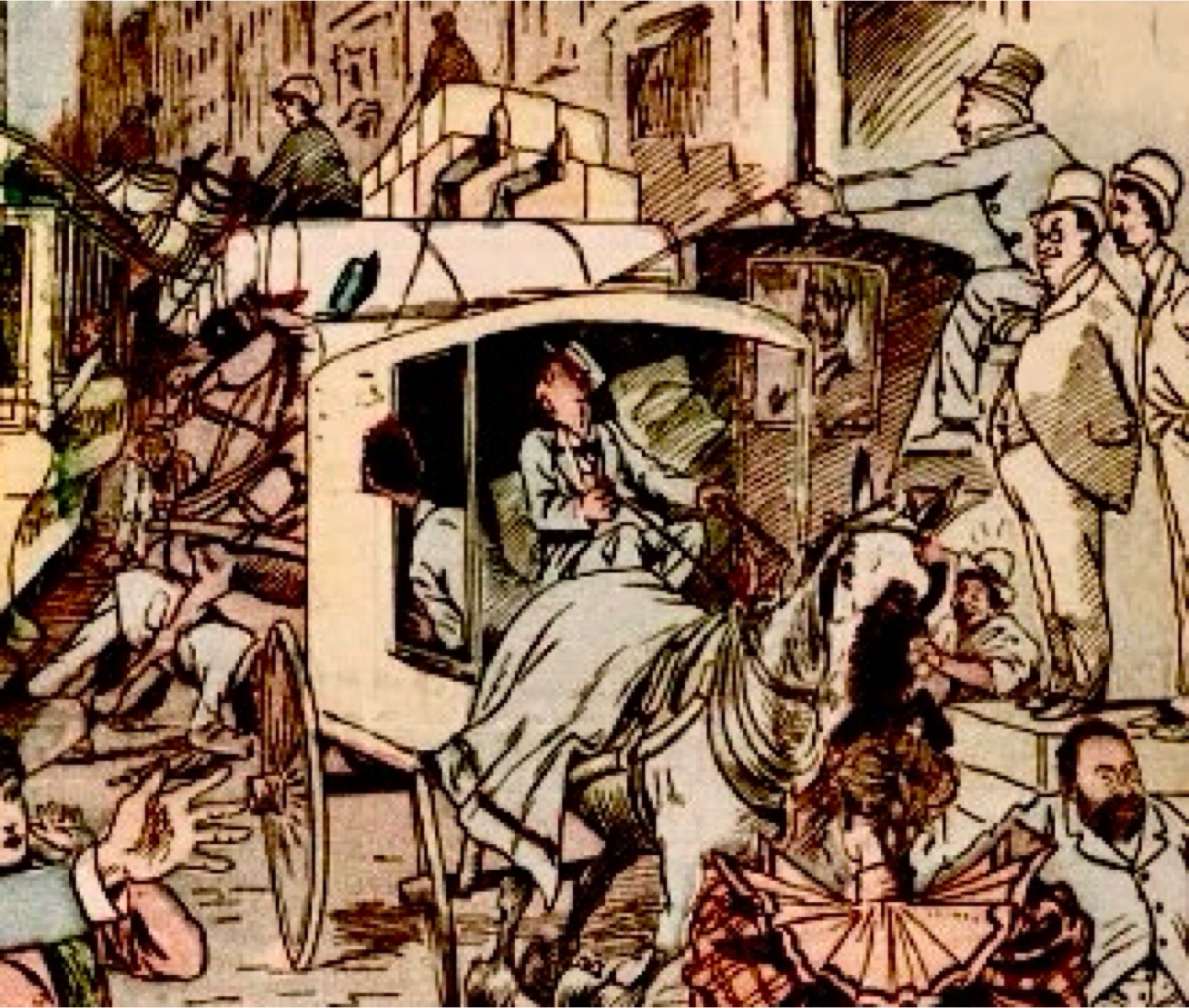
So many elements of the cartoon city are already here. Disruption, chaos, the dire forces of unstoppable motion, cause and effect – were all mainstays of the great early comics, from Hogan’s Alley to Katzenjammer Kids to Happy Hooligan. Comics historians are fond of using the loaded, politically-inflected term “anarchy” to describe the glorious violence of the medium’s first decade. I am more inclined to call it entropy. The basic comedy of early comics is in things falling apart and careening out of control. Whether it is Hans and Fritz’s latest prank on Mama, out-of-control street carts, angry dogs, Winsor McCay’s Sammy sneezing, or Opper’s Hap haplessly trying to help – plans fall apart – cause and effect unravel, energy dissipates, chaos wins. Or to look at it another way – newspaper comics crafted into visual poetry the fundamental forces driving modern cities and the anxieties they caused: force, motion, speed, and the structures being built to order and contain them. It was a medium uniquely situated to embody and make art of the daily sensation of living in a modern environment.
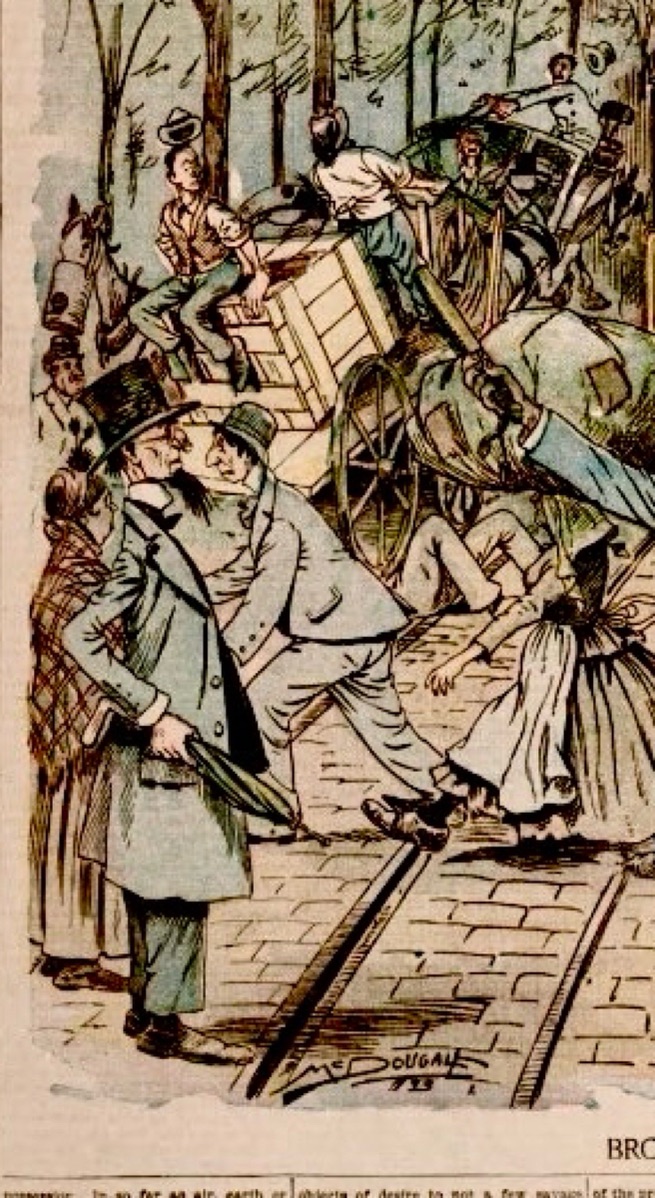
But the genius of this medium may be that it channeled some of these vaguest sensations of modernity through the more concrete, recognizable objects of social change. The comics helped create an iconography of the modern world. The medium’s future role in proliferating fashion is evident in this strip. Check out the two middle class lasses in the foreground, and the care with which McDougall details the lady dog-walker. Meanwhile, the knee-patched, newsboy rushes beneath. The democratic diversity of the city street is enhanced further by ethnic typing (the derby-hatted, hook-nosed figure dashing out of stage left), and the shocked country rubes (the country-cloaked couple far left). Ethnic typing, dialect, class differences, country vs. city – were already central to late 19th Century American humor in vaudeville, minstrelsy, almanacs, joke books, etc. But as a creature of the city, the early newspaper cartoon put all of these types and tensions into a diverse mosh pit where conflict and comedy were part of the medium’s language.
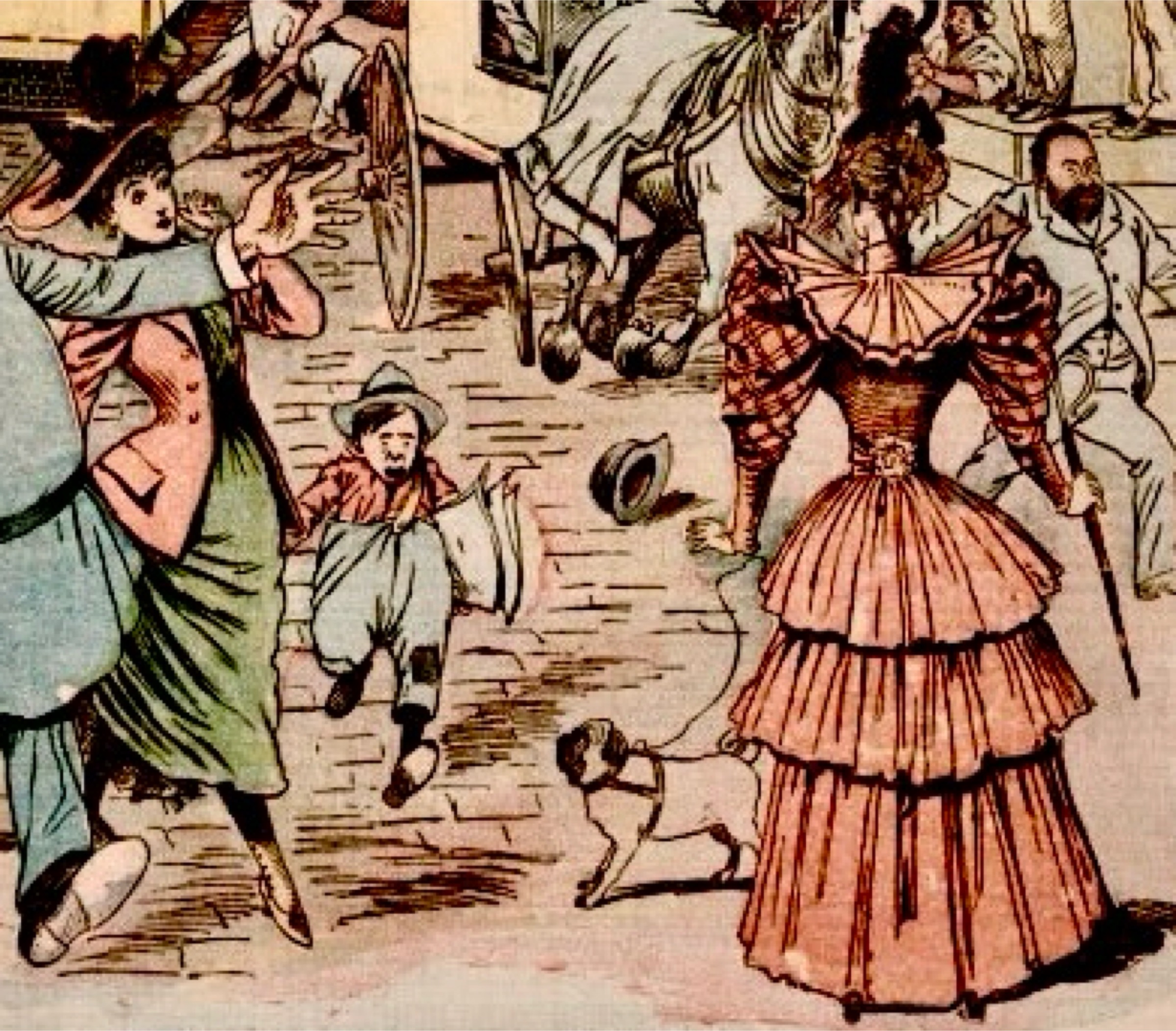
Rather than whimsical and antiseptic, the cartoon version of the city hits dire notes. Clearly, figures have fallen beneath the wheels of the trolley and buggies. There was something at once serious and unserious about the way comics transformed often dark realities of everyday life in turn-of-the-century America into something that was more manageable than necessarily safe.
I think that McDougall was an unrecognized master of the urban cartoon. His 1898 “Familiar Sights of a Great City – No. 1 The Cop Is Coming” is among my favorite pre-1900 comics. And his “Life in the City as the Countryman Pictures It” (1904) is an exceptional, highly detailed dissection of urban mythologies and hype.
By bringing the classic tableau format onto the modern city street, McDougall (and later Outcault, Swinnerton, Opper) was able to do something no other medium could. It froze the urban experience into a decipherable moment that somehow embraced all of the movement, diversity, violence, pace, noise, crowdedness that was otherwise deeply disorienting to Americans of every social class and background. The cartoon had the power to make the new city accessible, if not fully understandable. It turned the street into spectacle, a kind of public theatre towards which we were both spectator and participant.
- As comics historians know well, Chicago’s Inter Ocean had issued the first color supplement the prior year, a sensation that in fact inspired Pulitzer to acquire a color press and launch one in the World. “The Inter Ocean Illustrated Supplement,” however was not comics-focused, although it had color illustrations on the front and back covers. Initially, Pulitzer himself was inclined to give his supplement a fashion focus until his editor Merrill Goddard persuaded him to dedicate the section to comics. While McDougall’s impessive cover was designed for the newspaper experience, the interior cartoons were reprints of humor magazine cartoons. ↩︎
Discover more from Panels & Prose
Subscribe to get the latest posts sent to your email.


I’m sure I’ve seen this premier McDougall colour cartoon reproduced in colour somewhere before, but darned if I can even remember where. I certainly agree that it should be much more famous than it is, and your discussion of it is quite perceptive. I’d very much like to see the entire first colour section, even though I assume it included one side only of the outer wrap (the back cover being an illustration of a sailing ship).
One minor quibble — you dated it as March 21 when it is clearly May 21.
I think it unfair to minimize the importance of the Inter Ocean colour section, early issues of which offered just as much cartooning content as these early World efforts. I would so very much like to see more of the 1892 issues, which make hen’s teeth seem like an item in wide circulation. I have put together an almost complete run of 1893-94, but 1892s remain stubbornly elusive.
Thank you for the note, and the correction. Brain freeze, I guess. i think the fact that Pulitzer hired Charles Saalburg from the Inter Ocean to lead the World’s Sunday push speaks volumes for the value of those pre-World Sundays. I would love to see them, as I would a complete run of the Ting Lings, to provide a firmer context for the evolution of the Supplement format.
I have ’em (along with their Inter-Ocean predecessors, the ersatz Brownies), and have long planned to write a piece on them, but I consider it such an important mostly uncovered topic that I keep getting cold feet about it!
Great post Steve. It’s so good to see Cable Car Possibilities and Walt McDougall getting the recognition they both deserve.
You’ve looked at the cartoon from a different angle from me and I agree with your insights. Always good to experience. One minor quibble. You write ‘the first true color comics supplement of the modern era’ and this is how the May 21 supplement is often described. But it wasn’t a comics supplement. IIRC it identified itself as a ‘Colored Section’. Mc Dougall’s cartoon dominated the front page but there was also a lot of unrelated text adjacent to it. the two B&W interior pages had a short story and a humorous column. The back page was an attempt to reproduce an oil painting of Christopher Columbus’s ship, which was probably very crude indeed (AFAIK it can only be seen in very poor B&W microfiche form.). It was reportedly disliked by Pulitzer and led to the immediate realisation that the new color press was not able to achieve what Pulitzer had imagined it would.
Week two was pretty similar; one color political cartoon and some illustrations of oil paintings and other stuff.
Only patchy copies of the color section survive. I don’t think anyone can say how much color material was actually published in the rest of 1893. (I’d love to be proved wrong! Maybe there’s a bound volume somewhere!) But the comics section proper can be dated fairly precisely to January 1894. That’s another long story in itself.