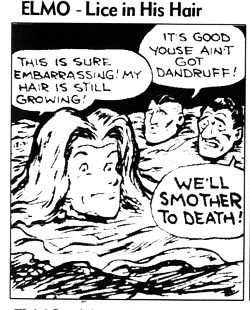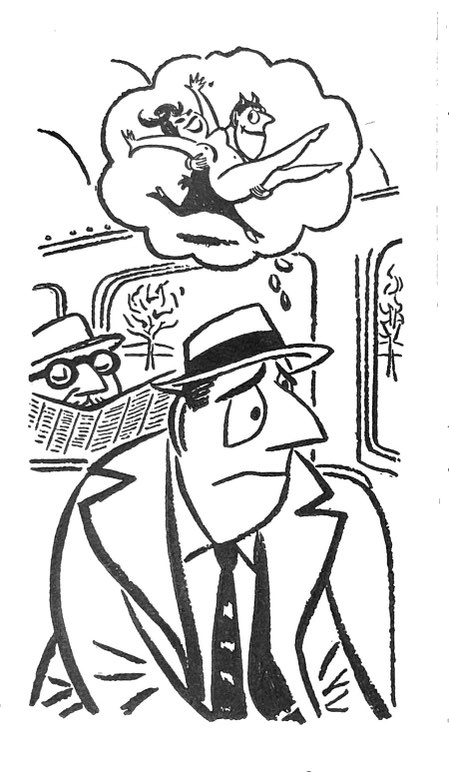
You may not think you know Max Shulman and Eldon Dedini, but you have seen their stuff. Shulman was a comic novelist of the 1940s and 50s whose most famous, enduring creation was The Many Loves of Dobie Gillis, a short story collection that became an MGM musical in 1953 and a genuinely witty TV sitcom (1959-1963). But throughout those those decades, Shulman was a bestselling satirist of mid-Century suburbia. His 1943 breakout college satire Barefoot Boy With Cheek was followed by The Feather Merchants, the Dobie Gillis collection and Rally Round the Flag, Boys!. In their Bantam paperback releases, many of Shulman’s novels enjoyed cartoon complements by Eldon Dedini, best remembered as a longtime Playboy magazine regular. His cartoon style is immediately recognizable: highly abstracted balloon faces, sharp triangle noses, bright watercolor washes. His lascivious satyrs were among jhis signature series in Playboy.
Continue readingTag Archives: 1950s
EC Sci-Fi At Scale: Taschen’s XXL Weird Science

The EC science fiction titles hold a special place in American pop culture. The books that ran from 1950 to 1955 (Weird Science, Weird Fantasy, Weird Science-Fantasy) were indispensable waystations for the still-niche genre of science-based speculative fiction. I would argue they were the crucible in which pop sci-fi as we have known it was forged. These comics not only popularized some of the foundational tropes of the genre. But EC’s stable of premiere artists then visualized many of these themes in ways that were far more sophisticated than the typically awful B- and C-level production values Hollywood applied to the sci-fi genre. Even though these comics were among the least popular of the EC titles, they likely were legitimating sci-fi in more young readers’ minds than any pulp mag or film c-lister could. And at the same time, artists like Wally Wood, Al Feldstein, Joe Orlando, Harvey Kurtzman and Jack Kamen were inventing a visual language for sci-fi themes: post-apocalyptic vistas, space travel, the romance of a starship launch, bug-eyed and fish-faced aliens. Their influence on the subsequent conceits of sci-fi fiction, art and film, as well as their look, is undeniable. From Forbidden Planet (1956) to 2001: A Space Odyssey (1968), Star Trek (1966), Star Wars (1977) and beyond, these comics were the first rough sketches of what our fantasies of the future would become.
Continue readingBook Review: From Distressed Damsels to Dauntless Dames
Comic strip history fans should run, not walk, to grab the one indispensable reprint project of this holiday book season, Trina Robbins and Pete Maresca’s Dauntless Dames: High-Heeled Heroes of the Comics (Fantagraphics/Sunday Press, $100). And I don’t mean “indispensable” as a blurb-able critical throwaway, either. The female characters and creators reprinted here from the 1930s and 40s have been “dispensable” in too many histories of the newspaper comic. The central value of this volume is the smart editorial decision Trina and Peter have made here: surfacing strips and artists who have been underserved by the standard anthologies and reprint series. Whether it is Frank Godwin’s pioneering adventuress Connie or Neysa McMein and Alicia Patterson’s Deathless Deer, Bob Oksner and Jerry Albert’s Miss Cairo Jones or Jackie Ormes’ Torchy Brown Heartbeats, the editors have not only featured previously un-reprinted and forgotten material. We get here substantial continuities from each strip that allows a much deeper appreciation for each strip’s character interactions and story arcs than we get from typical anthology samples. You are in the hands of two masters here. Trina has single-handedly championed the history of women comics creators in a number of previous historical and reprint works. And the longtime editor and founder of The Sunday Press, Peter is not only a walking library of comic strip history, but a sensitive curator and restorer. As a book, Dauntless Dames has the same qualities as the heroines it reprints: at once brainy and drop dead gorgeous.
Continue readingThe Grumbling American: Jimmy Hatlo’s Benign Hell
Jimmy Hatlo’s They’ll Do It Every Time (1929-2008) was as long-lived and beloved as it was throughly benign. To be fair, this single-panel museum of petty grievance had banality baked into its title and premise. The actual identity of the “they” is kept usefully loose enough to encompass an “other” of our choosing, but most likely all of humanity but us. And their “doing it every time” is by definition rote and predictable. But of course it is the aching familiarity of Hatlo’s observations that gave the strip purchase. Widely praised for poking at the small hypocrisies, human foibles, bombast of everyday existence, the strip had a special populist appeal. Hatlo was inspired by readers who submitted ideas and got daily credit with a “tip of the Hatlo hat” and even their name and street address for millions to see. Indeed, that was a vastly different era when it came to personally identifiable information. And yet, not so ancient. We can see in They’ll Do It Every Time predecessors of both user-generated content (UGC) and observational humor.
Continue readingQueer-Coding A La 1948: Buz Sawyer Flexes His Pecs
The sublimations of the American comic strip are legion. Whether it is the unbridled eroticism of Flash Gordon or the beefcake of Prince Valiant, the kinkiness of The Phantom or the stripteasing of Terry and the Pirates, the most “innocent” of modern American mass media contained many quiet erotic sub-texts for horny readers across ages and sexes. Case in point, Buz Sawyer in the 1940s. I have no idea what was going on with Buz’s artist Roy Crane and writer Edwin Granberry in the 1947-48 years, but the strip seemed a bit obsessed with gender-bending, sexual stereotypes and masculine identity across storylines in those years. In two adjoined episodes, our two-fisted hero deals with the barely-veiled advances of an effeminate gun-runner and sexual harassment at the hands of a masculinized female Frontier executive. This is one of those many cases where the most reserved and adolescent of modern media, the family newspaper strip, traded in suggestive imagery and innuendo that would never pass muster in other media of the day.
Continue readingLi’l Abner’s Culture Wars: Superman, Sinatra and Zoot Suits
One of the pleasures of Al Capp’s Li’l Abner across the decades was that the strip never took itself or any other pop culture phenomenon very seriously. In fact, Capp may have been at his best in his absurdist parodies of pop culture fads, rising celebrities, and politics. Satirical proxies for Margaret Mitchell, John Steinbeck, Frank Sinatra, Marilyn Monroe, Elvis Presley, Marlon Brando showed up in the strip at the height of their popularity. Larger issues like the Cold War, student unrest, Third World politics all found their way to Dogpatch, or Dogpatchers somehow found their way to them. Ironically, what started as a comedy about a backwards and alienated community of big-hearted naives, was really illustrating in its own light way how interdependent and mass mediated the world had become by the 1930s. In Capp’s hands, Dogpatch is anything but disconnected from the rest of the world. The wide world rushes through the hillbilly berg.
Continue readingBrenda Starr Comes Out Swinging
Like its eponymous heroine, Dale Messick’s Brenda Starr strip had to conquer the systemic sexism of the newsroom to make her mark. It launched in 1940 in constricted, Sunday-only syndication under the skeptical stewardship of New York Daily News legend Captain Joseph Patterson, after he had rejected Messick’s multiple submission for female-led adventure strips. According to lore, Patterson was unabashed in dismissing women in cartooning, claiming to have tried and failed with them in the past, “and wanted no more of them.” Messick’s samples were salvaged from the discard pile by Patterson’s more open minded assistant Mollie Slott, who helped the artist rework her ideas to feature an ambitious and dauntless female reporter. The artist was acutely aware of the gender deck stacked against her. Born “Dalia” Messick, she deliberately adopted the androgynous “Dale” to help get her strips considered more seriously. Slott convinced thge reluctant Patterson to give this red-headed firebrand and Rita Hayworth lookalike a try. History was made.
Continue reading