
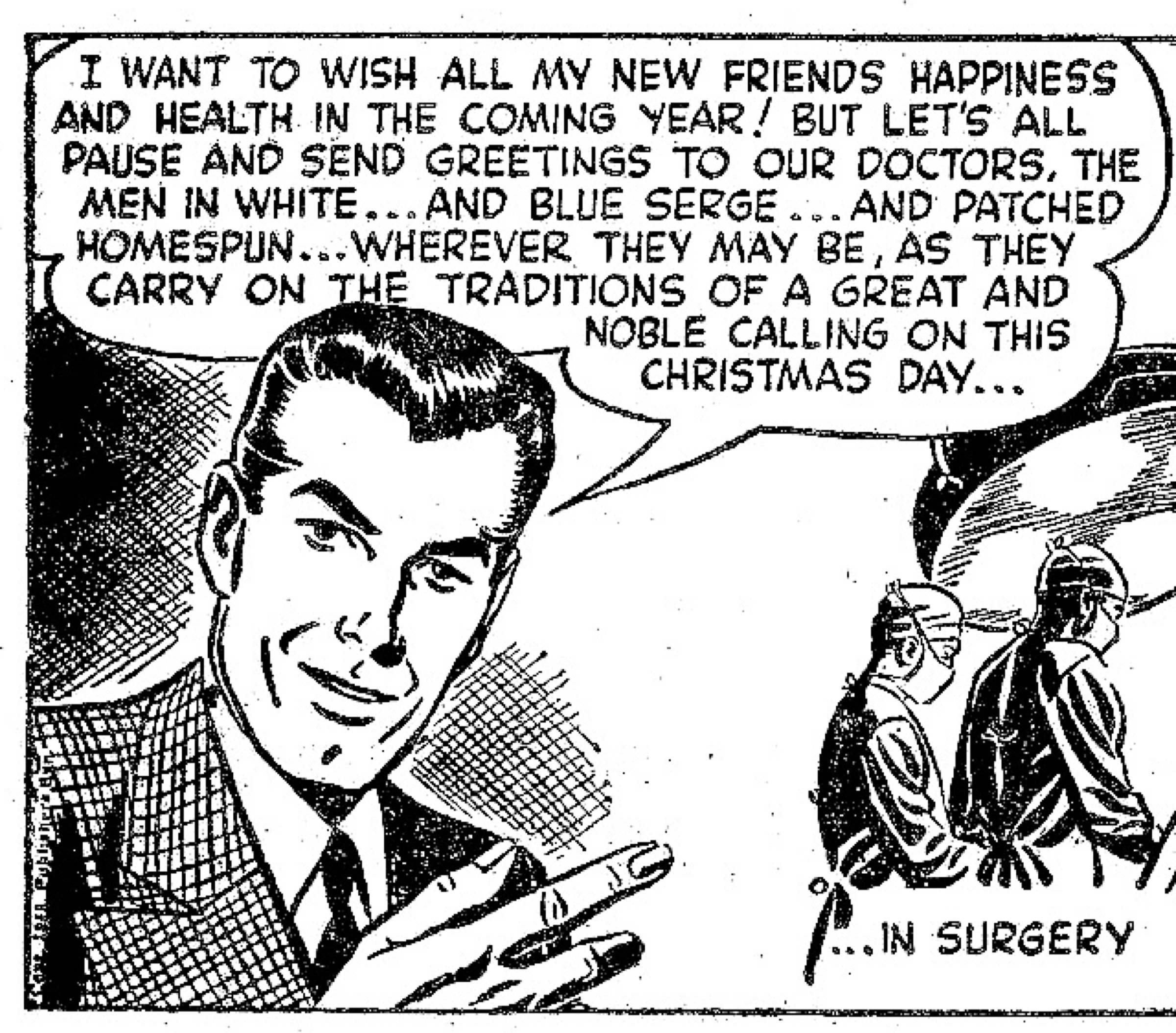
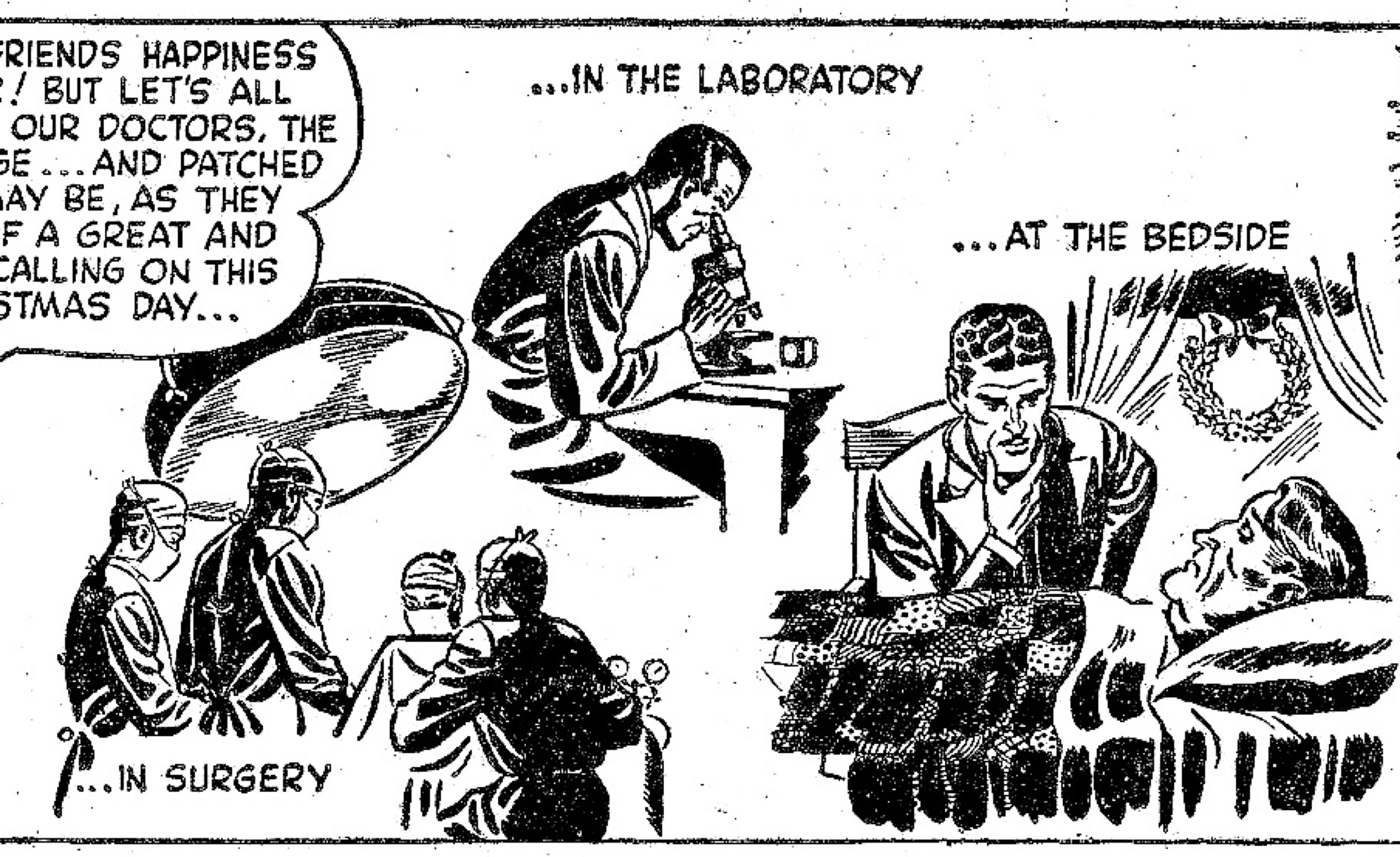
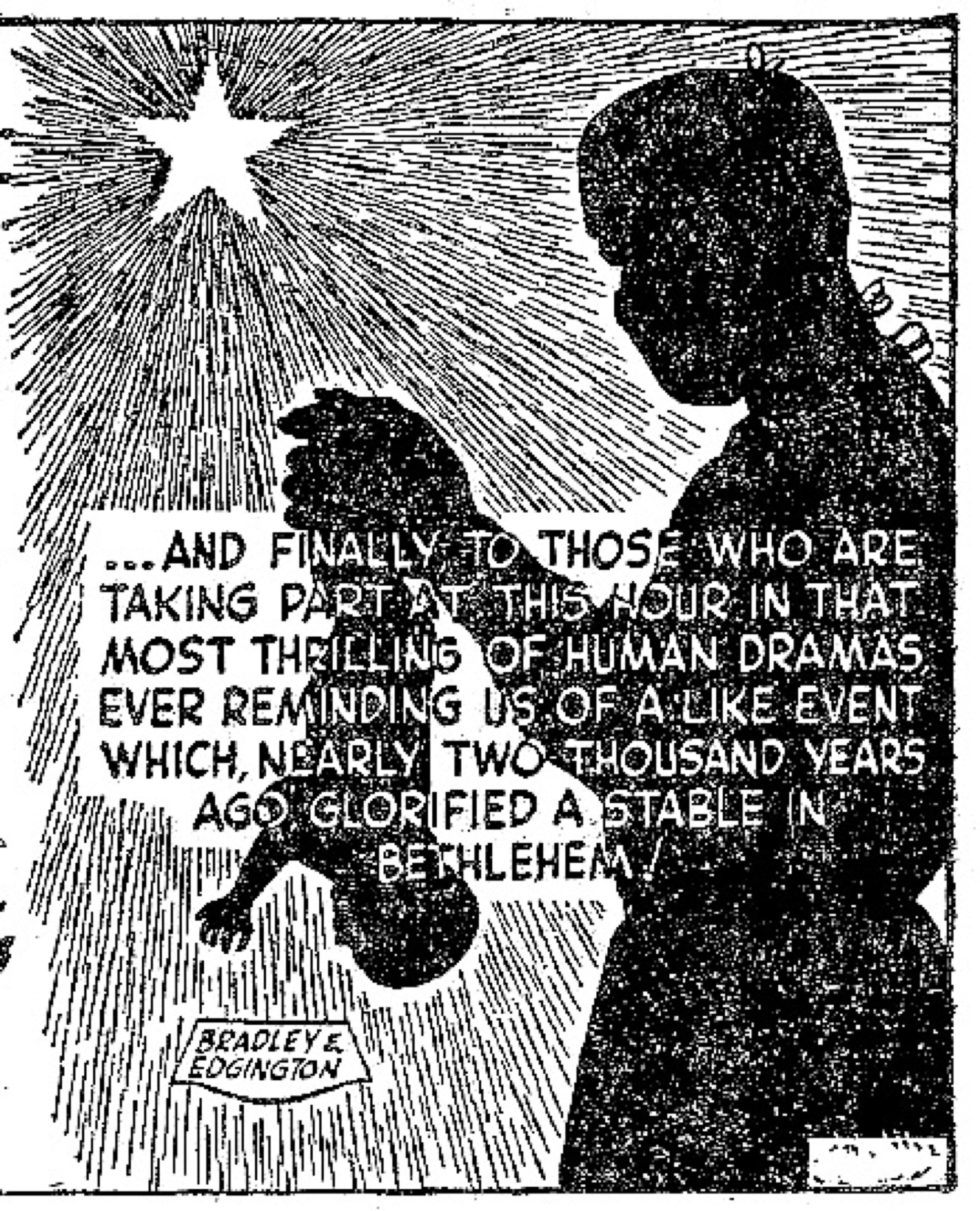
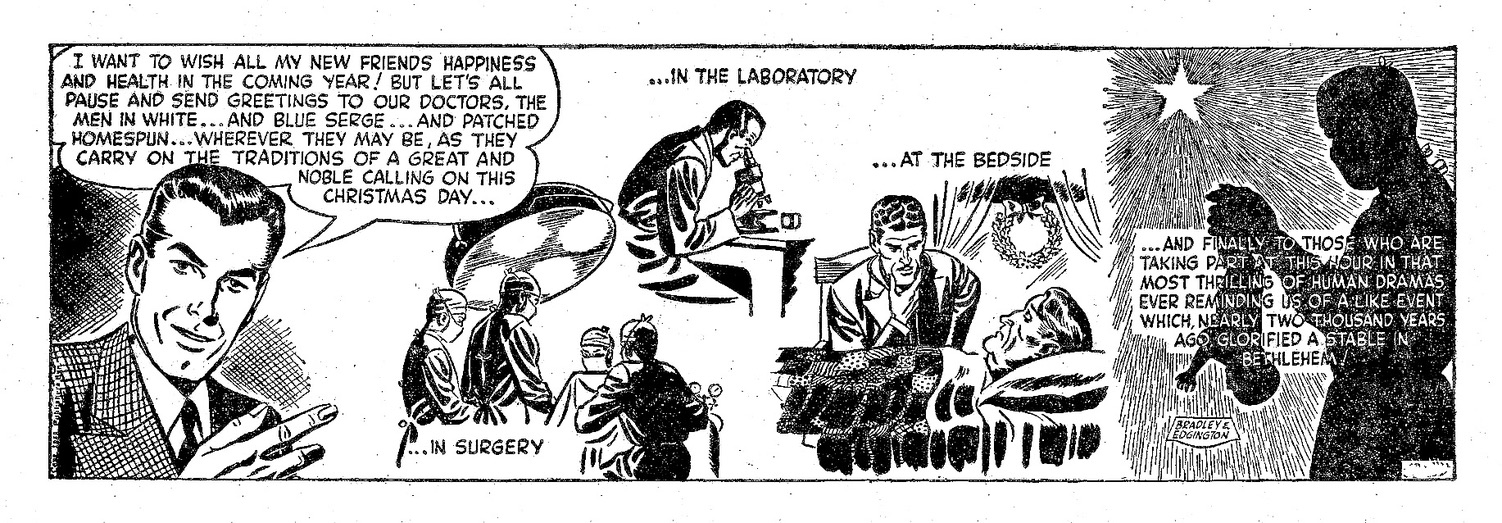
This just in from 1948… . Let’s give it up for doctors, expertise, institutional authority and the principles of science they represent. Nothing speaks to the post-WWII shift in American culture and comics as starkly as this Christmas 1948 message from Rex Morgan, M.D. The rise of the institutional hero was clear.
The Rex Morgan character had only been introduced that March by psychiatrist/writer Nicholas P. Dallis and drawing team Marvin Bradley and John Edgington. We did a deeper dive on Rex here. But it represented a larger tectonic shift in comics culture, a full embrace of institutional heroes as avatars of science, psychology, industry, productivity, law and government. Doc Morgan was among a generation of domesticated adventure heroes that included Rip Kirby, Kerry Drake, Steve Roper, Brenda Starr, Jet Scott and another Dallis creation, Judge Parker. And for the most part they adopted a photo-realist style that further normalized a buttoned-down world view.
Pipe smoking, of all things, became an icon of reserved paternal authority in these years. Just try counting the number of comic strip heroes and dads of the 40s and 50s, from Rip Kirby to Dennis the Menace’s Henry Mitchell, who nestled a pipe.
The impulse to restore institutional regularity after the war was intense. We see it most starkly in a generation of individualist 30s adventure heroes settling into marriage just between 1945 and 1955. There were still two-fisted mavericks like Buz Sawyer, Steve Canyon and Johnny Hazard, to be sure. But generally even these throwbacks to 30s individualism were tolerable wise-asses working for and within larger authorities. And of course the soap opera strip, which exploded in this era (Mary Worth, The Heart of Juliet Jones, On Stage) was a genre defined by the policing of community norms.
This trend was more than a natural need to restore normality after the tragic disruption of world war. It was accelerated by the next war – a “Cold” one. Distinguishing American culture from the Communist alternative was the prime directive of post-war pop culture. Obeisance and conformity to institutions of all sorts was, ironically, seen as a defense America’s highest principle — “freedom.” The internal inconsistences and hypocrisies of this cultural vision would not be lost on the baby boomers raised under it. Many of the bland realist stylings of 50s comics would become icons of American silliness for the next decade’s counter-culture.
Discover more from Panels & Prose
Subscribe to get the latest posts sent to your email.

