
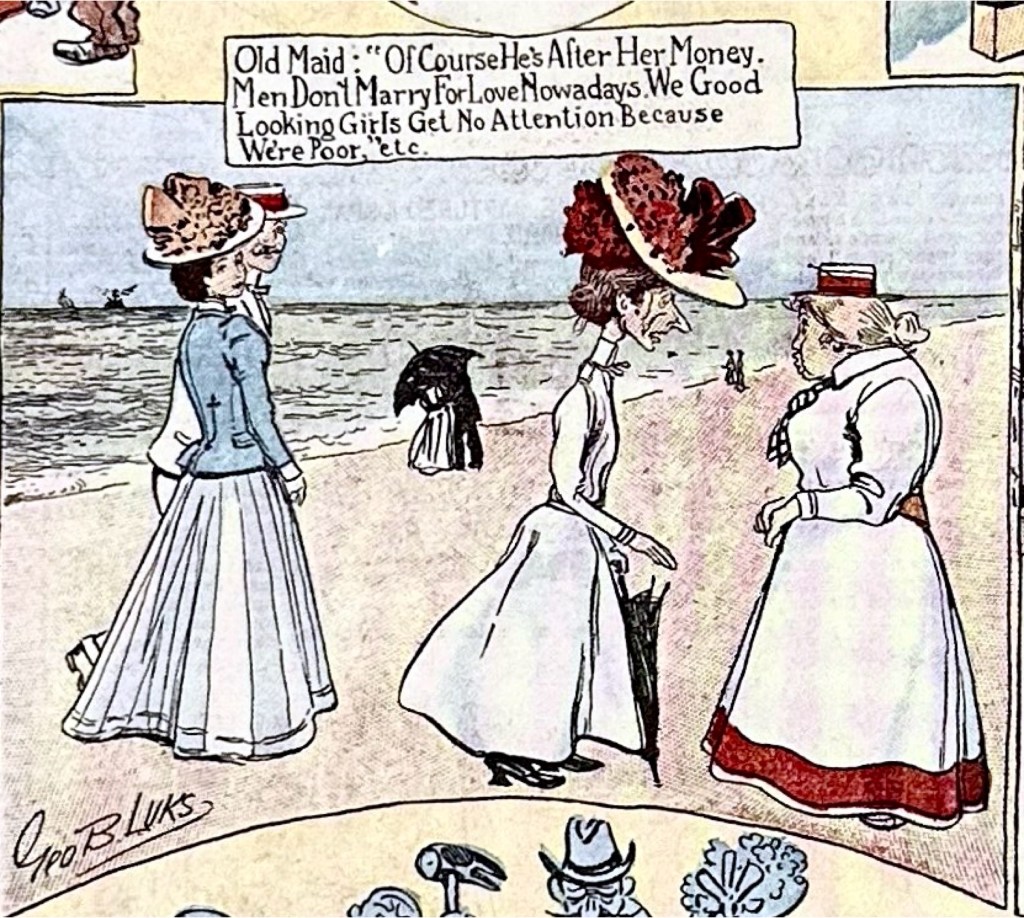
We often forget that the first generation of newspaper cartoonists were newspapermen. Pioneers of the “funnies,” like R.F. (Yellow Kid) Outcault, Rudolph (Katzenjammer Kids) Dirks, F.B. (Happy Hooligan) Opper, Jimmy (Little Jimmy) Swinnerton, Winsor (Little Nemo) McCay, as well as Art Young, Walt McDougall, George Luks emerged from newsrooms into the new comics supplements after 1896. They often spent years illustrating breaking stories and drawing pointed editorial cartoons while they were also inventing the comics as a new mass entertainment. The tone and style in these new comics pages were different – often ironic and satiric, screwball and sketchier – but they brought to these lighter arts the journalist’s deep acquaintance with all aspects of turn-of-the-century America. Outcault himself recounted how news gathering journeys through the slums of New York in the 1890s provided the raw material for Hogan’s Alley.
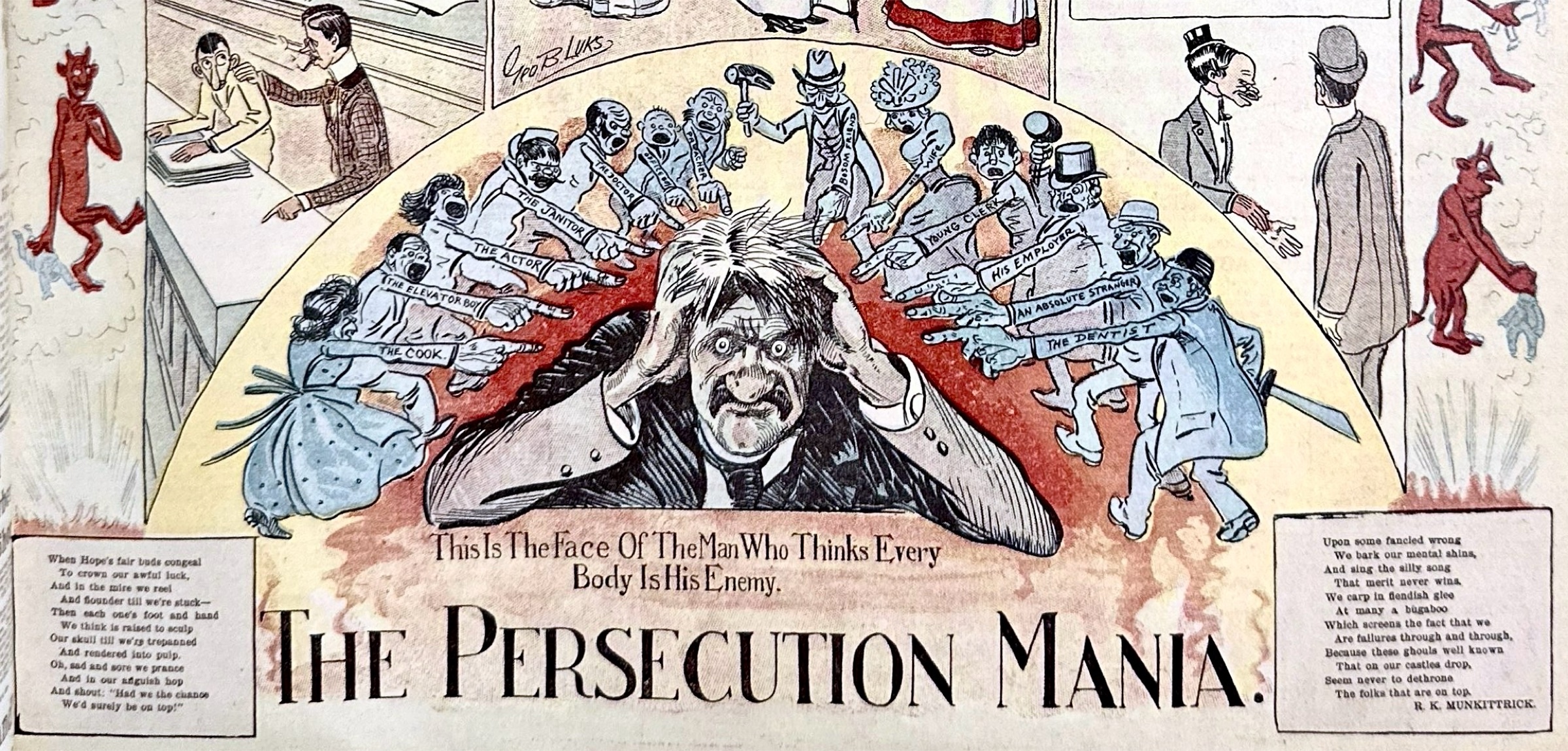
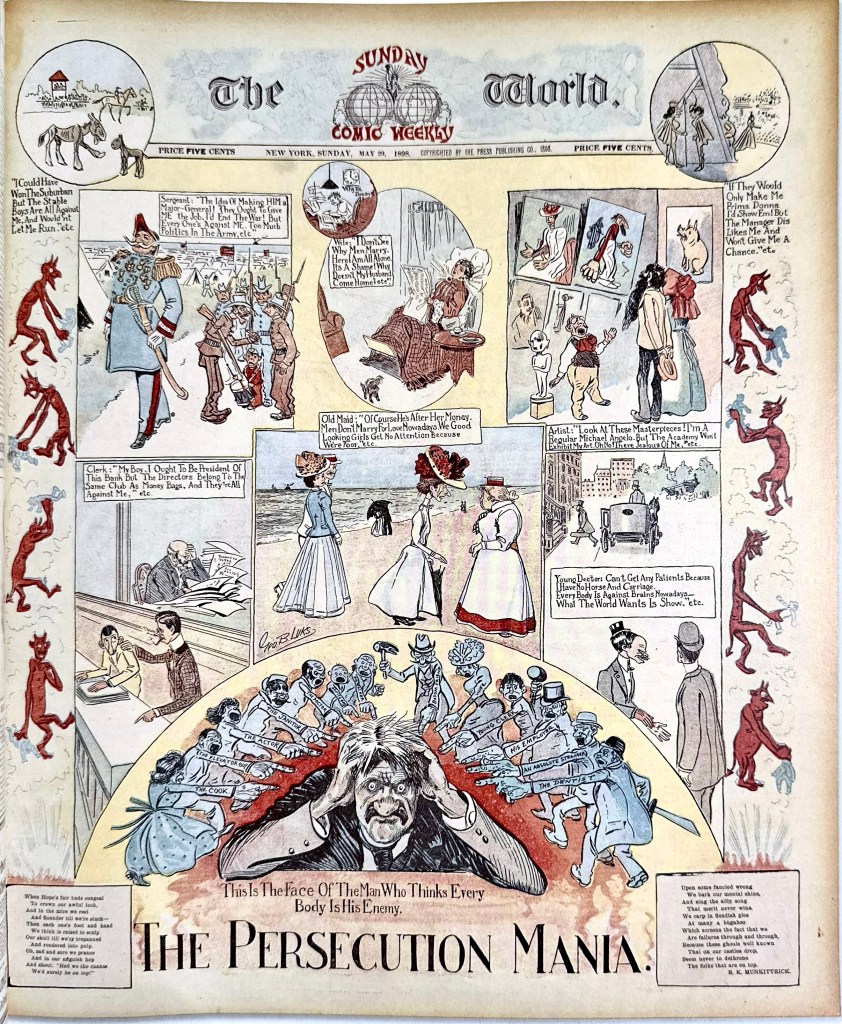
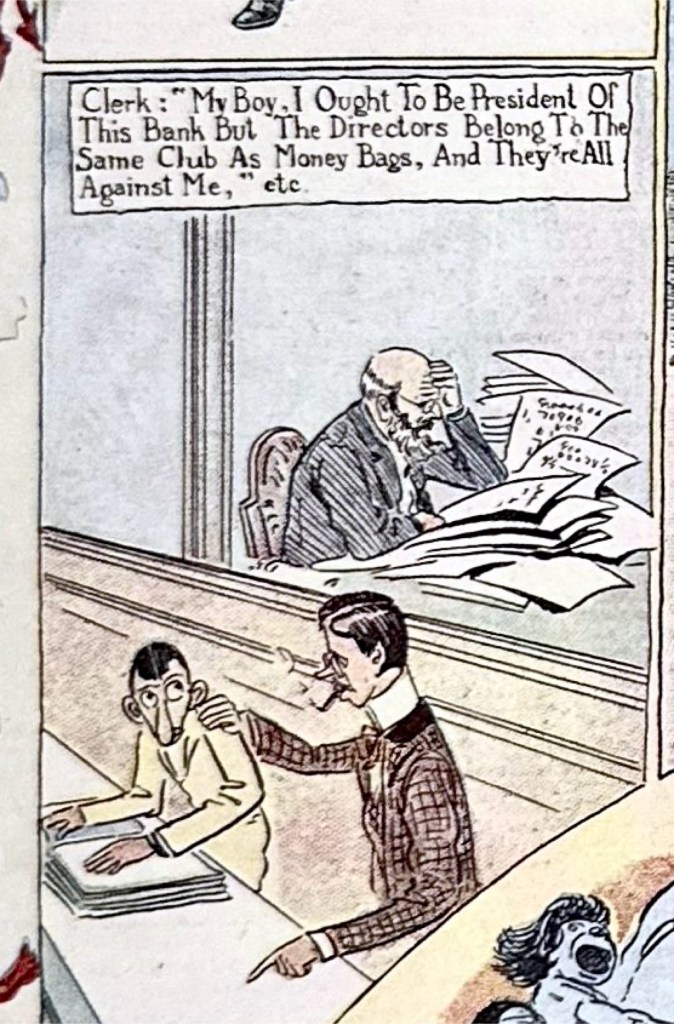
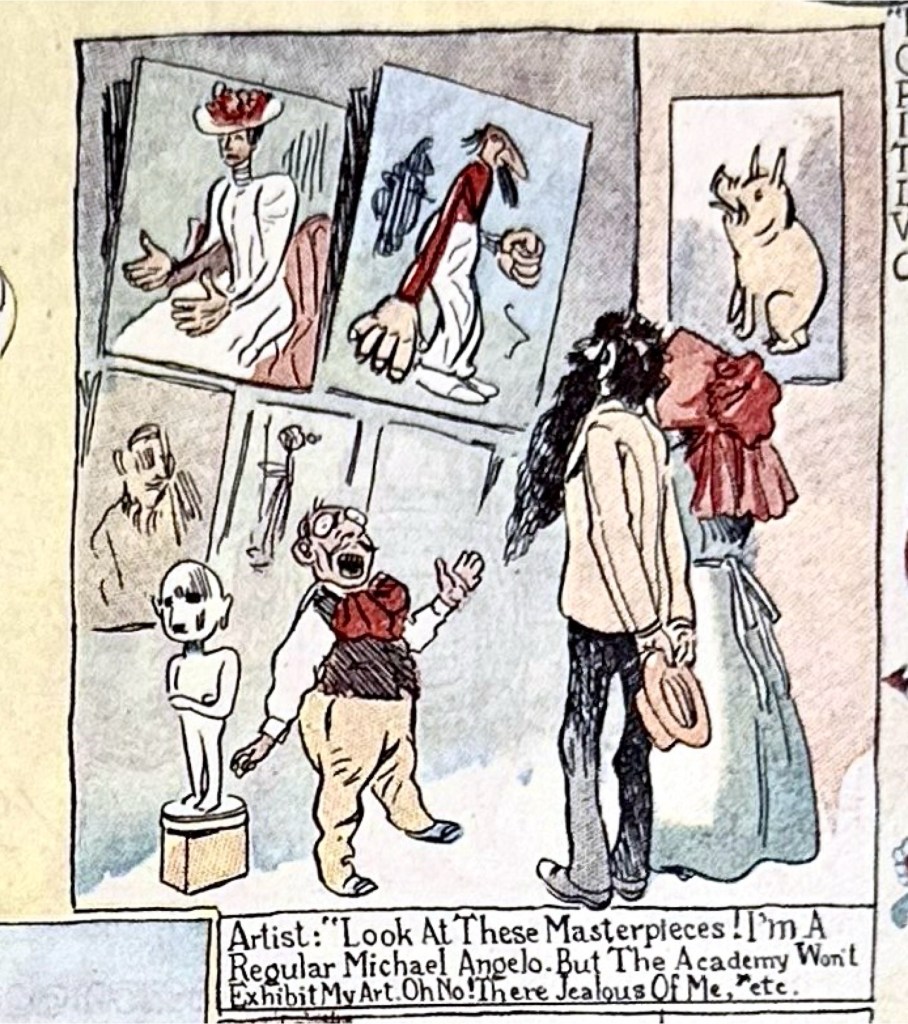
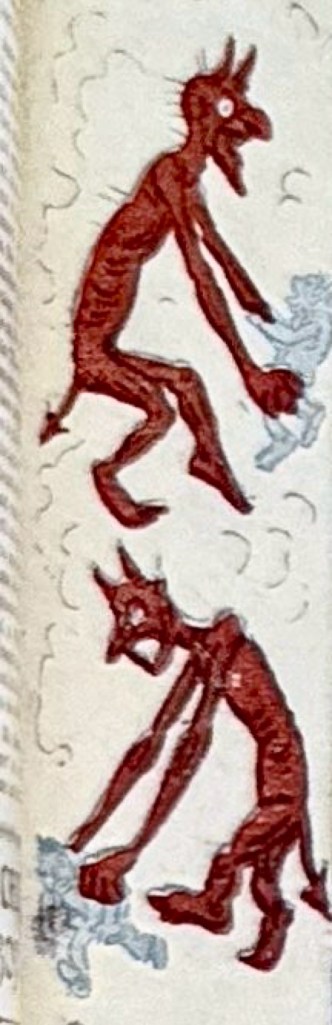
Another more subtle case in point is George Luks’s May 29, 1898 “The Persecution Mania” for the New York World. Hovering above his manic, besieged figure, Luks satirizes the little paranoias we use to explain our lot: why we didn’t get the promotion, the spouse, the accolades, the success we deserve. Lampoons of general social trends, styles of language and dress, and even vaguely defined attitudes were common in the early Sunday Supplements. It was newspaper journalism by different means, a new kind of op-ed that addressed the moods and tones of the zeitgeist.
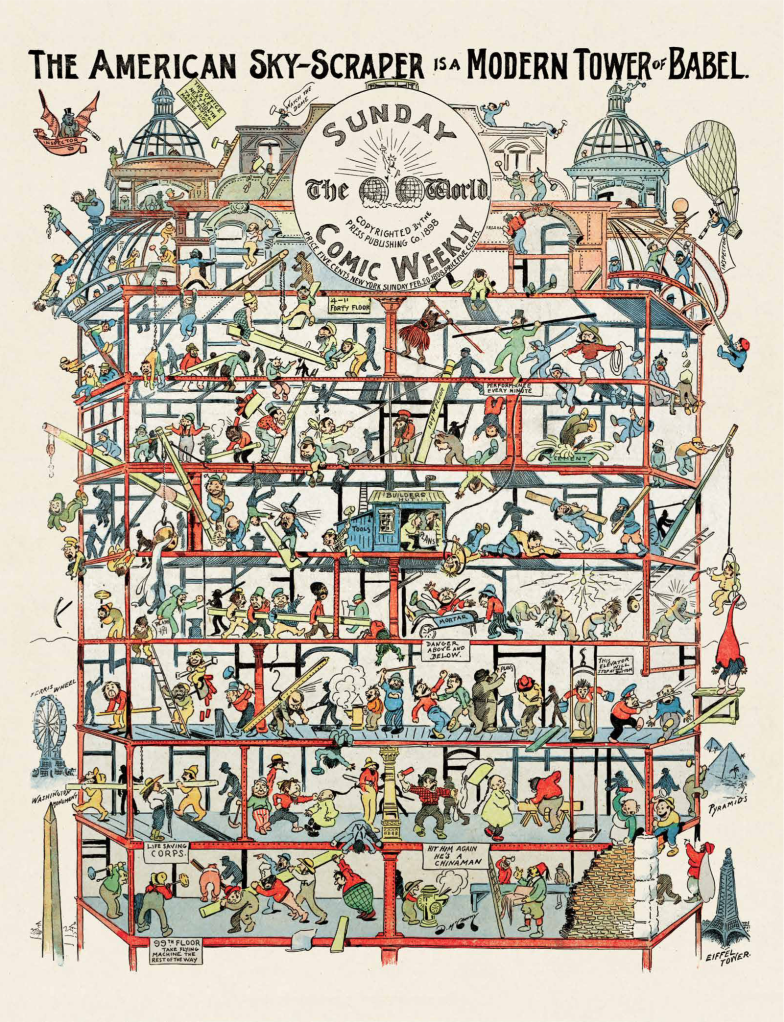
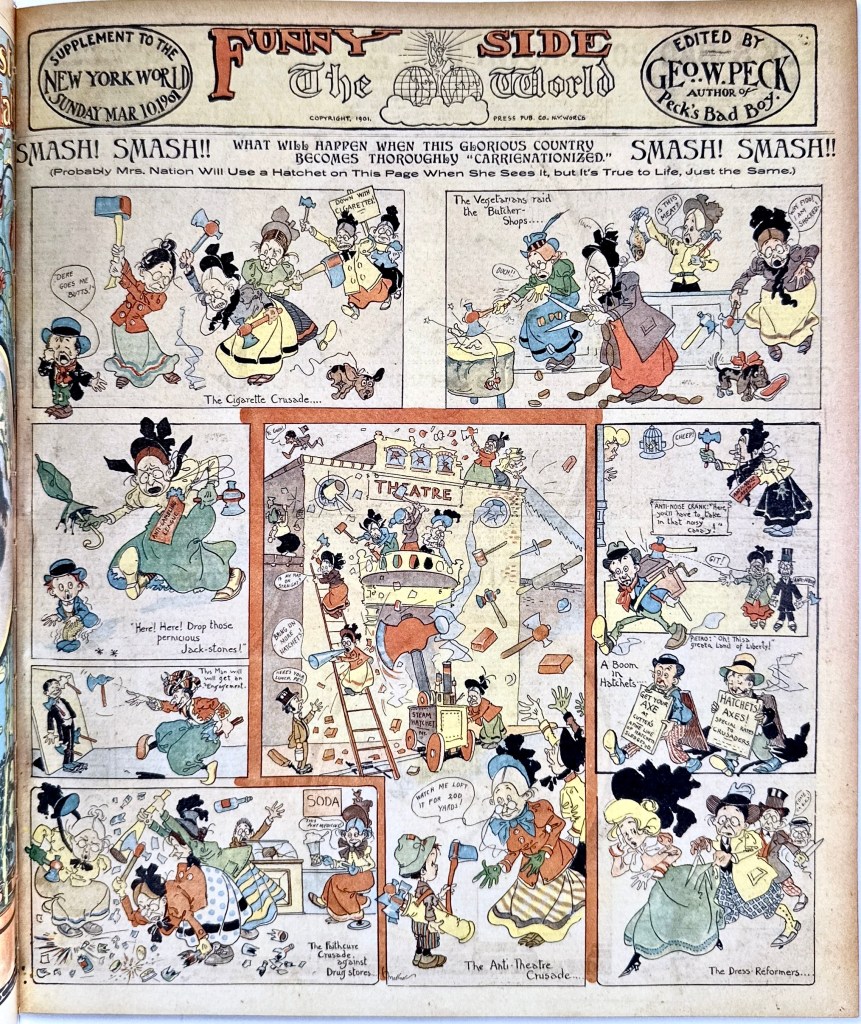
What we might call “trend cartooning,” or perhaps “Zeitgeist Funnies,” was a sub-genre of early newspaper comics, though it is often obscured by the delights of Katzenjammers, Buster Brown, Foxy Grandpa or Happy Hooligan. But supersized satires of everyday experience and vague sensibilities came in different forms. Some were pointedly social, like Dan McCarthy’s magnificent “The American Skyscraper is an American Babel” (The World, Feb. 20, 1898), which not only catalogued every ethnic stereotype, but hinted that the irony of America’s brave new world was it built by old world emigrees. Or the send-up of prissy social reform (The World, March 10, 1901), William Marriner’s “Smash! Smash! What Will Happen When This Glorious Country Becomes Thoroughly ‘Carrienationized’ Smash! Smash!” (The World, March 10, 1901), which envisions the axe-wielding, anti-saloon sensibility busting up every popular joy, from cigarettes to loud dresses.
These cheeky takes on current affairs extended similar cartoons that had appeared for over a decade in the humor weeklies like Puck and Life. Not coincidentally, future newspaper comic pioneer F.B. Opper specialized in observational humor during his years at Puck. He mocked the know-it-all social type (Puck, Oct. 19, 1887) and satirized “The Collecting Mania” (Puck, April, 15, 1891), while others poked at the fashion trends like the “hourglass figure” among women (Puck, April 27, 1881). Humor in this expanding America of distant frontiers and diverse national origins had always focused on social and regional types, dialects and dress.
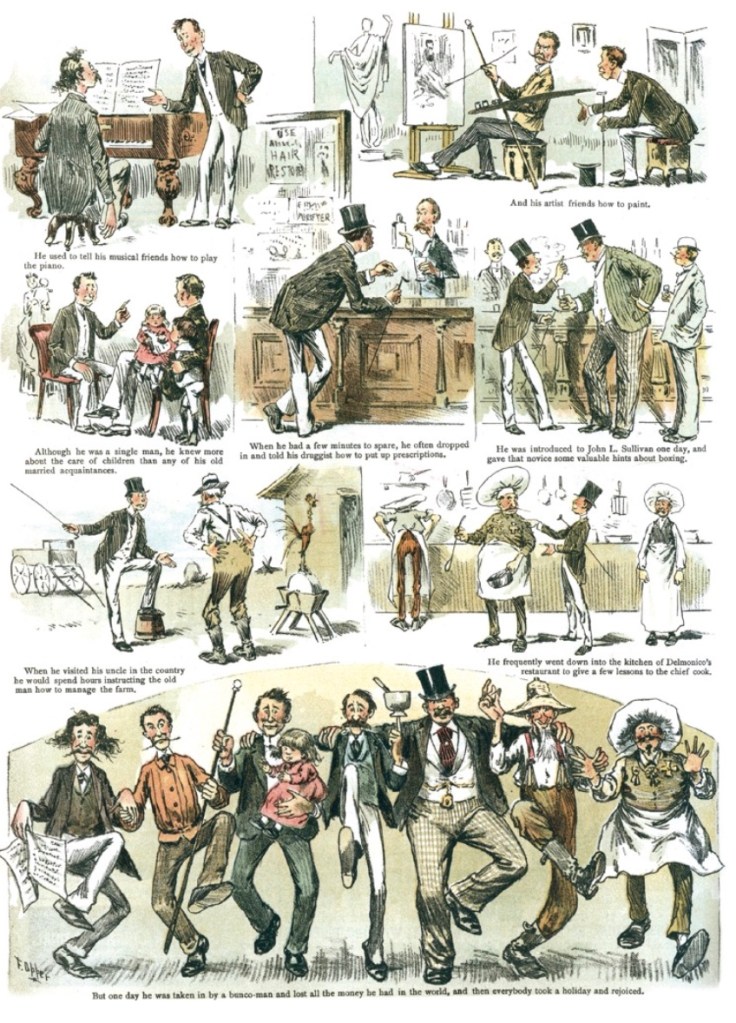
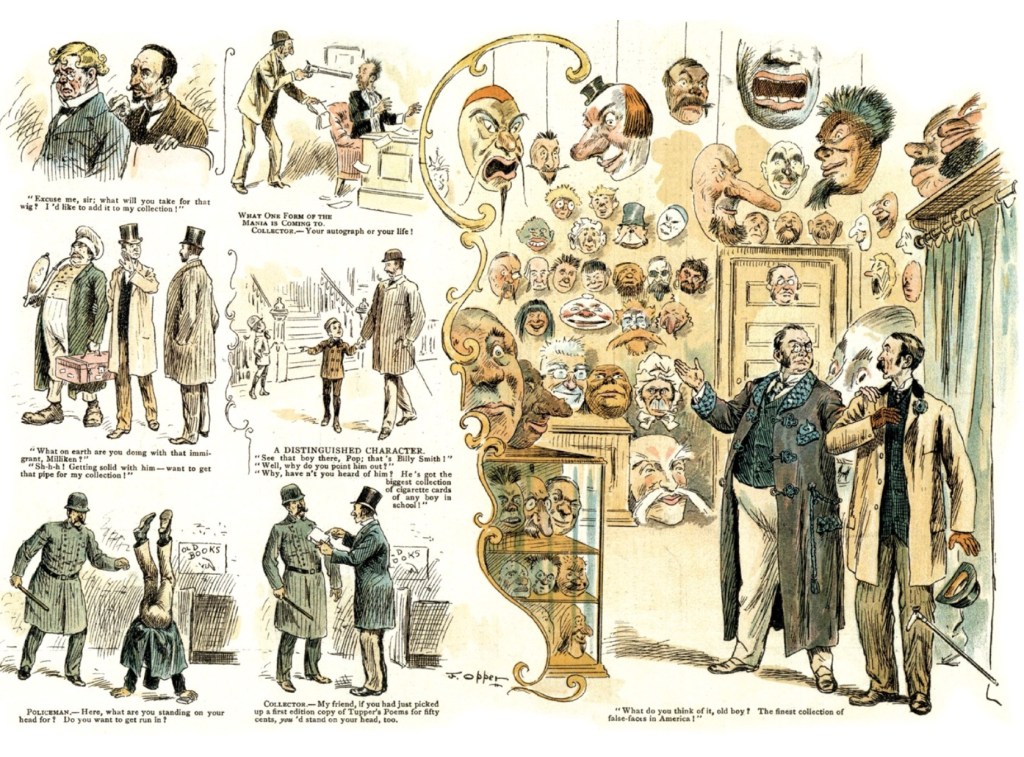
But as urbanization increased exponentially after the Civil War, and the major illustrated weeklies like Puck, Vanity Fair, and Life came to be based in New York City, cartooning adopted more sociological themes. In a mushrooming cityscape, trends were more apparent and social types more concentrated and diverse. The humor magazines started diagnosing “manias” and “crazes,” making widespread shifts in style sound like mass delusions. In fact, the culture was just beginning to see itself in sociological terms. In 1876 at Yale, the father of Sociology in America, William Graham Sumner, taught it for the first time in the U.S. Cartooning, with its unique powers of physical caricature, stereotyping and generalization, would play an important role for a nation starting to perceive itself in terms of “crowds” and “masses” through which pathologies, ideas, styles and attitudes seemed to spread.
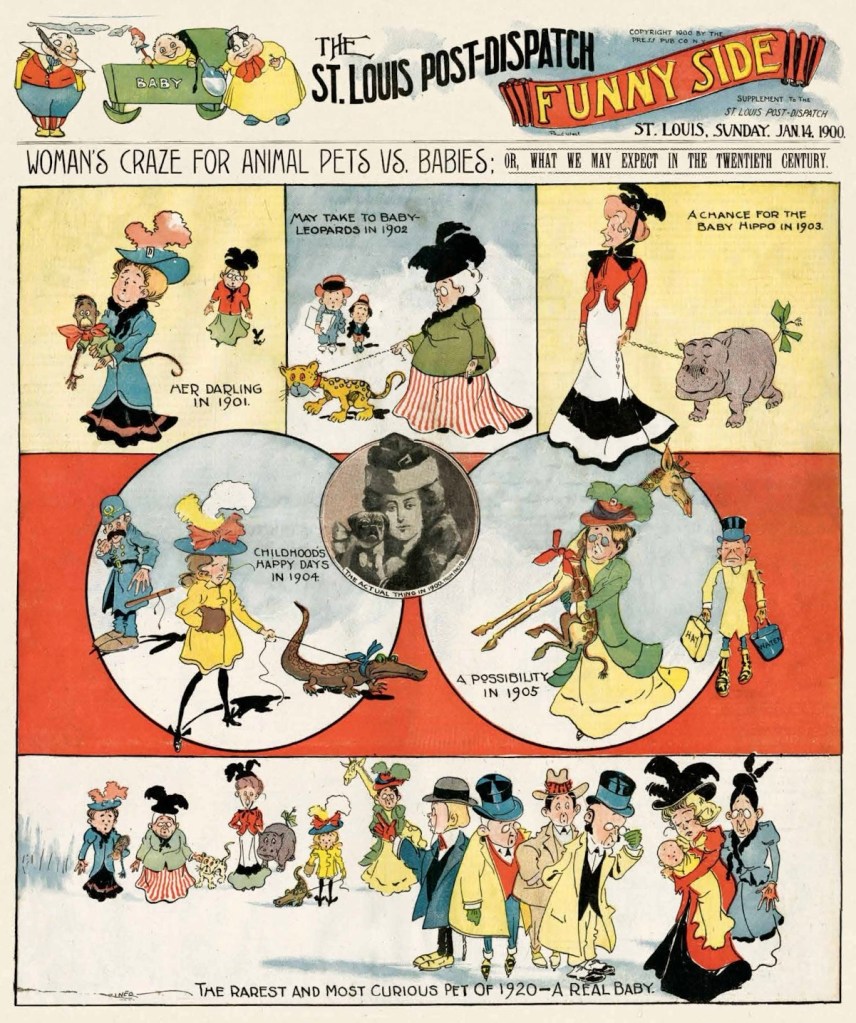
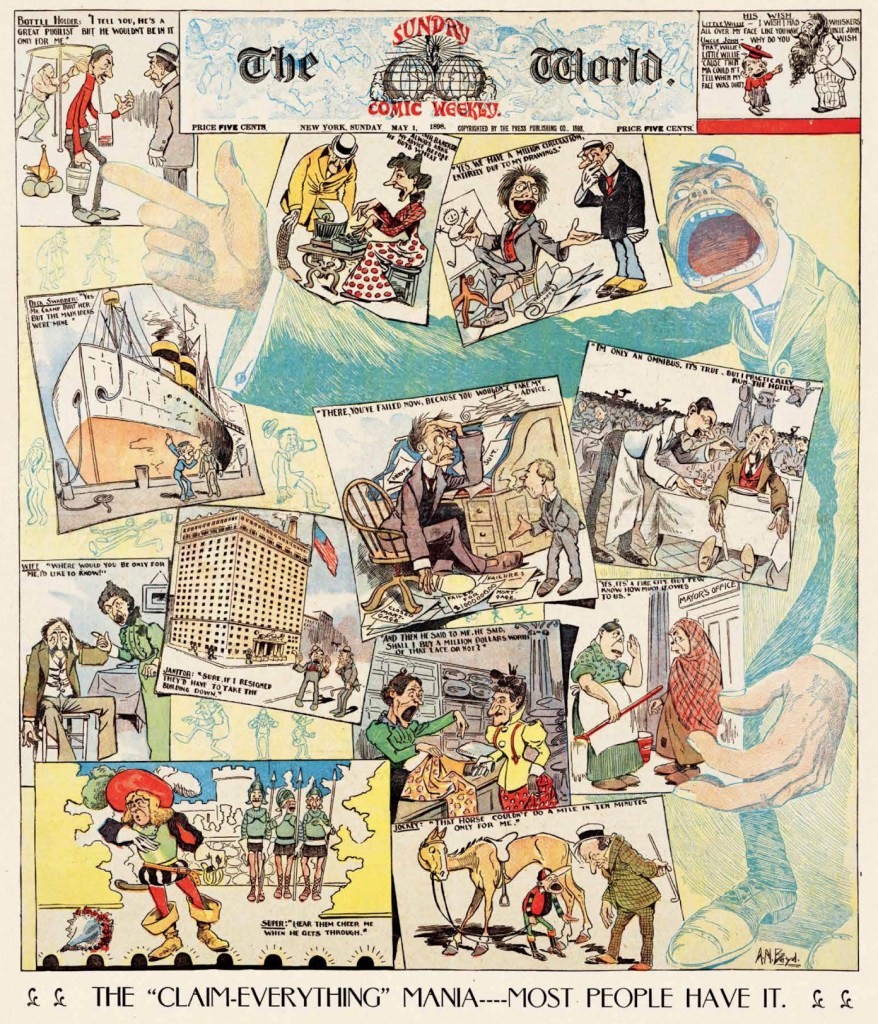
Trend cartooning in the newspaper comics, however, were more intimate and subtle than the social issue satires of magazine humor. For instance, a biting William Marriner page, “Woman’s Craze for Animal Pets Vs. Babies: Or what We May expect in the Twentieth Century” (The World, Jan. 14, 1900) called out the deflected maternalism of New York society women. Luks’s “Persecution Mania” cut much closer to the bone than we tend to see in the humor weeklies. More than social trends, these cartoons targeted pervasive psychological quirks. Even closer to Luks’s cartoon is A.N. Boyd’s “Claim Everything Mania – Most People Have It” (The World, May 1, 1898), which diagnosis a kind of mass trend in claiming one’s self-importance in the world.
In one sense, this sub-genre of early strips is the connective tissue between reportage and the funny pages. They suggest how the newspaper art departments during these years were developing visual styles, targets and perspectives that are loosely tied to newsy concerns but distinct from both news illustrations and editorial cartoons. This compartmentalization of newspaper graphic styles and content starts as 1893 with Jimmy Swinnerton’s Little Bear at The San Francisco Examiner in 1893. And the later fixation on fixations among early cartoonists further established for comics a new space of social humor. This was a space that could explore the vaguest yet intimate intangibles of modern experience: tone, attitude, personality, dreams, inner thoughts, fantastic extremes of emotional and physical expression. Which is to say that the singular comics form, image plus text, was especially well suited to visualizing aspects of modern experience that were outside the capabilities of other media like reporting, drama, even literature and later film, radio and TV.
Like many of the more slapstick antics in the first decade of newpaper comics, these Zeitgeist Funnies are at once light-hearted and as brutal as Katzenjammer pranks. After all, Luks is getting his audience of urban strivers to giggle over rationalizing their own under-achievements. Marriner is questioning the maternalism of privileged women. Boyd is diagnosing an infectious insecurity that underpins the identity of the modern everyman. These cartoon sociologists and screwball social-psychologists are onto something deeper than a joke. But the joke is the candy coating that makes a bitter core palatable.
There is a hint here of Henry David Thoreau’s famous, scathing diagnosis of middle-class America in Walden: “The mass of men lead lives of quiet desperation.” But with an ironic chuckle. Almost half a century after Thoreau, a new middle-class was becoming the backbone of a modern, increasingly bureaucratized, corporate structure. Luks is capturing early in “Persecution Mania” the grumbling and discontent that would become a mainstay of workplace culture. But he is also previewing what would become a centerpiece of American comic art – workplace style. Luks turns it into a more bearable burlesque of persecution at the hands of everyone from politician to house cook. Boyd’s “Claim Everything” surfaces the anxious responses of a new era of urban anonymity and clawing for identity.
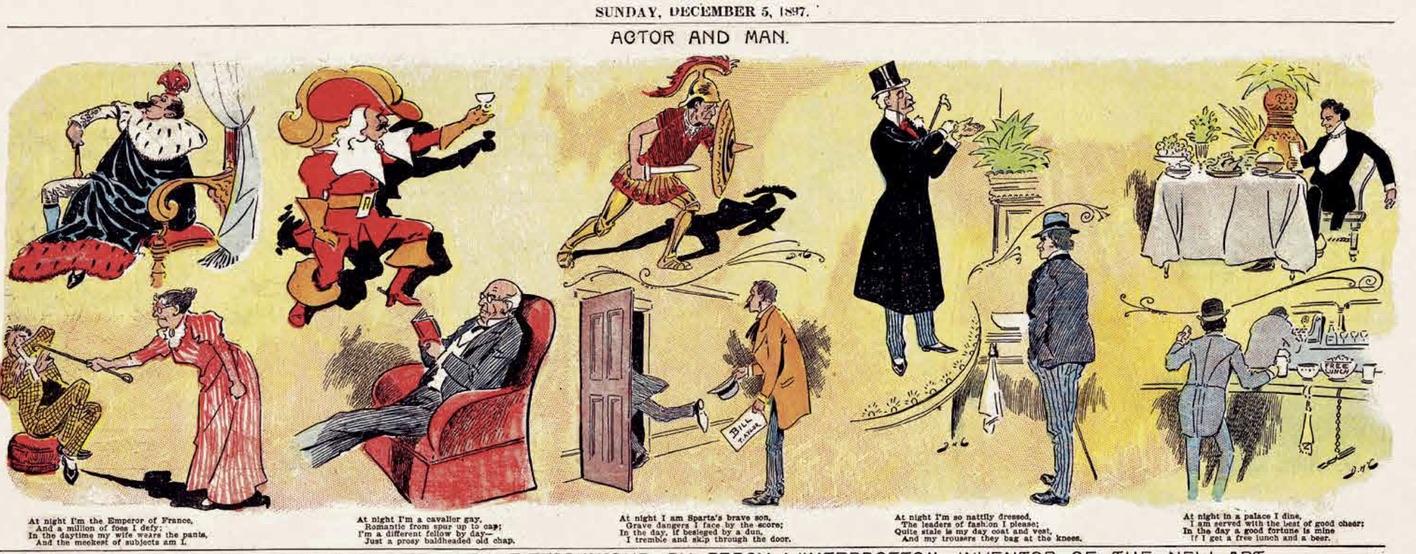
And this beleaguered sense of identity became the underlying theme across all of these and many other early comics, perhaps the theme that helped define the medium for the coming century. An especially trenchant comic, “Actor and Man” in The World on Dec. 5, 1897 anticipates this path. It marks the gap between the humbling, sometimes humiliating, lives we lead and the heroic fantasies we inhabit through popular entertainment. “Quiet desperation.”
In one of his many book introductions, the godfather of comics history Bill Blackbeard estimated that over 90% of 20th Century strips took a person’s name for its title. I haven’t checked his math on this, but I think he is closer to right than wrong. And I think it is also fair to say that this focus on individual personality in titling and content, distinguishes newspaper comics from any other modern mass medium. The underlying subject of the modern comic strip, what made it so compelling and different, was this fixation on individual personalities making its way through everyday life. From Mickey Dugan’s yellow frock to Jiggs’ unhappy fortune, Andy Gump’s bloviating to Uncle Walt’s parental fretting, Polly’s Paw raging at change to Annie, Dick and Popeye’s populist moralizing, the central power of the medium was visualizing self vs. modern society on a daily basis in uniquely intimate, extreme, never-ending ways.
Discover more from Panels & Prose
Subscribe to get the latest posts sent to your email.

