
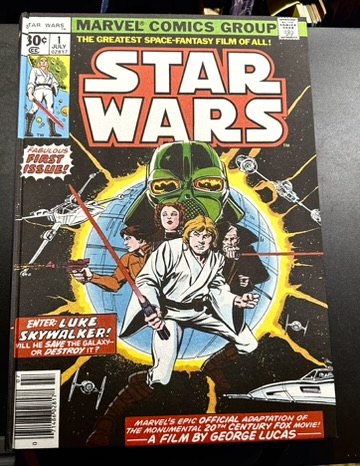
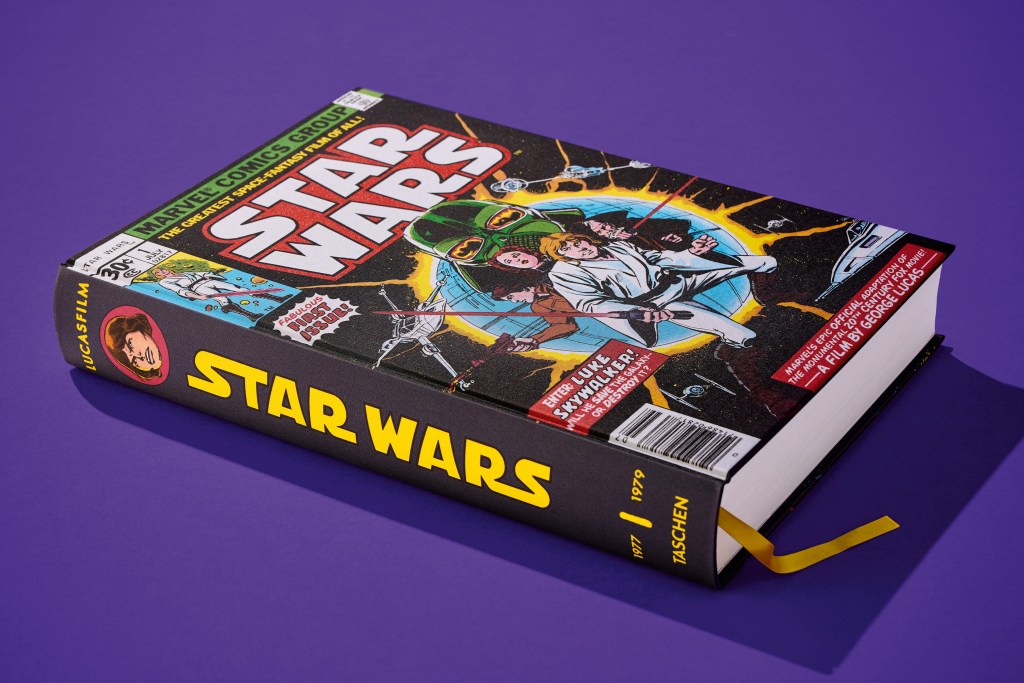
Marvel ‘s March 8. 1977 launch of Star Wars, the comic book, was never just another opportunistic hit-movie tie-in. In fact, no one knew then what a pop culture “Force” the franchise would become. The film itself premiered three weeks later, and many were skeptical that audiences would embrace a pulp-style space opera. But a comic book version of his epic property had been in George Lucas’s master plan all along. As Peter Sanderson recounts in his thorough introduction to TASCHEN’s Star Wars Comics Library. Vol. 1. 1977-1979, the director and his publicity man had been pitching the idea as early as 1975. Famously, Stan Lee wouldn’t even take Lucas’s first phone call, and Marvel resisted the project for a while. Ironically, the Star Wars comic series not only proved to be a massive hit once the film opened, but it outsold all other Marvel titles and helped save the struggling company.
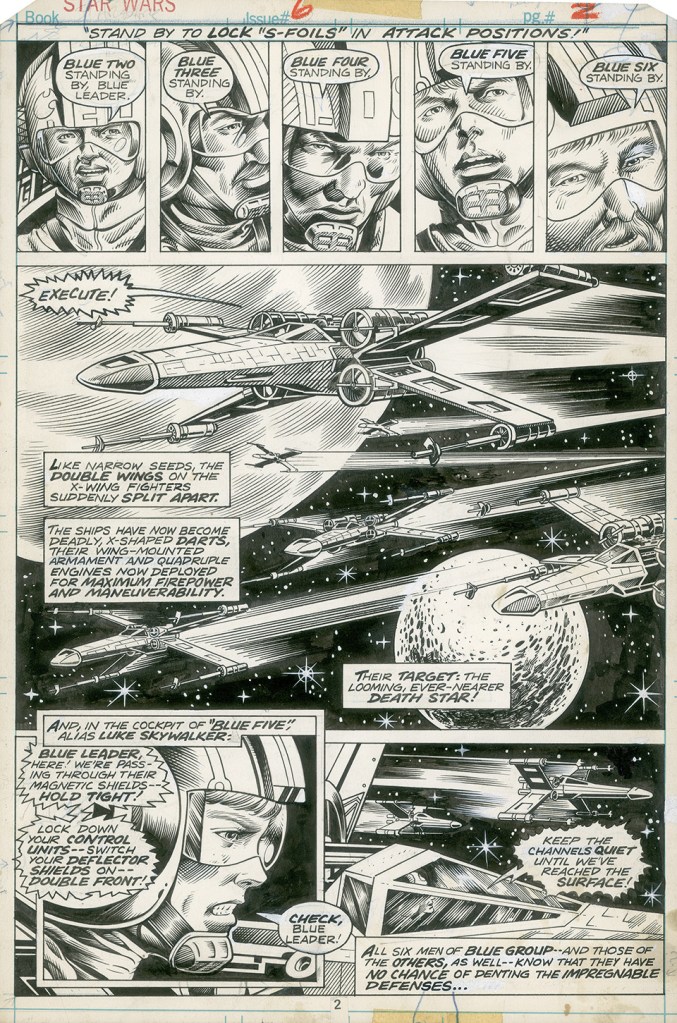
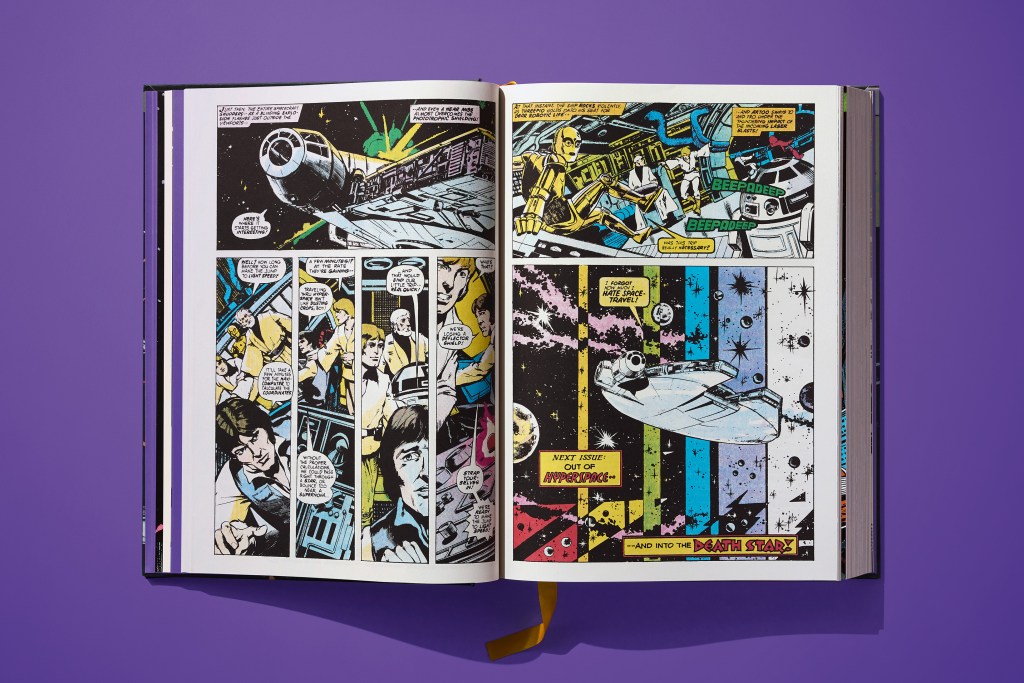
In some ways this beautifully done and gargantuan $200 reprint of the first 23 issues of Marvel’s Star Wars unintentionally supersizes the project’s inherent weaknesses. Ironically, Lucas’s foresight about using a comic book series to sustain interest in his saga between films actually may have diminished the power of the first six issues. Writer Roy Thomas and artist Howard Chaykin created their adaptation of the first film with only the shooting script and stills from the set. This led to a few glaring discrepancies, most notably a svelte and spry Jabba the Hut and a more prominent role for Luke Skywalker’s childhood friend Biggs Darklighter. Both aspects of the film story changed radically in the final cut. But more than that, Thomas and Chaykin worked without fully experiencing Lucas’s visual signatures for the series. Star Wars worked in part because Lucas alluded to film history so effectively. His visualizations of space, character, alien landscapes, costuming, and even technology invoked Flash Gordon serials, Alex Raymond art, John Ford westerns, and Akira Kurosawa samurai epics.
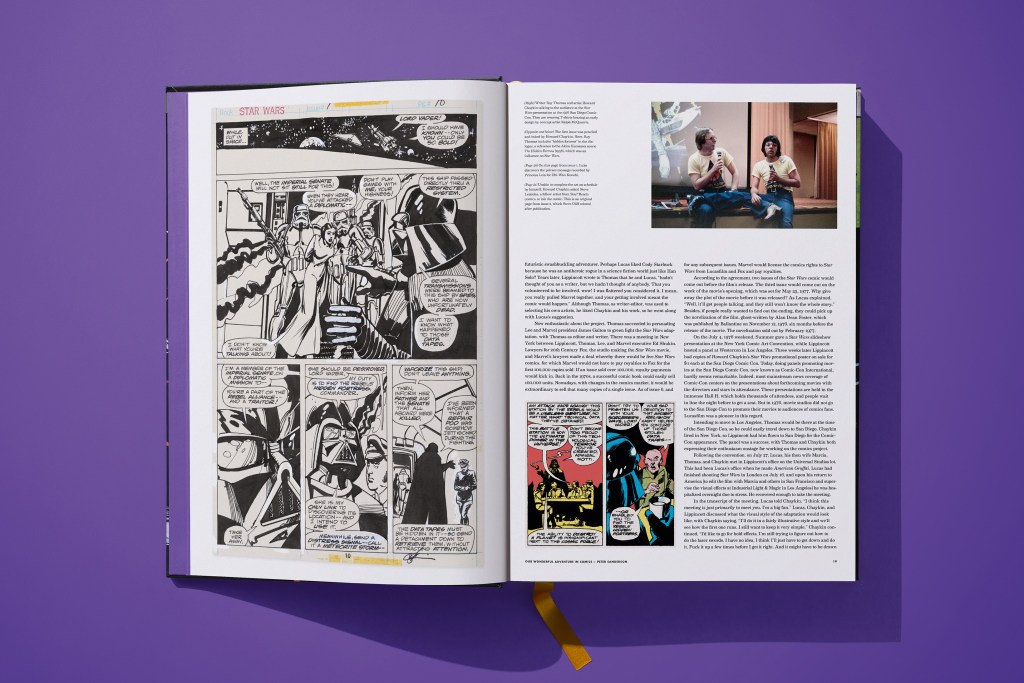
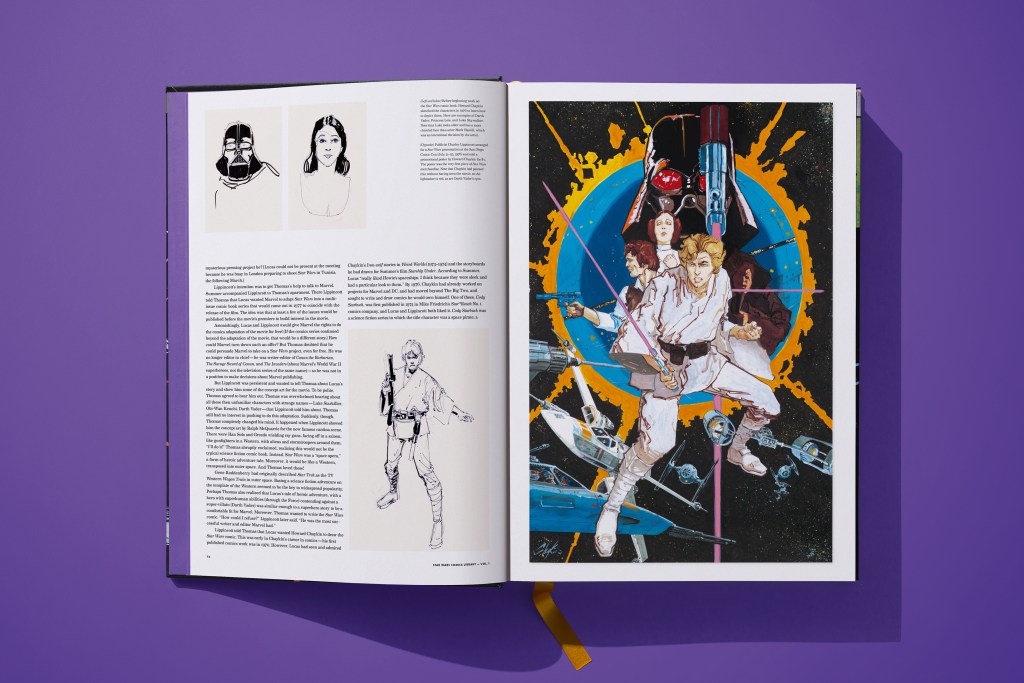
Instead, we get Star Wars, “The Marvel Way.” Thomas struggles to both quote the film dialog and describe thoughts and feelings that are conveyed better through film actors’ faces and gestures. I find his captioning in these early Star Wars issues more intrusive than additive. As well, the character design misses the point. Lucas’s casting of unglamorous faces like Hamill, Fisher and Guiness’s underscored the ragtag grassroots spirit of the Rebellion. Under the Marvel gloss, however, everybody is just too chiseled and homogenized, the action too superheroic to register any of Lucas’s more thoughtful nuances. The cover tag lines (i.e. “Here I Stand – Though I May die”) have all that unironic Marvel silliness that fails even to be campy.
Things don’t get much better even in issues 7-11, when Thomas and Chaykin try their hand at extending the Star Wars mythology in new directions. In surer hands, their recasting of Kurasawa’s “Seven Samurai” into space might have worked, perhaps if had been less ham-handed. Instead, this Han Solo storyline becomes a muddle of half-baked characters (complete with a Don Quixote figure) and unengaging story.
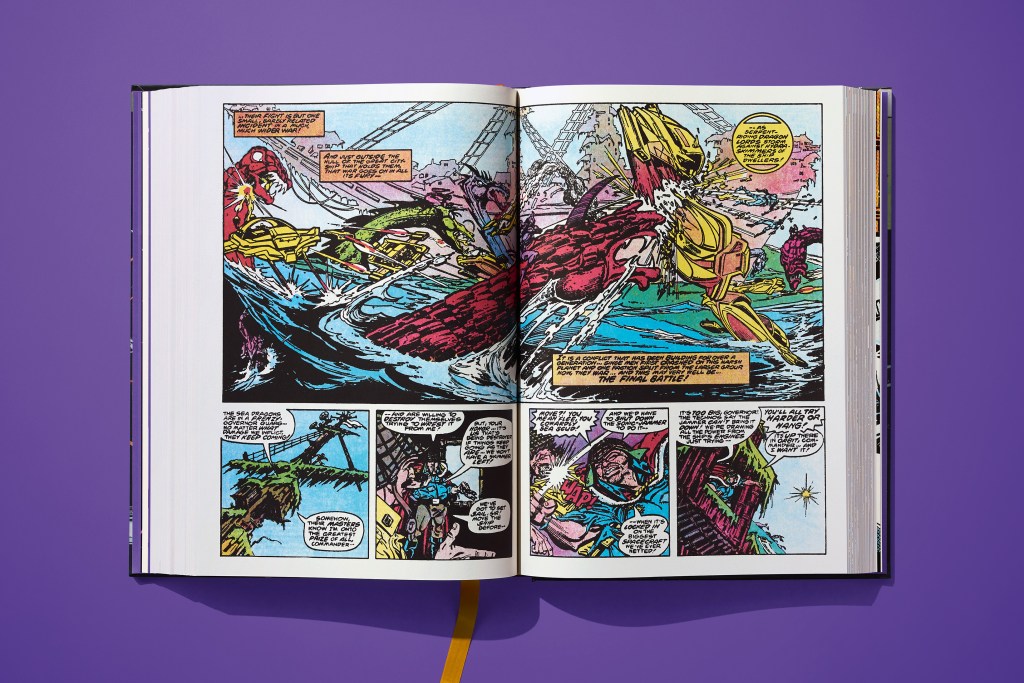
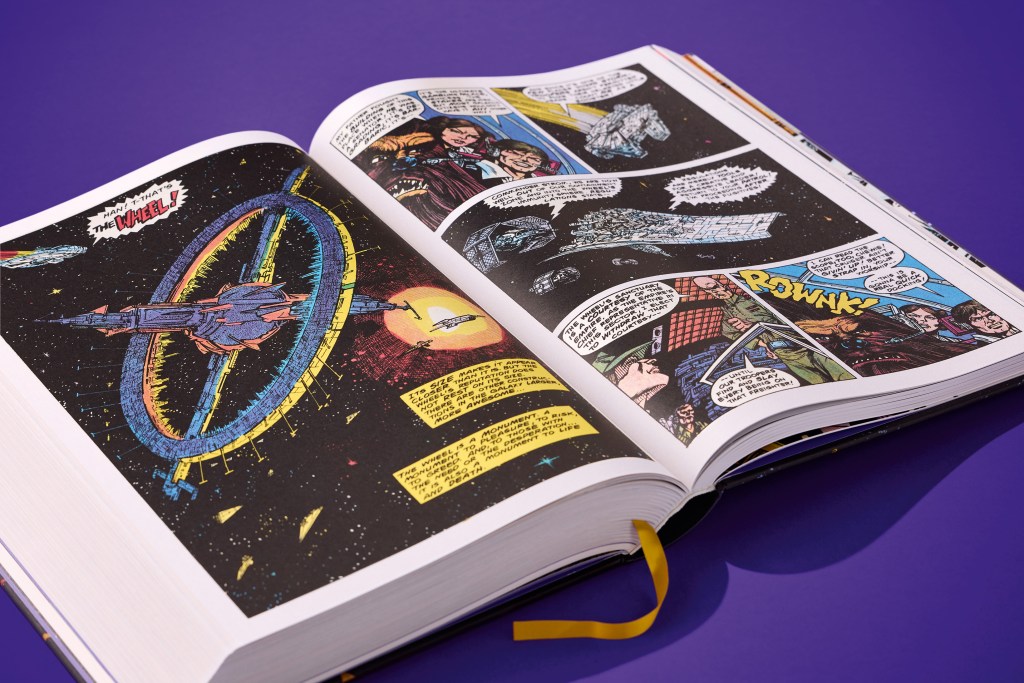
The title gets interesting in issue 12 when one of the best writers in comic book history, Archie Goodwin, teams with the estimable veteran Carmine Infantino. Their first tale involves a greedy space pirate, a conflicted ship “wrecker,” wildly imagined sea dragons, wry dialogue and a deft blend of ancient relics with future tech. In other words, Goodwin understood Lucas’s sensibilities. And Infantino got closer to the film’s use of spectacle, landscape, deep perspective and scale. He produced some breathtaking full page and two-page spreads in these issues. His revelation of the villain’s rotting 18th Century galleon HQ is both creepy and meaningful. His understanding of cadence and panel progression makes battle scenes as balletic as they should be. And so, the difference between the first and second halves of this massive 23-issue reprint is striking.
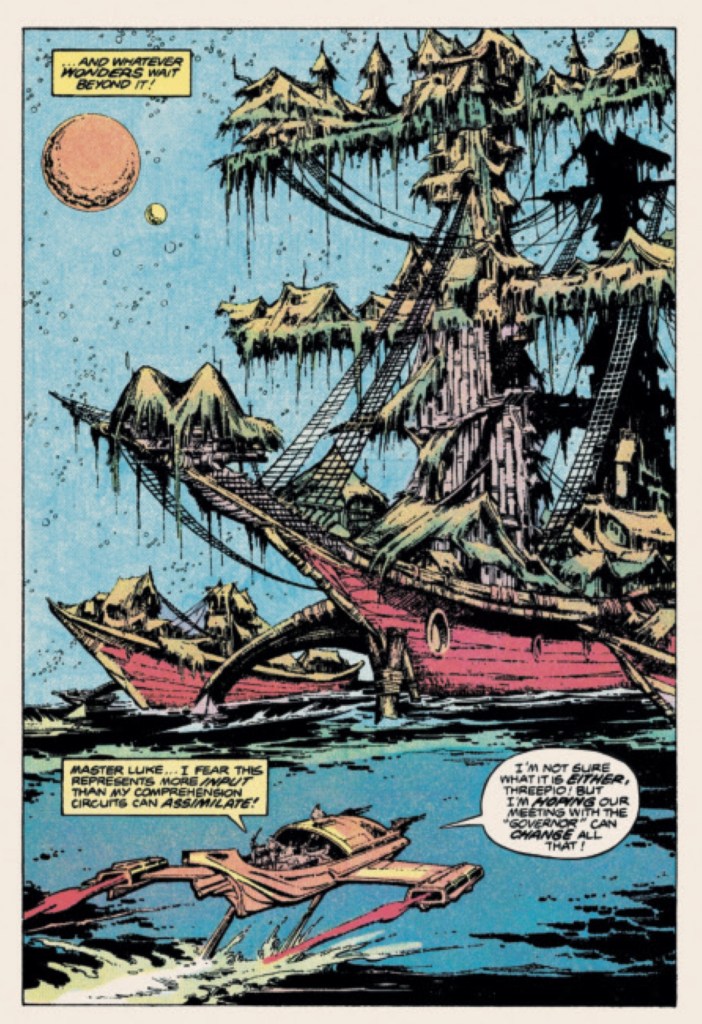
Increasingly, the comic finds its visual stride, with cleaner simpler action and more expressive characters. A who’s who of comics greats start popping in and out of the credits, including Chris Claremont (plotting), Walt Simonson (guest artist) George Roussos and Marie Severin (color).
TASCHEN follows the same scale and reproduction philosophy here as it has in other recent Marvel reprints (Avengers, X-Men, Spider-Man, et. al.). The 680 page behemoth is XXL- sized (15.6 x 11 inches) and weighs enough to numb your lap. In the past, I have admired both the immersive scale of this series as well as the designers’ restoration philosophy. Shot at “super-high-resolution” from the best available copies of comic print, the art is enhanced digitally in a light, judicious way that aims to preserve the experience of comic book reading but amp it up for this magnified scale. The paper, too, has some of the texture of cheap comics pages but is thick and holds the linework, blacks and colors ever so much better. It is an artful, thoughtful approach that has worked well in other Marvel titles and the EC reprints. The technique is not quite as effective in many of these Star Wars pages, to my eye. This may be in the nature of Chaykin and Infantino’s art and their attempts to stay true to the franchise. Some of these panels are packed with creature and setting detail that do not resolve well under dense inking on newsprint.
But if you weight your Star Wars pleasure by the pound, then Star Wars Comics Library, Vol. 1. 1977-1979 measures up. Sanderson’s strong 44-page intro includes the comic’s complete origin story as well as generous helpings of original and unpublished art. Full story specs and synopses as well as bios of everyone that seems to have touched these first issues round out the book.
Personally, I just love seeing comics at this scale, and generally enjoy TASCHEN’s treatment. For me, at least, this film adaptation project is just not as compelling in XXL, nor as historically resonant as, say, Kirby’s early Fantastic Four and Ditko’s Spidey, the Weird Science issues or even the Silver Surfer gliding across the page. But I am not the right target for this book. Lucas lost my interest after the initial trilogy, which was deservedly a landmark of late 20th Century popular art. And among the spin-offs I find Goodwin’s partnership with Al Williamson on the early 1980s newspaper strip iteration more engaging than most. So take my nits with a pinch of salt. In the end, Goodwin’s writing is very involved and inventive, and Infantino is in top form. Star Wars completists and true fans of the lore will eat all of this TASCHEN volume up and eagerly await the next one in the series.
Discover more from Panels & Prose
Subscribe to get the latest posts sent to your email.

